Choosing the right inverter is one of the most important decisions when designing a rooftop solar system in Australia.
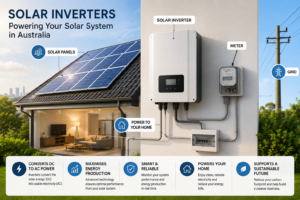
Solar panels generate electricity as direct current (DC), while most household appliances and the electricity grid use alternating current (AC). The inverter converts the electricity produced by your panels into a form your home can use and, where permitted, export to the grid.
Two common approaches are microinverters and string inverters.
Both can work well in Australian homes, but they operate differently and have different strengths when it comes to shading, roof design, monitoring, battery integration, installation, maintenance and future expansion.
There is no universally better technology. The right choice depends on your roof, solar exposure, system size, budget, electricity needs and plans for future upgrades.
This guide compares microinverters vs string inverters in Australia in 2026 so you can understand the practical differences before choosing a system.
What Is the Difference Between a Microinverter and a String Inverter?
The fundamental difference is where DC-to-AC conversion takes place.
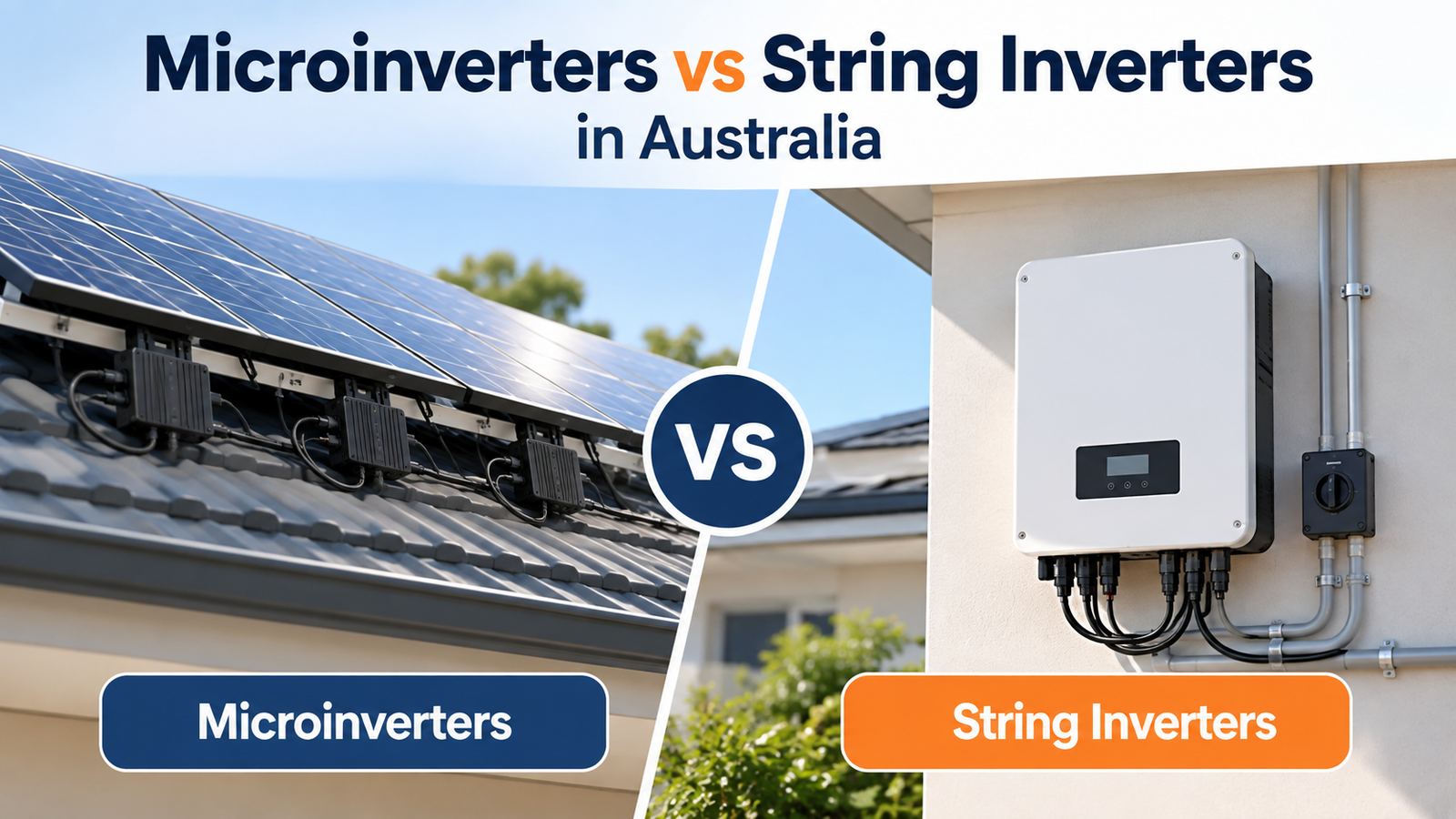
With a conventional string-inverter system, multiple solar panels are connected into one or more strings. DC electricity travels from the panels to a central inverter, which converts it to AC electricity.
With microinverters, each panel has its own small inverter. The conversion from DC to AC happens at the individual panel level.
Both designs can be suitable for grid-connected Australian solar systems. The difference is how the system manages variations between panels.
How a string inverter works
A string inverter receives DC electricity from groups of panels connected in series.
A typical system might have several panels connected to an MPPT (Maximum Power Point Tracking) input on the inverter. The inverter manages the electrical characteristics of the string and converts the combined DC output into AC.
Modern string inverters can have multiple MPPTs, allowing different roof sections or orientations to be managed separately.
How a microinverter works
A microinverter is installed with each solar panel, or in some system designs with a small number of panels.
Each panel operates independently from the others from a power-conversion perspective. This can be particularly useful where panels experience different shading, orientations or operating conditions.
The original article correctly identifies the basic distinction: microinverters perform conversion at panel level, while conventional string systems use a central inverter connected to strings of panels.
Microinverters vs String Inverters: Key Differences
| Feature | Microinverters | String Inverters |
|---|---|---|
| Power conversion | At panel level | Central inverter |
| Shading response | Individual panels can operate more independently | Depends on string design, MPPT configuration and shading |
| Different roof orientations | Highly flexible | Possible with multiple MPPTs, but requires careful design |
| Panel-level monitoring | Typically available | Usually system/string level; some systems offer module-level monitoring with additional equipment |
| Upfront equipment cost | Generally higher | Generally lower |
| Central inverter replacement | No single central inverter | Central inverter is a key component |
| Roof-mounted electronics | More electronics on/near the panels | Usually one main inverter located elsewhere |
| Battery integration | Requires compatible AC-coupled or other system architecture | Many hybrid string inverters can directly manage compatible batteries |
| Future expansion | Can be flexible, subject to design and electrical limits | May require MPPT/string and inverter capacity assessment |
| Best suited to | Complex roofs, variable shading, multiple orientations | Simple, largely unshaded roofs and many conventional systems |
These are general characteristics rather than guarantees. The actual performance of a particular system depends heavily on equipment specifications and system design.
Microinverters: Advantages and Limitations
Microinverters are often considered when a roof has multiple orientations, partial shading or other conditions that can cause panels to operate differently.
Advantages of microinverters
Panel-level operation
Because each panel has its own inverter, a problem affecting one panel does not necessarily force the entire array to operate according to that panel’s output.
This can be useful where different sections of the roof receive different amounts of sunlight.
Useful for complex roof designs
A home might have panels facing north, east and west, with a chimney or roof structure creating additional shading.
Microinverter architecture can simplify the electrical design because each panel is individually converted.
Panel-level monitoring
Many microinverter systems provide detailed monitoring, allowing homeowners or installers to identify individual panel performance.
This can be useful for troubleshooting and maintenance.
Reduced impact from panel mismatch
Panels don’t always perform identically. Differences can result from manufacturing tolerances, temperature, soiling, shading and orientation.
Panel-level conversion can reduce the extent to which one panel’s operating conditions affect other panels.
Limitations of microinverters
Higher upfront cost
Microinverter systems typically involve more inverter hardware, which can increase equipment and installation costs compared with a conventional string-inverter system.
More electronics distributed across the array
Instead of one central inverter, there may be multiple microinverters installed on or near the panels.
This means the installation needs to account for accessibility, environmental exposure and manufacturer requirements.
Battery system design requires attention
If you plan to add a battery, don’t assume every microinverter platform will integrate with every battery.
Battery compatibility, backup functionality, communications and energy-management architecture should be considered before installation.
String Inverters: Advantages and Limitations
String inverters remain a common choice for Australian residential solar because they can provide a relatively straightforward and cost-effective architecture.
Advantages of string inverters
Lower equipment cost in many installations
A single inverter can manage a substantial number of panels, reducing the number of power-conversion devices required.
This can make string-inverter systems attractive where the roof is simple and mostly unshaded.
Straightforward system architecture
The main inverter is normally installed in an accessible location, such as a suitable wall or dedicated equipment area.
That can simplify servicing compared with having electronics distributed across the roof.
Strong battery integration options
Many modern hybrid string inverters are designed to work with compatible battery systems.
For homeowners installing solar and battery storage together, a hybrid inverter can potentially manage solar generation, battery charging and household/grid energy flows within one platform.
The exact architecture depends on the inverter and battery manufacturer.
Well suited to uniform roofs
If most panels face the same direction and receive similar sunlight throughout the day, a well-designed string system can perform very effectively.
Limitations of string inverters
Shading needs careful design
The statement that one shaded panel will always reduce the output of an entire string is an oversimplification.
Modern string systems use MPPTs, bypass diodes and, in some designs, optimisers. The impact of shading depends on the location of the shade, string configuration, inverter design and the electrical characteristics of the panels.
Nevertheless, significant or uneven shading is an important consideration when designing a string system.
Less inherent panel-level visibility
A basic string inverter may show overall system or MPPT/string performance rather than the output of every individual panel.
Module-level monitoring can still be added in some systems through compatible optimisers or monitoring equipment.
Future expansion needs planning
Adding panels to an existing string system isn’t necessarily difficult, but it isn’t always as simple as connecting another panel.
The inverter’s maximum DC input, MPPT voltage and current ranges, string configuration, roof layout, network requirements and applicable standards all need to be considered.
How Do Microinverters and String Inverters Perform in Shaded Areas?
Shading is one of the areas where the architectural difference becomes particularly important.
Suppose a chimney shades two panels for part of the afternoon while the rest of the roof remains in full sun.
With a microinverter system, each panel operates through its own inverter, so the shaded panel’s reduced output doesn’t directly establish the operating point of all the other panels.
With a string system, the outcome depends on the string configuration and inverter technology. A carefully designed string system with appropriate MPPTs or optimisers can also manage partial shading effectively.
Therefore, microinverters are not automatically necessary just because a roof has some shade.
The important question is how much shade exists, where it occurs, when it occurs and how the proposed string system would be configured.
A professional installer should model these conditions rather than making a decision based solely on the presence of a tree or chimney.
What About Different Roof Orientations?
Australian homes commonly have roof sections facing different directions.
For example, one section may face north while another faces east or west.
Microinverters can handle these differences naturally at panel level.
String systems can also accommodate multiple orientations when the inverter has suitable independent MPPT inputs and the strings are correctly configured.
For a relatively simple north-facing roof, this difference may have little practical significance.
For a roof containing several orientations, dormers, skylights and shading obstacles, microinverters can provide greater design flexibility.
Monitoring: Microinverters vs String Inverters
Monitoring is often overlooked when comparing solar systems.
With microinverters, panel-level monitoring is commonly available. This can make it easier to identify an individual panel that is producing significantly less than expected.
With a standard string inverter, monitoring may primarily show:
- total system generation
- inverter output
- MPPT/string performance
- historical energy production.
Some string-based systems can provide module-level monitoring when paired with compatible power optimisers or additional monitoring hardware.
The key question is therefore not simply “Does it have monitoring?”
Ask:
What level of monitoring is included, and what information will the homeowner and installer actually be able to access?
Installation, Maintenance and Reliability
Reliability shouldn’t be judged simply by counting the number of inverter units.
A microinverter system has more individual power-conversion devices, while a string system concentrates conversion into fewer devices.
That creates different maintenance considerations.
If a microinverter fails, the affected panel can generally stop contributing while the rest of the array continues operating, subject to the system architecture.
If a central string inverter fails, a larger portion — potentially all — of the solar array connected to that inverter may stop producing until the issue is resolved.
On the other hand, string inverters are typically installed in an accessible location, which can make central servicing more straightforward.
For either architecture, product quality, installation workmanship, environmental conditions, warranty terms and local service support matter considerably.
A longer advertised warranty also isn’t necessarily useful if warranty claims are difficult to process or replacement equipment is difficult to source.
When comparing products, look at the manufacturer’s Australian warranty arrangements and local support, not just the headline warranty period.
Microinverters, String Inverters and Solar Batteries
Battery integration is increasingly important in Australia because many households are installing storage alongside solar or planning to add it later.
A conventional hybrid string inverter can often connect directly to compatible battery storage.
Microinverter systems can also be paired with batteries, but the system architecture may be different. Depending on the equipment, an AC-coupled battery system or another compatible solution may be used.
If a battery is part of your future plan, tell the installer before choosing the inverter.
The better question isn’t simply:
“Which inverter is more efficient?”
It is:
“Which inverter architecture works with the solar array, battery, backup requirements and future energy loads I am planning?”
Australian 2026 Inverter Requirements Matter
Australian solar systems have specific electrical and grid-connection requirements, and inverter products should not be selected solely on international specifications.
The Clean Energy Council maintains an Approved Products List covering compliant inverters and power-conversion equipment. Products used for certain government incentives and network connections need to meet the applicable requirements.
There was also an important standards update in Australia.
AS/NZS 4777.2:2020 Amd 2:2024 came into effect on 23 August 2025, and non-compliant inverter models were removed from the CEC approved inverter list.
This is relevant when comparing quotes in 2026 because an installer should be supplying equipment that meets the current applicable requirements.
Australia is also moving towards stronger communications requirements for smart distributed energy resources. The Clean Energy Council notes that CSIP-AUS and secure network communications are being progressively introduced, with requirements varying by network and jurisdiction.
For homeowners, the practical takeaway is simple: verify the exact make and model of the inverter being quoted, rather than assuming that every product from a particular manufacturer automatically has the same approval status.
Which Inverter Should You Choose?
Rather than choosing based on a simple “micro is better” or “string is cheaper” rule, consider your roof and future plans.
A microinverter system may suit you if:
- your roof has significant partial shading
- panels face several different directions
- the roof has multiple small sections
- panel-level monitoring is important to you
- you want independent panel operation
- your system design benefits from distributed conversion.
A string inverter may suit you if:
- your roof has broad, relatively unshaded areas
- most panels have a similar orientation and tilt
- you want a conventional system architecture
- upfront equipment cost is an important consideration
- you’re considering a compatible hybrid inverter and battery
- a central inverter is convenient for your installation location.
A string inverter with optimisers may be worth considering if:
- only certain panels experience shading
- you want module-level optimisation or monitoring
- a conventional string architecture remains suitable
- the additional optimiser hardware makes sense for your specific roof.
Optimisers should not be added automatically. They add equipment and cost, so their value depends on the actual roof conditions and system design.
The Most Important Factor: Your Roof, Not the Inverter Label
Two houses with the same electricity consumption may require completely different inverter designs.
Consider a single-storey home with a large, north-facing roof and no nearby trees. A conventional string inverter may provide a straightforward solution.
Now consider a two-storey home with:
- east, north and west roof sections
- a chimney
- nearby trees
- several small roof areas
- plans for a battery and EV.
The second home may benefit from a different architecture because the panels will experience more varied operating conditions.
Neither example makes one technology universally superior.
The correct decision comes from modelling the actual site.
Frequently Asked Questions
Are microinverters better than string inverters?
Neither technology is universally better. Microinverters can be advantageous for complex roofs, shading and multiple orientations, while string inverters can be a practical and cost-effective choice for many simple, unshaded arrays.
Do microinverters produce more electricity?
They can improve energy harvest where individual panels experience different conditions, particularly shading or different orientations. However, they do not automatically produce more energy than a properly designed string system on every roof.
Are microinverters worth the extra cost in Australia?
It depends on the site. The additional cost may be easier to justify where shading, multiple orientations or panel-level monitoring provide meaningful benefits. On a simple, unshaded roof, a string inverter may provide a more economical architecture.
Can a string inverter handle shaded panels?
Yes. Modern string systems can use MPPTs, suitable string design and, where appropriate, power optimisers. The effect of shading depends on the specific system design rather than simply whether the inverter is a string inverter.
Can microinverters work with batteries?
Yes, but battery integration needs to be designed around the specific equipment and system architecture. Tell your installer if you intend to add battery storage now or in the future.
Which inverter is better for an east-west solar system?
Both can work. Microinverters provide independent panel-level conversion, while a string system with suitable MPPT configuration can also manage different roof orientations. The number of roof sections and their electrical characteristics should be assessed before choosing.
Do microinverters make solar panels easier to monitor?
Generally, yes. Many microinverter platforms provide panel-level monitoring, although the exact monitoring features vary by manufacturer and system.
How long do solar inverters last?
There is no single guaranteed lifespan for either technology. Actual service life depends on product quality, environmental conditions, installation and operating conditions. Compare warranty coverage, manufacturer support and replacement arrangements alongside technical specifications.
Final Verdict: Microinverters or String Inverters?
The best inverter for an Australian home depends on the site and system design, not simply the technology category.
Microinverters can be particularly useful when panels experience different shading conditions, orientations or roof constraints, and when detailed panel-level monitoring is valuable.
String inverters remain a strong option for many homes with straightforward, relatively unshaded roof layouts, particularly where cost-effective system design and battery integration are priorities.
There is also a middle ground: string inverters with power optimisers can provide additional module-level control where the roof conditions justify it.
Before choosing, compare the complete system rather than the inverter alone. Look at the panel layout, shading analysis, MPPT configuration, battery compatibility, monitoring, warranty, local support, network requirements and the exact approved product model.
For Australian installations in 2026, it is also important to verify that the proposed inverter appears on the applicable Clean Energy Council Approved Products List and meets current Australian requirements.
Solar Authority can assess these factors as part of a broader solar system design, helping homeowners compare inverter architectures based on their actual roof conditions, energy use and future plans rather than relying on a one-size-fits-all recommendation.