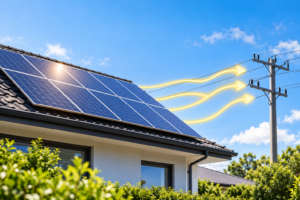

If you’ve installed solar panels — or are thinking about it — understanding solar feed-in tariffs (FiTs) can help you maximise the financial return on your investment. Feed-in tariffs are one of the key ways solar owners earn money from excess electricity they generate.
🧐 What Is a Solar Feed-In Tariff?
A solar feed-in tariff (FiT) is a payment you receive for sending surplus solar energy from your rooftop solar system back into the electricity grid. When your solar panels produce more electricity than your home uses, the excess doesn’t go to waste — it goes to the grid, and your energy retailer pays you for it.
Essentially, it’s a credit or small payment per kilowatt-hour (kWh) for exported solar energy. While FiTs rarely match the price you pay for grid electricity, they still lower your overall power bills and improve your solar system’s return on investment.
⚡ How Feed-In Tariffs Work — Simplified
Here’s the customer journey with a feed-in tariff:
1. Solar generation — Your panels produce electricity during daylight.
2. Self-use first — Your home uses this power directly (lighting, appliances, air-con, etc.).
3. Export surplus — Any excess electricity that your home doesn’t use gets exported to the grid.
4. Earn credits — Your energy retailer credits your account with a set amount for each kWh exported.
These credits appear on your electricity bill, reducing what you owe. Over time, feed-in tariff income helps shorten the payback period on your solar system.
🔍 What Feed-In Tariff Rates Look Like in Australia
FiT rates vary widely across states and retailers, and there’s no single national standard — but here’s the general landscape:
NSW: Retailer-set rates around 4.8 – 7.3 ¢/kWh for exported solar (benchmarks vary by location and provider). Victoria: Minimum flat FiTs as low as ≈3.3 ¢/kWh with time-varying options higher in peak periods (e.g., ~6–7 ¢). Queensland: SEQ markets retailer FiTs (no mandated minimum); regional areas may have regulated rates of ~8–12 ¢/kWh. Tasmania: Regulated minimum around 8.9 ¢/kWh, with some retailers offering higher rates. NT: Around 9.3 ¢/kWh standard, potentially higher during peak export windows (~18.66 ¢/kWh). South Australia & ACT: Mostly retailer-set in the low single digits to mid-single digits (~3–12 ¢/kWh).
Average FiT rates these days are well below average retail electricity prices, which is why using your solar power at home or storing it in a battery is often more valuable than exporting it.
🧠 Feed-In Tariffs vs. Electricity Use Value
A common misconception is that FiTs pay you as much as retail grid electricity costs. This isn’t the case — retailers usually pay a lower export rate because they only pay for the energy itself, not transmission, supply, or network charges.
For example:
· If your retail rate is $0.30/kWh, but your FiT is $0.07/kWh, exporting earns less than using the solar power yourself.
· This is why many system owners aim to use as much solar energy onsite as possible before exporting the surplus or consider adding a battery for evening use.
📊 How Feed-In Tariffs Impact Solar Savings
FiTs help your solar system deliver value in two main ways:
✔ Bill credits: Exporting excess solar energy earns you a small amount that reduces your electricity bill. ✔ Return on investment: Every dollar earned from feed-in tariffs shortens the time it takes for solar to pay for itself.
However, because FiTs are usually much lower than retail rates, you can get even more value by consuming your solar energy directly — especially with the help of a battery system.
📌 Important Notes for Solar Owners
Compare energy plans carefully: Different retailers pay different FiT rates, and some plans include bonus solar credits. Feed-in rates change: FiT rates go up and down over time based on regulation, retailer offers, and grid conditions.
High exports don’t always equate to best value: Low FiTs mean it’s often better to store and use more solar power.
📌 FAQs — Solar Feed-In Tariffs
Q: Do all solar systems get a feed-in tariff? Most grid-connected rooftop solar systems earn FiT credits, but eligibility and rates depend on your electricity plan and local regulations.
Q: Can feed-in tariffs change after installation? Yes — FiT rates are set by retailers or regulators and can change annually or when your plan changes.
Q: Are feed-in tariffs worth relying on for savings? They add value, but because they’re typically low compared to retail rates, using your solar energy onsite (or storing it in a battery) often gives greater financial benefit.
Q: Do batteries affect feed-in tariff earnings? Yes — using a battery to store and use your solar power overnight reduces the amount you export and thus the FiT credits you receive. But the overall savings can still be higher.
🧠 Bottom Line — What Feed-In Tariffs Mean for Your Solar Investment
A solar feed-in tariff pays you for the excess solar electricity you send back to the grid and is one piece of your solar savings puzzle. While modern FiT rates in Australia are lower than they once were, they still deliver useful credits that help offset your energy costs.
To get the most value from your system, maximise onsite use of solar power, choose retail plans with competitive FiT rates, and consider battery storage if you want to capture and use more of your solar energy.
Want to see how feed-in tariffs affect your savings? Solar Authority can help you compare offers and estimate your solar earnings based on your location and usage.