Choosing the right solar inverter can be just as important as choosing your solar panels.
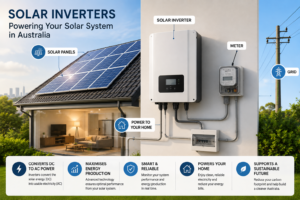
Your panels generate DC electricity, but your home uses AC electricity. The inverter converts that energy into a form your appliances can use and manages how electricity flows between your solar panels, home, battery and the electricity grid.
But choosing an inverter isn’t as simple as picking the brand with the highest efficiency.
The right inverter depends on your:
- Solar system size
- Roof design and shading
- Single-phase or three-phase supply
- Battery plans
- Electricity usage
- Backup-power requirements
- Budget
- Future energy needs
This guide explains how solar inverters work, the different types available in Australia, which features actually matter, and what to compare before signing a solar quote.
Quick answer: For many Australian homes, a good-quality string inverter offers an excellent balance of price, performance and simplicity. A hybrid inverter can make sense if you’re installing or planning to install a battery. Microinverters can be particularly useful on roofs with shading or multiple orientations. The best choice depends on your property and system design.
What Is a Solar Inverter?
Solar panels produce electricity as direct current (DC).
Your home appliances and the electricity grid generally operate using alternating current (AC).
A solar inverter converts the DC electricity generated by your panels into AC electricity that can be used by your home or exported to the grid.
Depending on the inverter type, it can also:
- Monitor solar generation
- Manage battery charging and discharging
- Control energy flow
- Detect system faults
- Provide remote monitoring
- Integrate with home energy management systems
- Support backup power in compatible systems
This makes the inverter one of the most important components to consider when comparing a solar system.
Which Type of Solar Inverter Is Best?
There isn’t one inverter type that is best for every home.
The main options are:
| Inverter type | Best suited to | Main advantage |
|---|---|---|
| String inverter | Most standard homes | Good value and simple design |
| Hybrid inverter | Solar + battery | Manages solar and battery together |
| Microinverters | Shaded or complex roofs | Panel-level optimisation |
| Three-phase inverter | Three-phase homes/businesses | Designed for three-phase systems |
| Off-grid inverter | Remote/off-grid properties | Designed to operate without the grid |
Let’s look at the differences.
1. String Inverters — Best for Many Australian Homes
A string inverter connects multiple solar panels together into one or more strings.
The combined DC electricity is sent to the inverter, which converts it into AC electricity.
String inverters are widely used because they’re generally:
- Cost-effective
- Straightforward to install
- Easy to maintain
- Efficient
- Suitable for many residential systems
Best for:
Homes with:
- A relatively simple roof
- Limited shading
- Panels facing similar directions
- Standard grid-connected solar systems
The potential downside
If different parts of your roof receive very different amounts of sunlight, a traditional string configuration may not be ideal.
For example, imagine half your panels face north while the others face west, with some panels partially shaded.
Your installer may need to use multiple MPPTs, optimisers or another system design to manage those differences effectively.
Bottom line
For a straightforward roof, a quality string inverter can provide excellent value.
2. Hybrid Inverters — Best for Solar + Battery
A hybrid inverter can manage solar generation and battery storage within the same system architecture.
This makes hybrid inverters particularly attractive if you’re installing a battery now or want the option to add one later.
A hybrid system can potentially manage:
Solar → Home
Solar → Battery
Battery → Home
Grid → Home
Depending on the system, it may also support backup power.
Why choose a hybrid inverter?
✔ Battery-ready system design
✔ Better integration between solar and storage
✔ Potentially easier future expansion
✔ Centralised energy management
✔ Useful for households wanting greater energy independence
But don’t assume “hybrid” automatically means backup.
This is an important distinction.
Some hybrid inverter systems can provide backup power, while others require additional equipment and configuration.
If backup power is important to you, ask the installer:
“Which circuits will remain powered during a blackout, and what additional equipment is required?”
3. Microinverters — Best for Shading and Complex Roofs
Microinverters work differently from conventional string inverters.
Instead of having one central inverter handle a group of panels, a microinverter is installed at the panel level.
This means each panel can operate more independently.
Microinverters can be useful when:
- Your roof has multiple orientations
- Parts of the roof are shaded
- Chimneys or trees create partial shading
- You have a complicated roof layout
- Panel-level monitoring is important
Example
Imagine you have 12 panels.
Two panels become shaded by a tree during the afternoon.
With a conventional string configuration, the impact can depend on how the system is designed.
With panel-level power electronics such as microinverters, the affected panels can be managed independently.
The trade-off
Microinverter systems can cost more upfront and may involve more equipment installed on the roof.
That doesn’t make them better or worse.
It means you need to determine whether their benefits justify the additional cost for your property.
4. Three-Phase Solar Inverters
Some Australian homes and many commercial properties have three-phase electrical supplies.
Three-phase systems can be useful for larger electrical loads and larger solar installations.
Three-phase inverters are commonly considered for:
- Large homes
- Commercial buildings
- Workshops
- Farms
- Properties with significant three-phase loads
- Larger solar systems
If you’re unsure whether your property is single-phase or three-phase, ask your electrician or installer to confirm it before choosing an inverter.
5. Off-Grid Solar Inverters
Off-grid systems are different from standard grid-connected solar.
An off-grid property cannot rely on the electricity grid when solar generation is unavailable.
The inverter therefore needs to work with other components such as:
- Batteries
- Solar panels
- Backup generation
- Energy management equipment
Off-grid systems require careful design because the system must provide reliable electricity even when solar generation is low.
If you’re building an off-grid system, don’t choose an inverter based on the same criteria used for a normal grid-connected household.
Solar Inverter Brands in Australia
There are many inverter brands available in the Australian market.
Commonly encountered brands include:
- Sungrow
- Fronius
- SMA
- SolarEdge
- Enphase
- GoodWe
- Growatt
The “best” brand depends on the specific inverter model, installation, warranty, price and your requirements.
A brand name alone isn’t enough.
When comparing inverter brands, check:
- Exact model
- Efficiency
- Warranty
- Australian support
- Battery compatibility
- Backup capability
- Monitoring
- Maximum PV input
- Number of MPPTs
- Operating temperature
- Installer experience
Best Solar Inverters in Australia: What Should You Actually Compare?
Instead of asking:
“What is the best inverter brand?”
Ask:
“Which inverter is best suited to my solar system?”
These are very different questions.
Here are the specifications that matter most.
1. Inverter Size
Inverter size is normally expressed in kilowatts (kW).
For example:
- 5kW inverter
- 6kW inverter
- 8kW inverter
- 10kW inverter
Your inverter needs to be appropriately matched to your solar panel array and electricity requirements.
Bigger isn’t automatically better.
A larger inverter may cost more without providing meaningful benefits if your solar array and household demand don’t require it.
At the same time, installers may deliberately install more panel capacity than the inverter’s nominal AC rating.
This is known as DC oversizing or overpowering.
Can Solar Panels Be Oversized Compared With the Inverter?
Yes — but there is no universal “33%” rule.
Many modern inverters allow a solar array with a higher DC capacity than the inverter’s AC output rating.
For example, an installer may pair a 6kW inverter with a solar array larger than 6kW.
Why?
Because solar panels rarely operate at their nameplate output throughout the entire day.
A larger DC array can help produce more energy during:
- Early morning
- Late afternoon
- Cloudy conditions
- Winter
- Lower-light conditions
However, the allowable ratio depends on the specific inverter model, manufacturer specifications and installation requirements.
Ask your installer:
“What DC-to-AC ratio are you using, and why?”
That’s a much better question than simply asking whether the inverter is “big enough.”
2. MPPTs: An Important Feature Many Homeowners Miss
MPPT stands for Maximum Power Point Tracking.
It allows the inverter to optimise the operating point of solar panels to extract available power under changing conditions.
The number of independent MPPTs can be important when you have panels facing different directions.
For example:
North-facing panels + West-facing panels
may benefit from separate MPPT inputs depending on the system design.
Ask your installer:
“How many independent MPPTs does this inverter have, and how are my roof sections connected?”
This can tell you much more about the system design than the inverter’s headline efficiency.
3. Inverter Efficiency
Inverter efficiency measures how effectively the inverter converts DC electricity into usable AC electricity.
Higher efficiency can reduce conversion losses.
However, don’t obsess over a tiny difference in headline efficiency.
For example, if two systems have very similar efficiency ratings, other factors such as:
- Price
- Warranty
- Reliability
- System design
- Shading
- Monitoring
- Battery compatibility
may matter more.
4. Battery Compatibility
If you’re considering a battery, check compatibility before purchasing your inverter.
Some inverters work with specific battery brands or battery voltage ranges.
Others may require additional equipment.
If you already have solar and want to add a battery, you may have several options, including:
- Replacing the existing inverter
- Adding an AC-coupled battery system
- Adding compatible battery equipment
- Installing a hybrid inverter
The best approach depends on your existing system.
Planning to add a battery later?
Tell the installer before they design the solar system.
A small amount of planning today can avoid unnecessary replacement costs later.
5. Backup Power
If blackout protection is important to you, don’t assume every battery system automatically provides it.
Ask:
“Will my solar system work during a blackout?”
A standard grid-connected solar system generally shuts down when the grid goes down for safety reasons.
A battery system with appropriate backup equipment can operate selected circuits during an outage.
But the configuration matters.
Ask:
- Does the inverter support backup?
- Is a backup gateway required?
- Which circuits are backed up?
- Can the whole house be backed up?
- What happens if the battery is empty?
- Can solar recharge the battery during a blackout?
These questions can prevent unpleasant surprises later.
6. Monitoring
Most modern inverters provide some form of monitoring.
A good monitoring platform should allow you to see things such as:
- Solar generation
- Household consumption
- Grid imports
- Grid exports
- Battery charging
- Battery discharging
- System faults
Monitoring isn’t just a nice feature.
It can help you identify unusual drops in solar production and understand when you’re using electricity.
7. Inverter Warranty
The warranty is one of the most important things to compare.
Don’t look only at the number of years.
Check:
- Standard warranty period
- Extended warranty options
- What is covered
- Labour coverage
- Replacement process
- Australian support
- Warranty claim process
A long product warranty is useful, but you should also understand who will help you if something goes wrong.
How Long Does a Solar Inverter Last?
Solar inverters generally have a shorter expected service life than the solar panels themselves.
That means inverter replacement should be considered when calculating the long-term economics of a solar system.
Ask your installer:
“What is the expected service life of this inverter, and what would replacement typically cost?”
This is particularly important if you’re comparing a cheap inverter with a more expensive alternative.
A lower upfront price doesn’t necessarily mean lower lifetime cost.
How Much Does a Solar Inverter Cost?
The cost varies significantly depending on:
- Inverter capacity
- Brand
- Technology
- Single-phase vs three-phase
- Hybrid capability
- Battery compatibility
- Backup functionality
- Installation requirements
More importantly, homeowners should compare the installed system price, not just the retail price of the inverter.
Your solar quote may include:
Panels + inverter + mounting + electrical work + installation + monitoring + commissioning + applicable incentives
This is why comparing complete quotes is more useful than searching for the cheapest inverter online.
Solar Inverter Problems to Watch For
Like any electronic equipment, solar inverters can experience faults.
Potential issues can include:
- Overheating
- Grid faults
- Communication errors
- Isolation faults
- Poor ventilation
- Component failure
- Monitoring problems
- Installation-related faults
Many inverter problems are not necessarily caused by the inverter itself.
Poor installation, incorrect configuration, excessive heat or electrical issues can also affect system performance.
Where should your inverter be installed?
Ideally, the installer should choose a location that provides:
- Good ventilation
- Protection from excessive heat
- Protection from water exposure
- Appropriate clearance
- Easy access for servicing
Avoid assuming that an inverter should simply be placed wherever there is an empty wall.
Location matters.
Solar Inverter Comparison: What Matters Most?
| Factor | Why it matters | Priority |
|---|---|---|
| Correct inverter size | Ensures appropriate system design | ⭐⭐⭐⭐⭐ |
| Battery compatibility | Important for future storage | ⭐⭐⭐⭐⭐ |
| MPPT configuration | Important for multiple roof orientations | ⭐⭐⭐⭐ |
| Warranty | Protects your investment | ⭐⭐⭐⭐⭐ |
| Backup capability | Important during blackouts | ⭐⭐⭐⭐ |
| Efficiency | Reduces conversion losses | ⭐⭐⭐ |
| Monitoring | Helps track performance | ⭐⭐⭐⭐ |
| Australian support | Important for warranty/service | ⭐⭐⭐⭐⭐ |
| Installation location | Helps manage heat and longevity | ⭐⭐⭐⭐ |
| Price | Affects overall ROI | ⭐⭐⭐⭐⭐ |
String Inverter vs Microinverter: Which Is Better?
This is one of the most common questions homeowners ask.
Choose a string inverter when:
- Your roof is relatively simple
- There is little shading
- Most panels face the same direction
- You want a cost-effective system
- You prefer a simpler system architecture
Consider microinverters when:
- Your roof has multiple orientations
- Shading affects individual panels
- Panel-level monitoring is important
- Your roof design is complex
What about a hybrid inverter?
Consider a hybrid inverter if:
- You want solar + battery
- You plan to install a battery later
- You want centralised energy management
- Backup power is important
There isn’t a universally superior technology.
The best option depends on the roof and the way your household uses electricity.
How to Choose the Right Solar Inverter: 8 Questions to Ask Your Installer
Before accepting a quote, ask these questions:
1. Why did you recommend this inverter?
You should receive an answer specific to your property.
2. How many MPPTs does it have?
Especially important if your panels will face different directions.
3. Is it battery compatible?
Ask about both current and future battery options.
4. Can it provide backup power?
If yes, ask exactly which circuits will be backed up.
5. How much can the solar array be oversized?
Ask for the manufacturer’s allowable DC input rather than relying on a generic percentage.
6. Where will the inverter be installed?
Check ventilation, heat exposure and accessibility.
7. What warranty do I receive?
Ask about both product and installation warranties.
8. Who handles warranty claims?
Knowing who to contact if something fails can be just as important as the warranty length.
Don’t Choose Your Inverter Separately From Your Solar Panels
One of the biggest mistakes homeowners make is choosing panels and inverter brands independently.
Your solar system should be designed as a complete system.
The installer needs to consider:
Roof → Panels → Strings/MPPTs → Inverter → Battery → Home → Grid
Changing one component can affect the others.
For example, installing a larger solar array may require an inverter with greater DC input capacity.
Adding a battery may influence your inverter choice.
A complex roof may make microinverters or optimisers more attractive.
This is why a professional system design is more valuable than simply buying the highest-rated equipment.
What Is the Best Solar Inverter in Australia?
There is no single inverter that wins for every property.
As a starting point, commonly considered brands in the Australian market include:
Sungrow, Fronius, SMA, SolarEdge, Enphase, GoodWe and Growatt.
But don’t select an inverter based on brand popularity alone.
Compare the specific model and how it fits your solar system.
For example:
Simple roof + standard solar:
A quality string inverter may provide excellent value.
Solar + battery:
A compatible hybrid inverter may simplify the system.
Complex/shaded roof:
Microinverters or module-level electronics may be worth considering.
Large three-phase property:
A suitable three-phase inverter may be more appropriate.
The Most Important Question: What Is the Best Inverter for My Home?
Before you choose an inverter, answer these five questions:
1. How much electricity do I use?
Look at your electricity bills rather than guessing.
2. What does my roof look like?
Consider orientation, shading and usable space.
3. Do I want a battery?
If yes, tell the installer before the system is designed.
4. Do I need blackout backup?
If yes, make backup capability a requirement from the beginning.
5. What will my electricity usage look like in five years?
Think about EVs, heat pumps, home offices, pool pumps and other future loads.
These answers will narrow down the right inverter technology far more effectively than simply searching for the “best inverter.”
Get Multiple Solar Authority Quotes Before You Choose an Inverter
A good solar quote should explain why a particular inverter has been recommended.
If you receive three quotes and all three installers recommend completely different inverter solutions, that’s not necessarily a problem.
It gives you an opportunity to ask:
“Why is your design different?”
Compare:
- Inverter brand and model
- Inverter capacity
- Number of MPPTs
- Panel configuration
- Battery compatibility
- Backup capability
- Estimated annual generation
- Warranty
- Installation location
- Total installed price
Don’t compare the inverter in isolation.
Compare the complete solar system and the reasoning behind the design.
Ready to Compare Solar Systems?
Choosing a solar inverter can feel complicated, but you don’t need to work it all out yourself.
Get up to three personalised Solar Authority Quotes and compare the complete system — including panels, inverter, battery options, installation, warranties and expected performance.
👉 Get 3 Free Solar Authority Quotes
Tell us about your home and energy requirements and compare suitable options from Australian solar installers.
Free to request. No obligation to buy.
Frequently Asked Questions
What does a solar inverter do?
A solar inverter converts the DC electricity produced by solar panels into AC electricity that can be used by your home or exported to the electricity grid.
What is the best solar inverter in Australia?
There is no single best inverter for every home. The right choice depends on your solar system size, roof configuration, battery plans, electrical supply and budget.
Are hybrid inverters better?
Not necessarily. Hybrid inverters are particularly useful when you want solar and battery storage, but a standard string inverter may provide better value for a simple solar-only system.
Are microinverters worth it?
They can be, particularly for roofs with shading, multiple orientations or complex layouts. However, they can cost more than conventional string inverter systems.
How big should my solar inverter be?
The correct size depends on your solar panel capacity, electricity usage, inverter specifications and system design. Your installer should explain the DC-to-AC ratio used in the proposal.
Can I add a battery to my existing solar system?
Often yes, but the best approach depends on your existing inverter, solar system age, battery compatibility and desired backup functionality.
Do solar inverters work during a blackout?
A standard grid-connected solar system normally shuts down when the grid fails. Backup operation requires compatible equipment and system configuration.
How long does a solar inverter last?
The expected service life varies by product, installation conditions and usage. Because inverters generally have a shorter service life than solar panels, potential replacement should be considered when evaluating long-term solar costs.
Should I choose the cheapest solar inverter?
Not necessarily. Consider the total cost of ownership, including warranty, reliability, support, compatibility, system performance and potential replacement costs.
Final Verdict: Choose the Inverter Around Your Home — Not the Other Way Around
The best solar inverter isn’t necessarily the one with the highest efficiency, the longest warranty or the lowest price.
It’s the inverter that works well with your panels, your roof, your electricity usage, your battery plans and your future energy needs.
Before you sign a solar contract, make sure you understand:
✔ What inverter you’re getting
✔ Why it was recommended
✔ How your panels are configured
✔ Whether you can add a battery
✔ Whether backup power is supported
✔ What warranty you receive
✔ Who provides after-sales support
✔ What the complete system will cost
A well-designed solar system can deliver value for decades.
The goal isn’t to buy the most expensive inverter.
The goal is to buy the right inverter for your home.
Compare Your Solar Options
Get up to 3 free Solar Authority Quotes and compare inverter brands, system designs, battery options, warranties and installation prices before you make a decision.
👉 Request Your Free Solar Authority Quotes