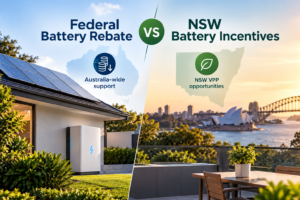

Looking to reduce electricity costs and claim the new NSW Commercial Battery Rebate? From 1 September 2026, eligible businesses across New South Wales can access significant financial incentives through the Peak Demand Reduction Scheme (PDRS). Depending on your battery size, project design, and certificate prices, the incentive may reduce the upfront cost of a commercial battery by 20% to 50%.
This guide explains how the rebate works, who is eligible, how much your business could save, and whether investing in battery storage is the right financial decision.
At a Glance
● Scheme: NSW Peak Demand Reduction Scheme (PDRS)
● Starts: 1 September 2026
● Who Can Apply: Eligible commercial and industrial businesses
● Battery Size: 20kWh to 30MWh
● Incentives: BESS4 and BESS5
● Estimated Discount: 20%–50% of installed battery cost
● Can it be combined with solar? Yes
● Can it be combined with the Federal Battery Rebate? Eligible systems up to 100kWh may be able to stack incentives where program rules allow.
What Is the NSW Commercial Battery Rebate?
The NSW Government has expanded the Peak Demand Reduction Scheme (PDRS) to encourage businesses to install battery energy storage systems (BESS). Unlike a traditional government grant with a fixed payment, the program provides financial incentives through Peak Reduction Certificates (PRCs).
These certificates have a market value, and the number of certificates created depends on your battery size, inverter capacity, and whether the project includes new solar generation.
The objective is simple: encourage businesses to store electricity and reduce demand on the grid during peak periods, improving energy reliability while lowering electricity costs.
Why Is This Rebate Important?
Electricity prices have continued to rise, and many businesses face increasing demand charges. Batteries allow businesses to:
● Store excess solar energy instead of exporting it at lower feed-in rates.
● Reduce expensive peak demand charges.
● Increase energy independence.
● Protect operations during grid outages (where backup capability is installed).
● Participate in demand response or Virtual Power Plant (VPP) programs where available.
With the introduction of BESS4 and BESS5 incentives, commercial battery projects that previously had long payback periods may now become financially attractive.
Who Is Eligible?
To qualify, your project must generally meet these requirements:
● The property must be a commercial, industrial, or community site.
● Residential properties are not eligible under BESS4 or BESS5.
● Data centres are excluded.
● The project must not have previously received a BESS4 or BESS5 incentive.
● Required planning approvals must be obtained.
● Installation must occur on or after 1 September 2026.
Eligibility should always be confirmed with an accredited installer or Accredited Certificate Provider (ACP), as program requirements may change.
Understanding BESS4 and BESS5
BESS4 – Small and Medium Businesses
BESS4 is designed for businesses installing batteries with usable capacity greater than 20kWh and up to 200kWh.
Typical businesses include:
● Retail stores
● Medical centres
● Restaurants
● Cafés
● Offices
● Schools
● Small warehouses
● Automotive workshops
Key requirements include:
● Battery and inverter listed by the Clean Energy Council (CEC).
● Installation completed by a Solar Accreditation Australia (SAA) accredited installer
● Battery duration not exceeding six hours.
● New solar installations must satisfy the required solar-to-battery ratio.
BESS5 – Large Commercial & Industrial Projects
BESS5 applies to larger battery systems with usable capacity greater than 200kWh and up to 30MWh.
Typical projects include:
- Manufacturing facilities
- Large warehouses
- Shopping centres
- Cold storage facilities
- Hospitals
- Universities
- Community energy projects
Additional requirements include:
- Battery systems tested to UL9540A fire safety standards.
- Battery duration not exceeding six hours.
- Compliance with all applicable engineering and safety standards.
BESS4 vs BESS5
| Feature | BESS4 | BESS5 |
|---|---|---|
| Battery Size | 20–200kWh | 200kWh–30MWh |
| Suitable For | Small & medium businesses | Large commercial & industrial |
| Typical Sites | Offices, retail, cafés | Factories, warehouses, hospitals |
| New Solar Eligible | Yes | Yes |
| Installation | SAA Accredited Installer | Commercial engineering requirements |
How Much Is the NSW Commercial Battery Rebate Worth?
The rebate depends on:
- Battery capacity
- Inverter size
- Whether new solar is installed
- Current PRC certificate price
- Final system design
Indicative examples include:
| Example Project | Estimated Installed Cost | Estimated Incentive | Approximate Discount |
|---|---|---|---|
| 100kW / 200kWh Battery + Solar | $220,000 | $65,520 | 30% |
| 1.3MW / 5MWh Commercial Battery | $3,000,000 | $1,474,000 | 49% |
These figures are indicative only. Actual incentives vary depending on certificate prices and project details.
How Much Could Your Business Save?
Every business has a different electricity usage profile, but batteries can significantly reduce energy costs.
| Business Type | Potential Annual Savings* |
|---|---|
| Retail Store | $5,000–$15,000 |
| Medical Centre | $10,000–$25,000 |
| Warehouse | $20,000–$60,000 |
| Factory | $40,000–$150,000 |
| Shopping Centre | $60,000–$250,000 |
*Savings vary depending on electricity tariffs, operating hours, battery size, solar generation, and energy consumption.
Is a Commercial Battery Worth It?
For many businesses, the answer is increasingly yes.
Commercial batteries are particularly valuable if your business:
● Has high electricity bills.
● Already operates a commercial solar system.
● Pays demand charges.
● Operates during evenings.
● Wants greater energy security.
● Plans to remain at the premises for several years.
The new NSW incentives can significantly improve return on investment by reducing the initial capital cost.
Businesses That Benefit Most
The rebate can provide strong financial benefits across many industries, including:
● Manufacturing
● Warehousing
● Cold storage
● Hospitality
● Hotels
● Shopping centres
● Supermarkets
● Medical facilities
● Schools
● Universities
● Agricultural operations
● Commercial office buildings
Can You Combine the NSW Rebate with Other Incentives?
In many cases, yes.
Depending on your project, businesses may be able to combine:
● NSW PDRS Battery Incentive
● New commercial solar installation
● Federal battery incentive (where eligible)
● Virtual Power Plant (VPP) participation
● Ongoing electricity bill savings
Always confirm eligibility with your installer, as each program has specific rules.
How Does a Commercial Battery Reduce Electricity Costs?
Commercial battery systems can reduce electricity expenses in several ways: Increase Solar Self-Consumption
Instead of exporting unused solar power during the day, excess electricity is stored and used later when your business needs it.
Reduce Peak Demand Charges
Many commercial electricity bills include demand charges based on the highest level of electricity used over a short period. Batteries can discharge during these peaks to help lower demand-related costs.
Energy Arbitrage
Businesses on suitable electricity tariffs may charge batteries during lower-priced periods and discharge during higher-priced periods, potentially reducing overall energy costs.
Backup Power
Some battery systems can provide backup power during outages, helping reduce operational disruptions where supported by the system design.
Common Mistakes to Avoid
Before investing, avoid these common issues:
● Choosing the wrong battery size.
● Ignoring demand charges.
● Installing without analysing electricity usage.
● Focusing only on the rebate rather than long-term savings.
● Using installers without appropriate commercial experience.
● Not considering future business growth.
A professional feasibility study can help identify the most suitable system size and expected financial return.
How to Choose the Right Commercial Battery
When comparing battery systems, consider:
● Usable battery capacity.
● Round-trip efficiency.
● Warranty period.
● Cycle life.
● Safety certifications.
● Integration with existing solar systems.
● Monitoring software.
● Manufacturer reputation.
● Local service and support.
Selecting the right system should be based on your energy profile and business objectives rather than upfront cost alone.
Frequently Asked Questions (FAQs)
1. What is the NSW Commercial Battery Rebate?
The NSW Commercial Battery Rebate is a financial incentive available under the Peak Demand Reduction Scheme (PDRS) from 1 September 2026. It encourages eligible businesses to install battery energy storage systems by providing incentives through Peak Reduction Certificates (PRCs), which can significantly reduce the upfront installation cost.
2. Who is eligible for the NSW Commercial Battery Rebate?
The rebate is available to eligible commercial, industrial, and community sites in New South Wales. Businesses must install an approved battery system that meets the requirements of either the BESS4 or BESS5 activity. Residential properties and data centres are not eligible under these activities.
3. How much can my business save with the NSW battery rebate?
The value of the incentive depends on your battery capacity, inverter size, project design, and the market price of Peak Reduction Certificates (PRCs). In many cases, businesses may receive an incentive worth 20% to 50% of the installed battery cost, although actual savings vary by project.
4. Can I combine the NSW Commercial Battery Rebate with the Federal Battery Rebate?
In some cases, yes. Eligible battery systems of up to 100kWh may be able to combine the NSW PDRS incentive with the Australian Government’s battery incentive, provided all program
requirements are met. Your installer or Accredited Certificate Provider (ACP) can confirm your eligibility.
5. Do I need to install solar panels to qualify for the rebate?
No. Battery-only projects can still qualify if they meet the scheme requirements. However, projects that include new solar PV may receive a higher incentive because the certificate calculation provides additional value for eligible solar-and-battery installations.
6. What size commercial battery should my business install?
The ideal battery size depends on your electricity consumption, demand charges, solar generation, operating hours, and future energy needs. A professional energy assessment can help determine the most cost-effective battery capacity and maximise your return on investment.
7. How long does it take for a commercial battery to pay for itself?
Many commercial battery projects achieve a payback period of 2 to 5 years, depending on electricity prices, available incentives, battery size, demand charge savings, and solar generation. Businesses with high electricity usage often see faster returns.
8. Which businesses benefit the most from commercial battery storage?
Businesses with high electricity consumption or significant demand charges typically receive the greatest financial benefits. This includes manufacturers, warehouses, supermarkets, shopping centres, hotels, cold storage facilities, hospitals, schools, agricultural businesses, and large office buildings.
9. How do I apply for the NSW Commercial Battery Rebate?
The rebate is generally claimed through an Accredited Certificate Provider (ACP) or an approved commercial battery installer participating in the NSW Peak Demand Reduction Scheme. They will assess your eligibility, calculate the available certificates, complete the required documentation, and apply the incentive to your project where applicable.
10. How do I choose the best commercial battery installer in NSW?
Choose an installer with proven experience in commercial battery projects, knowledge of the NSW PDRS, and relevant industry accreditations. Ask for detailed energy modelling, estimated savings, warranty information, references from previous commercial installations, and a clear explanation of how the rebate will be applied. Comparing multiple quotes can also help you find the best value and solution for your business.
Final Thoughts
The NSW Commercial Battery Rebate represents one of the most significant incentives introduced for business energy storage in Australia. By reducing the upfront cost of battery systems, the program gives businesses an opportunity to improve energy resilience, reduce operating costs, and increase the value of existing or new solar installations.
Before proceeding, it’s important to assess your electricity usage, demand profile, available roof space, and long-term business plans. A tailored feasibility assessment can help determine the optimal battery size, expected savings, estimated incentive, and projected return on investment, ensuring your business makes an informed decision.