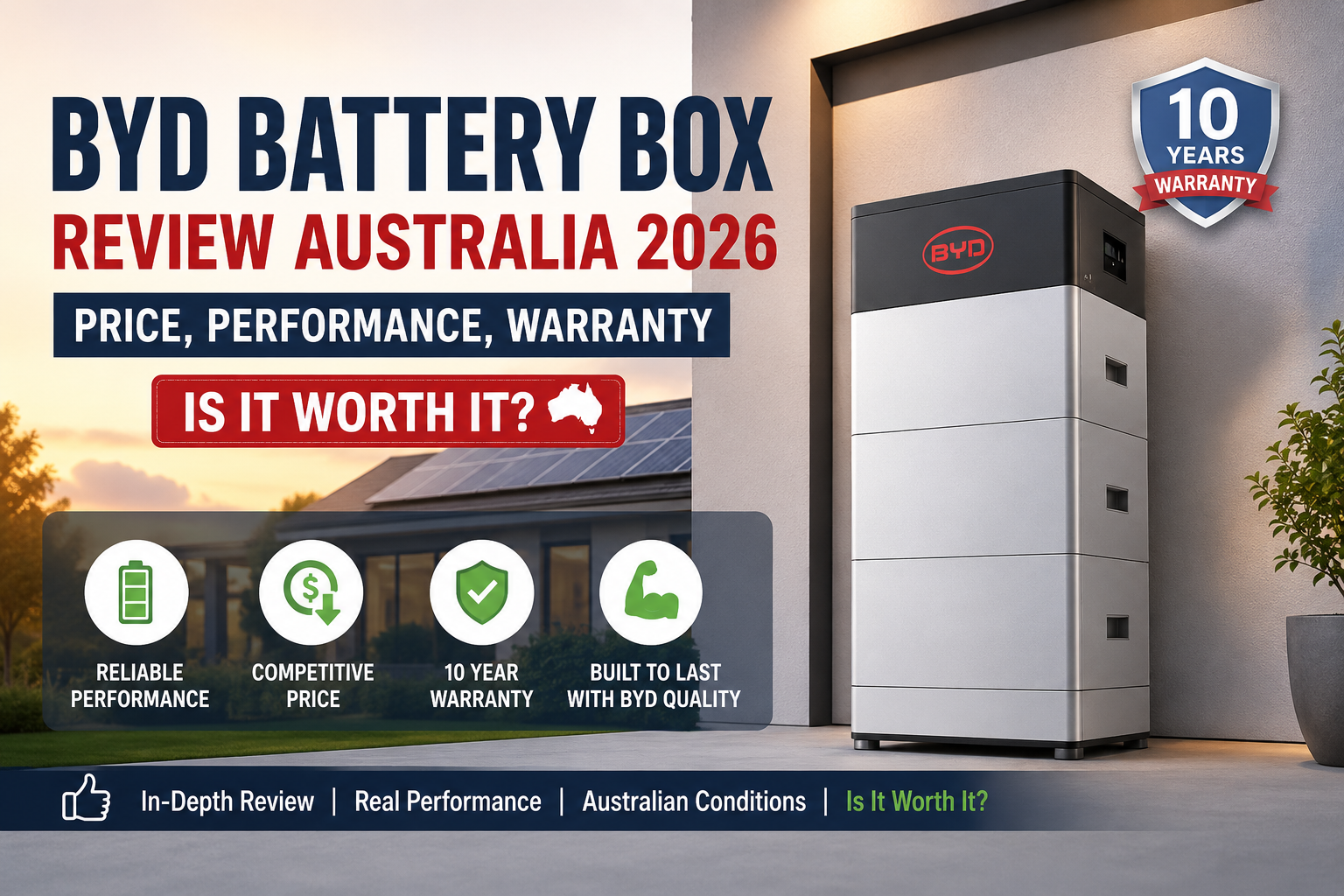
Considering a BYD Battery-Box for your home in Australia?
The BYD Battery-Box is one of the better-known modular battery storage platforms available to Australian solar customers. It has built its reputation around LFP battery chemistry, modular capacity, high-voltage architecture and compatibility with a range of battery inverters.
Unlike an all-in-one battery system where the battery and inverter are integrated into one product, the BYD Battery-Box is primarily a battery storage platform that works with a compatible inverter.
That distinction is important.
Depending on the model and system design, a BYD Battery-Box installation can provide:
- Battery storage
- Solar energy storage
- High-voltage battery operation
- Backup power
- Energy management through the compatible inverter
- System expansion
- Off-grid capability in suitable configurations
BYD offers several Battery-Box families, including HVS, HVM, LVS and LV Flex, allowing systems to be designed for different household, commercial and off-grid applications.
But is BYD still a good battery choice in Australia in 2026?
The important questions are:
How much does a BYD Battery-Box cost? Which model should you choose? How much usable capacity do you get? Is BYD reliable? Does it work with your existing inverter? What happens during a blackout? And is BYD worth the money compared with newer all-in-one battery systems?
This Australian-focused BYD Battery-Box review looks at the key factors you should consider before buying.
Looking for a BYD Battery-Box Quote?
Compare the complete system — not just the battery price.
👉 Get a Free BYD Battery-Box Quote
What Is the BYD Battery-Box?
The BYD Battery-Box is a modular lithium-ion battery storage platform designed for residential, commercial and specialised energy-storage applications.
BYD’s Battery-Box range uses Lithium Iron Phosphate (LFP) chemistry, which is widely used in stationary energy storage because of its thermal stability, safety characteristics and suitability for repeated cycling.
The major difference between BYD and some newer all-in-one battery products is that the Battery-Box is generally designed to work with a separate compatible battery inverter.
This means the complete system can look more like:
Solar Panels → Inverter → BYD Battery-Box → Home
rather than an integrated battery/inverter platform.
This architecture gives homeowners flexibility, but it also means the battery and inverter need to be correctly matched.
What Makes BYD Battery-Box Different?
The biggest advantage of BYD is its modular battery architecture.
Rather than buying a fixed-size battery, different Battery-Box configurations allow storage capacity to be built around the requirements of the property.
BYD’s high-voltage HVS and HVM systems can be configured in different sizes, while other Battery-Box families address low-voltage and larger-scale applications.
The HVS and HVM ranges are specifically designed as modular high-voltage battery systems and can be paired with compatible high-voltage battery inverters. BYD maintains an official inverter compatibility list for these systems.
The key advantages are:
- Modular battery capacity
- LFP chemistry
- High-voltage architecture
- Multiple battery configurations
- Compatible inverter ecosystem
- Backup potential
- Expansion capability
- Residential and larger-scale applications
This makes BYD particularly interesting for homeowners who want a flexible battery platform rather than a fixed all-in-one appliance.
BYD Battery-Box Capacity and Scalability
One of the strongest features of the BYD Battery-Box is the ability to configure storage capacity according to the property’s energy requirements.
For the Premium HVS range, available configurations include approximately:
- 5.1 kWh
- 7.7 kWh
- 10.2 kWh
- 12.8 kWh
The HVM range provides larger individual stacks:
- 8.3 kWh
- 11.0 kWh
- 13.8 kWh
- 16.6 kWh
- 19.3 kWh
- 22.1 kWh
BYD’s published specifications describe HVS systems from approximately 5.1–12.8 kWh per stack, with up to three identical HVS stacks capable of reaching approximately 38.4 kWh.
For HVM, a stack can range from approximately 8.3–22.1 kWh, with up to three identical stacks reaching approximately 66.2 kWh, subject to the applicable system configuration and inverter requirements.
Why does modularity matter?
Your energy consumption may change over time.
You might:
- Buy an EV
- Install a pool
- Add air conditioning
- Increase electricity consumption
- Add more solar
- Move to time-of-use electricity pricing
- Want additional backup capacity
A modular system gives you more flexibility to design around changing requirements.
Ask your installer:
“What is the maximum battery capacity I can install with this inverter, and can I expand the system later?”
Do not assume that every BYD model or inverter configuration can be expanded indefinitely.
BYD Battery-Box Chemistry: Lithium Iron Phosphate
BYD Battery-Box systems use Lithium Iron Phosphate (LFP) battery technology.
LFP is widely used in modern stationary energy storage because it offers a combination of:
- Thermal stability
- Safety characteristics
- Long-term cycling potential
- Stable chemistry
- Suitability for repeated charging and discharging
BYD describes its HVS/HVM systems as using cobalt-free LFP battery chemistry and highlights safety and lifecycle performance as key characteristics.
However, battery chemistry is only one part of battery safety.
The complete installation also depends on:
- Correct system design
- Battery location
- Electrical protection
- Inverter compatibility
- Installation quality
- Operating conditions
- Compliance with Australian requirements
A good battery installed poorly is not a good energy-storage system.
BYD High-Voltage Battery Architecture
The HVS and HVM ranges use a high-voltage series architecture.
This is an important difference from low-voltage battery systems.
High-voltage architecture can allow the battery and compatible inverter to operate efficiently at higher DC voltages, while reducing the current required for a given power level.
BYD’s HVS and HVM systems use modular battery stacks connected in series and are designed for compatible high-voltage battery inverters.
Why does this matter to homeowners?
You don’t necessarily need to understand the electrical engineering behind high-voltage batteries.
What matters is that the installer correctly matches:
Battery → Inverter → Solar → Home Loads
The inverter is a critical part of the complete system.
BYD Battery-Box and Inverter Compatibility
This is one of the most important things to understand before purchasing a BYD battery.
BYD Battery-Box is not universally compatible with every solar inverter.
The exact battery model needs to be matched with a compatible inverter.
BYD publishes compatibility documentation for its Battery-Box ranges, including an official compatible inverter list for HVS/HVM systems.
Depending on the specific configuration, BYD batteries can be used with compatible inverter platforms from major manufacturers.
However, compatibility can change as manufacturers release new inverter and battery firmware.
If you already have solar, ask:
“Is my existing inverter officially compatible with this exact BYD Battery-Box model?”
If it isn’t, you may need:
- A new hybrid inverter
- Additional control equipment
- AC-coupled battery equipment
- Or a different battery solution
This can significantly change the total installation price.
BYD Battery-Box Performance and Efficiency
Battery capacity isn’t the only specification that matters.
When comparing BYD with another battery, look at:
- Usable capacity
- Charge power
- Discharge power
- Round-trip efficiency
- Inverter efficiency
- Operating temperature
- Battery degradation
- Warranty conditions
- Expected daily cycling
BYD’s HVS/HVM architecture is designed for high-voltage operation and high-power applications, but the actual AC performance of a complete solar-plus-battery system depends on the battery, inverter and system configuration together.
This is why comparing batteries purely by their advertised kWh capacity can be misleading.
Ask your installer:
“What usable energy will I actually receive from the complete system, and what are the expected charge and discharge losses?”
BYD Battery-Box Monitoring and Energy Management
BYD provides tools such as Be Connect 2.0 and Be Connect Plus for battery commissioning, configuration and system-related functions, while ongoing homeowner monitoring can depend on the compatible inverter and its monitoring platform. BYD’s current downloads include a Be Connect 2.0 user guide.
This is an important distinction compared with some modern all-in-one battery systems.
With BYD:
Battery monitoring ≠ necessarily the same as your complete home energy monitoring experience.
The inverter platform may provide the homeowner-facing view of:
- Solar generation
- Battery charging
- Battery discharge
- Household consumption
- Grid imports
- Grid exports
- System status
Ask your installer:
“Which app will I use to monitor my complete solar and battery system?”
Don’t assume the BYD battery itself provides the same app experience as an integrated battery platform.
BYD Battery-Box Backup and Blackout Protection
A BYD Battery-Box can be used as part of a backup power system, but the battery itself does not determine whether your home receives backup power.
The inverter and overall electrical design are critical.
A backup system may be configured to operate:
- Selected essential circuits
- Part of the home
- Or, with suitable equipment and design, much larger household loads
During a blackout, the system needs to isolate the property from the grid before supplying backup electricity.
Backup performance depends on:
- Battery capacity
- Inverter power
- Backup equipment
- Switchboard configuration
- Essential-load design
- Household demand
- Single-phase or three-phase configuration
- Appliance starting loads
Ask your installer:
“Exactly which appliances will operate when the grid goes down?”
This is much more useful than simply asking:
“Does BYD have backup?”
How Fast Does BYD Switch to Backup?
The backup transition is determined primarily by the complete inverter and backup system, not simply the BYD battery.
If blackout protection is important to you, ask your installer about:
- Backup switching time
- Maximum backup output
- Continuous power
- Peak power
- Single-phase or three-phase backup
- Essential circuits
- Whole-home backup
- Air conditioning
- Pool pumps
- Refrigeration
- EV charging during outages
A large battery does not automatically mean you can operate every appliance in your home at once.
For example, a battery may have plenty of stored energy but still be limited by the inverter’s maximum instantaneous output.
BYD Battery-Box Off-Grid Capability
BYD Battery-Box systems can be used in appropriately designed off-grid and backup applications.
However, off-grid operation requires significantly more than simply adding a battery.
The system must be designed around:
Solar Generation + Battery Storage + Inverter/Charger + Energy Management + Household Loads
BYD’s HVS/HVM documentation specifically identifies emergency backup and off-grid functionality as supported applications when used in a suitable system configuration.
For remote properties, the installer needs to consider:
- Solar generation
- Battery capacity
- Generator integration
- Seasonal energy demand
- Inverter capacity
- Peak household loads
- Backup reserve
- Battery charging strategy
Ask:
“Is this system genuinely designed for off-grid operation, or is it primarily a grid-connected backup system?”
These are not the same thing.
Is BYD Battery-Box Suitable for Australian Conditions?
Australian battery installations can experience challenging environmental conditions, including:
- High temperatures
- Strong sunlight
- Humidity
- Heavy rain
- Coastal environments
- Dust
- Storm exposure
The suitability of a BYD battery installation therefore depends not only on the battery but also on the selected installation location.
Your installer should assess:
- Direct sunlight
- Heat exposure
- Rain
- Ventilation
- Flood risk
- Wall structure
- Clearance requirements
- Accessibility
- Distance from living areas
Ask:
“Where will the BYD battery be installed, and why is that location appropriate for the equipment?”
Never select a battery location based purely on convenience or appearance.
BYD Battery-Box Price Australia
There is no single BYD Battery-Box price in Australia.
The final installed price depends on the complete system.
Factors can include:
- Battery capacity
- HVS vs HVM vs LV system
- Hybrid inverter
- Existing inverter compatibility
- Backup requirements
- Switchboard upgrades
- Installation complexity
- Cable runs
- Additional protection equipment
- Solar system size
- Government incentives
- Installer labour
The original article’s fixed price ranges should therefore be treated as indicative rather than universal 2026 pricing.
Why comparing battery price alone can be misleading
Consider two quotes.
Quote A
- BYD battery
- Existing compatible inverter
- Standard installation
Quote B
- BYD battery
- New hybrid inverter
- Backup equipment
- Switchboard upgrade
- Additional electrical work
Quote B could be thousands of dollars more expensive even though the battery capacity is identical.
Ask:
“What exactly is included in the total installed price?”
BYD Battery-Box Price Per kWh
Price per kWh can be useful for comparing battery systems, but it should not be your only buying metric.
For example:
Battery price ÷ usable battery capacity = approximate battery cost per usable kWh
But the homeowner is paying for a complete energy system.
You also need to consider:
- Inverter
- Installation
- Backup equipment
- Switchboard work
- Monitoring
- Warranty
- Software
- Compatibility
- Rebates
- Future expansion
A cheaper battery can become more expensive if it requires additional equipment.
BYD Battery-Box Rebates and Incentives Australia
Australian battery incentives can materially reduce the upfront cost of an eligible installation.
The Australian Government’s Cheaper Home Batteries Program provides support for eligible small-scale battery systems connected to new or existing rooftop solar. The government states that from 1 July 2025 the program funds around a 30% discount on eligible small-scale battery systems, delivered through the Small-scale Renewable Energy Scheme.
However, the actual incentive depends on the system and installation circumstances.
Eligibility can depend on:
- Battery eligibility
- System configuration
- Installation requirements
- Installer participation
- Installation date
- Battery capacity
- Location
- Applicable SRES rules
Ask your installer:
“Which government battery incentive applies to my BYD system, and how much has been deducted from the quote?”
Always compare the final amount you pay, not just the advertised rebate.
BYD Battery-Box Warranty: What Should You Check?
BYD provides warranty documentation for its Australian Battery-Box products, but the exact terms depend on the model, product generation and applicable Australian warranty document.
For example, BYD’s Australian warranty documentation for the Premium HV range provides 10-year product warranty coverage and a performance warranty based on retaining 60% of usable energy for 10 years or reaching the applicable minimum throughput, whichever comes first, subject to the warranty terms.
The current Australian documentation should always be checked for the exact product being quoted.
Don’t simply compare:
“10-year warranty.”
Instead, compare:
Product warranty
How long is the equipment covered?
Capacity retention
How much usable capacity is guaranteed?
Throughput
Is there a maximum energy throughput?
Operating conditions
What operating conditions are required to maintain the warranty?
Inverter warranty
What warranty applies to the compatible inverter?
Labour
Who pays for labour if a battery component fails?
Warranty support
Who manages the warranty claim?
These details can be more important than the headline warranty period.
BYD Battery-Box Installation and Australian Compliance
A battery is a major electrical installation.
Correct system design and installation are essential for:
- Safety
- Performance
- Backup operation
- Grid connection
- Warranty
- Incentive eligibility
Your installer should understand:
- Battery sizing
- Inverter compatibility
- Battery protection
- Switchboard requirements
- Backup configuration
- Electrical isolation
- Grid requirements
- Applicable Australian standards
- Battery installation requirements
For Australian homeowners, it is also sensible to verify the installer’s current accreditation and experience rather than assuming that any solar installer has extensive battery experience.
Ask:
“Who is installing the battery, what battery accreditation do they hold, and how many BYD systems have they installed?”
BYD Battery-Box and Existing Solar Systems
One of BYD’s attractions is that it can be incorporated into different solar architectures.
But existing solar does not automatically mean BYD is compatible with your current system.
Your installer needs to assess:
- Existing inverter
- Inverter age
- Inverter model
- Solar capacity
- Phase configuration
- Battery compatibility
- Backup requirements
- Switchboard
- Available installation space
You may be able to retain your existing solar equipment, but in other cases a new hybrid inverter or different architecture may be more appropriate.
Ask:
“Can you add the BYD battery to my existing solar system without replacing my current inverter?”
The answer can have a significant impact on the total project cost.
BYD Battery-Box and EV Charging
BYD Battery-Box is fundamentally a battery-storage product rather than an integrated EV energy platform.
However, a BYD battery system can form part of a broader household energy system that includes an EV charger.
The important question is how the battery, solar system, inverter, home loads and EV charger will interact.
For an EV owner, the system could be designed around:
Solar → Home → Battery → EV → Grid
depending on the selected equipment and energy-management platform.
If you own or plan to buy an EV, ask:
“How will the BYD battery and EV charger be managed together, and can my solar system prioritise EV charging when solar generation is available?”
Don’t assume that the battery itself provides intelligent EV management.
That function may come from the inverter, energy-management system or EV charger.
BYD Battery-Box Efficiency and Real-World Performance
Battery efficiency is important, but homeowners should focus on whole-system performance rather than one battery specification.
Your real-world result depends on:
- Solar generation
- Battery capacity
- Battery cycling
- Inverter efficiency
- Household consumption
- Battery charge/discharge limits
- Electricity tariffs
- Feed-in tariff
- Weather
- System configuration
A 20 kWh battery does not automatically produce twice the savings of a 10 kWh battery.
If your home only needs 8–10 kWh of evening storage, a significantly larger battery may spend much of its capacity unused.
Ask:
“How much energy will my battery realistically cycle every day?”
This is one of the most important questions to ask before buying.
How Big a BYD Battery-Box Do You Need?
The biggest battery isn’t necessarily the best battery.
Battery sizing should be based on your actual energy profile.
Consider:
- Average daily consumption
- Daytime electricity use
- Evening electricity use
- Solar generation
- Exported solar
- Feed-in tariff
- Electricity tariff
- EV charging
- Pool
- Air conditioning
- Electric hot water
- Future electricity demand
- Backup requirements
Example
A household that uses most of its electricity during the day may need less battery storage.
A household with:
- High evening consumption
- Ducted air conditioning
- Pool equipment
- EV charging
- Low overnight solar generation
may benefit from substantially more storage.
Ask your installer:
“What BYD battery size gives me the best balance between savings, backup and payback?”
How Much Can a BYD Battery Save?
A BYD battery can help reduce grid electricity purchases by storing surplus solar energy for use later.
Without a battery:
Solar → Home → Excess solar → Grid
With a battery:
Solar → Home → Battery → Evening/Night Loads
The financial result depends on:
- Solar production
- Household consumption
- Battery size
- Electricity prices
- Feed-in tariff
- Battery efficiency
- Battery cycling
- Installation price
- Government incentives
A battery should therefore be assessed using your own electricity data.
Ask your installer:
“What annual electricity bill saving are you forecasting for my home, and what assumptions are you using?”
A personalised calculation is much more useful than a generic payback claim.
BYD Battery-Box vs All-in-One Battery Systems
This is one of the most important comparisons in the 2026 battery market.
A traditional BYD configuration can look like:
Solar → Hybrid Inverter → BYD Battery → Home
An integrated battery platform may combine:
Battery + Inverter + Energy Management + Backup + EV
The BYD approach provides flexibility and an established battery/inverter ecosystem.
The all-in-one approach can provide a more integrated user experience.
BYD can be attractive if you:
- Want flexible battery configurations
- Already have compatible equipment
- Prefer a modular battery platform
- Want a widely established battery technology
- Have an installer experienced with BYD
- Want to build the system around a particular inverter
An all-in-one system may be attractive if you:
- Want a simplified architecture
- Want integrated energy management
- Want strong EV integration
- Want battery and inverter from one platform
- Prefer one central monitoring ecosystem
The best option depends on the complete system — not just the battery brand.
Who Is BYD Battery-Box Best Suited To?
BYD may be particularly attractive if you:
✅ Want modular battery storage
✅ Already have or are installing a compatible hybrid inverter
✅ Want to expand storage in the future
✅ Prefer LFP battery chemistry
✅ Want backup capability with suitable system design
✅ Have relatively high evening electricity consumption
✅ Want a proven battery platform with a broad inverter ecosystem
✅ Are comparing multiple battery/inverter combinations
BYD May Not Be the Best Fit If:
⚠ You want a simple all-in-one battery system
⚠ You want battery and inverter integrated into one platform
⚠ Your existing inverter is incompatible
⚠ You want highly integrated EV energy management
⚠ You are primarily looking for the lowest upfront price
⚠ Your installer has limited experience with BYD systems
BYD Battery-Box Pros and Cons
BYD Pros
✔ Established battery-storage platform
✔ LFP battery chemistry
✔ Highly modular architecture
✔ Multiple capacity options
✔ HVS and HVM high-voltage configurations
✔ Can be expanded in suitable system configurations
✔ Compatible with a range of inverter platforms
✔ Backup capability when correctly designed
✔ Suitable for residential and larger energy-storage applications
✔ Australian-specific warranty and technical documentation is available
BYD Cons
✘ Battery requires a compatible inverter
✘ Complete system can involve more components than an all-in-one solution
✘ Compatibility needs to be checked carefully
✘ Final installation cost depends heavily on inverter and electrical requirements
✘ Monitoring experience can depend on the inverter platform
✘ Not necessarily the simplest solution for homeowners wanting one integrated energy platform
Is BYD Battery-Box Worth It in Australia?
For the right homeowner, BYD Battery-Box can still be a very strong battery option in 2026.
Its biggest strengths are not simply the number of kilowatt-hours it can store.
The attraction is the combination of:
LFP Chemistry → Modular Capacity → High-Voltage Architecture → Inverter Compatibility → Backup Potential → Expansion
BYD is particularly worth considering if you want a flexible battery platform and are comfortable with a separate inverter-based system.
However, you should not choose BYD simply because it is a well-known battery brand.
Before buying, compare:
Usable Capacity → Power → Inverter → Compatibility → Backup → Efficiency → Warranty → Support → Installation → Rebate → Final Price
And most importantly:
Does the system actually match your household’s energy profile?
A larger battery isn’t automatically a better investment.
A more expensive battery isn’t automatically a better battery.
The right system is the one that delivers the right combination of energy savings, backup capability, reliability, scalability and long-term value for your property.
12 Questions to Ask Before Buying a BYD Battery-Box
Before signing your battery contract, ask your installer:
- Which exact BYD Battery-Box model am I getting?
- What is the total and usable battery capacity?
- Which inverter is being used with the battery?
- Is that inverter officially compatible with this exact BYD model?
- Can I expand the battery later?
- What happens during a blackout?
- Which appliances will operate during backup?
- Can I keep my existing solar inverter?
- Which government battery incentive has been applied to my quote?
- What exactly does the BYD warranty guarantee after 10 years?
- Who handles warranty claims if the battery or inverter develops a problem?
- What annual electricity saving and payback are you forecasting for my home?
Getting clear answers to these questions makes it much easier to compare BYD against other battery options.
Get a BYD Battery-Box Quote
A battery is a long-term investment, so don’t choose one based on brand, capacity or advertised price alone.
Compare the complete system:
Battery → Usable Capacity → Inverter → Solar → Backup → EV → Performance → Warranty → Support → Installation → Rebate → Final Price
At Solar Authority, we can help you assess your electricity usage, existing solar system, future energy requirements and backup needs before selecting a battery.
If BYD is the right fit for your property, the system can be designed around your actual energy requirements rather than simply selling you the largest battery available.
👉 Get a Free BYD Battery-Box Quote
Tell us about your home, electricity usage and existing solar system and compare a BYD battery solution designed around your needs.
Free to enquire. No obligation to proceed.