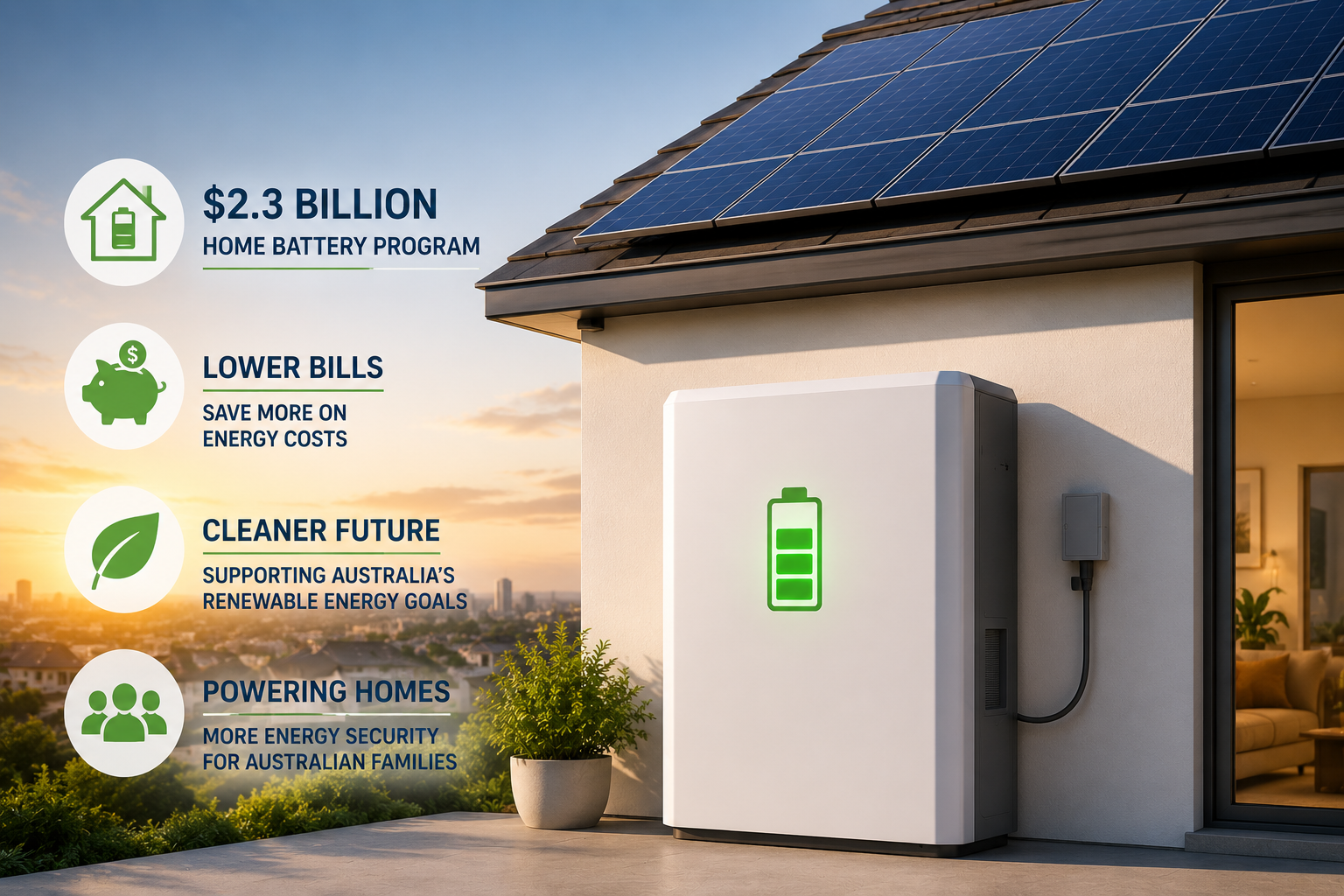
If you’re considering installing a home battery in Australia, you’ve probably heard about Labor’s $2.3 billion Cheaper Home Batteries Program and the federal battery rebate.
But there has been a major evolution since the program was first announced.
The Australian Government originally announced the program with an estimated $2.3 billion commitment. In December 2025, the government announced an expansion, taking the estimated funding to approximately $7.2 billion over four years. The program is designed to help more Australian households and small businesses install eligible battery storage.
The bigger question for homeowners is:
How much can you actually save, how does the battery rebate work in 2026, and is now the right time to install a battery?
This guide explains the Cheaper Home Batteries Program, STCs, eligibility, battery sizing, rebate reductions, battery costs, potential savings, payback periods and what to check before signing a battery quote.
Quick Answer: Is the Australian Home Battery Rebate Still Available in 2026?
Yes.
The Australian Government’s Cheaper Home Batteries Program continues in 2026.
Eligible battery systems can receive financial support through the Small-scale Renewable Energy Scheme (SRES), with eligible systems receiving STCs that can be assigned to an agent or retailer in exchange for an upfront discount.
The program was designed to provide support equivalent to around a 30% discount on eligible battery installation costs, although the actual dollar value of the discount depends on the battery’s usable capacity, STC factor and STC market value.
Important 2026 update
From 1 May 2026, the program changed significantly.
The STC calculation now uses:
- 100% of the STC factor for the first 14 kWh
- 60% of the STC factor for capacity above 14 kWh up to 28 kWh
- 15% of the STC factor for capacity above 28 kWh up to 50 kWh
Only the first 50 kWh of usable battery capacity is eligible for STCs.
This means homeowners should no longer assume that a larger battery automatically receives a proportionally larger rebate.
What Is Labor’s $2.3 Billion Home Battery Program?
The Cheaper Home Batteries Program was introduced by the Australian Federal Government to reduce the upfront cost of eligible battery storage for households and small businesses.
The program commenced on 1 July 2025.
Rather than operating like a traditional cash rebate paid directly into your bank account, the program works through the Small-scale Renewable Energy Scheme (SRES).
Eligible battery systems can create Small-scale Technology Certificates (STCs).
These certificates have a monetary value and can generally be assigned to a registered agent or retailer, who then provides the value as an upfront discount on the battery installation.
The basic process is:
Eligible battery
↓
STCs calculated from usable battery capacity
↓
STCs assigned to registered agent/retailer
↓
STC value applied to the purchase
↓
Lower upfront battery price
The program is intended to make battery storage more affordable while encouraging households to store excess rooftop solar and use that energy later.
Why Was the Original $2.3 Billion Program Expanded?
The original program generated extremely strong demand.
The government subsequently announced that estimated funding would increase from approximately $2.3 billion to $7.2 billion over four years.
The Clean Energy Regulator reported that more than 193,000 valid battery installations had already been recorded during the first six months of the program in 2025, representing approximately 4.6 GWh of battery storage capacity.
The strong uptake demonstrates that Australian homeowners are increasingly looking beyond solar panels alone and considering batteries as a way to increase their use of self-generated electricity.
How Does the Home Battery Rebate Work?
The battery incentive is delivered through the SRES and STCs.
The number of STCs available depends on the battery’s usable capacity and the applicable STC factor for the installation period.
The STC factor is designed to decline over time as battery costs are expected to fall.
This is why the incentive available today should not automatically be assumed to remain the same in future years.
Battery Rebate Reduction 2026–2030: What Are the Numbers?
This is one of the most important sections for anyone considering waiting before buying a battery.
The official Clean Energy Regulator schedule shows that the STC factor declines every six months, rather than simply dropping once per year.
Official STC Factor Schedule
| Period | STC Factor | Reduction From Previous Period |
|---|---|---|
| Jan–Apr 2026 | 8.4 | — |
| May–Dec 2026 | 6.8 | 19.0% ↓ |
| Jan–Jun 2027 | 5.7 | 16.2% ↓ |
| Jul–Dec 2027 | 5.2 | 8.8% ↓ |
| Jan–Jun 2028 | 4.6 | 11.5% ↓ |
| Jul–Dec 2028 | 4.1 | 10.9% ↓ |
| Jan–Jun 2029 | 3.6 | 12.2% ↓ |
| Jul–Dec 2029 | 3.1 | 13.9% ↓ |
| Jan–Jun 2030 | 2.6 | 16.1% ↓ |
| Jul–Dec 2030 | 2.1 | 19.2% ↓ |
These percentages are calculated from the official STC factor schedule published by the Clean Energy Regulator.
What Does This Mean?
From 8.4 in early 2026 to 2.1 by the second half of 2030, the STC factor falls by approximately 75%.
In other words:
8.4 → 6.8 → 5.7 → 5.2 → 4.6 → 4.1 → 3.6 → 3.1 → 2.6 → 2.1
This does not mean your battery rebate will automatically be exactly 75% lower.
The actual dollar discount also depends on the STC price and your eligible battery capacity.
However, the official schedule clearly shows that the number of STCs generated per kWh is progressively declining.
Why Is the Incentive Reducing?
The government says the STC factor is adjusted in line with falling battery costs over time, with the aim of maintaining support at around a 30% discount while keeping the program financially sustainable.
Therefore, homeowners should think about the incentive as a declining support mechanism, not a permanent 30% cash rebate.
Why the 2026 Changes Matter for Larger Batteries
The reduction isn’t only about the year of installation.
From 1 May 2026, the STC factor is also progressively tapered according to battery capacity.
Current Capacity Tiers
First 14 kWh
100% of the applicable STC factor
14–28 kWh
60% of the applicable STC factor
28–50 kWh
15% of the applicable STC factor
Only the first 50 kWh of usable capacity can generate STCs.
What This Means for Homeowners
A 30 kWh battery does not receive three times the incentive of a 10 kWh battery.
The incentive is progressively tapered for larger systems.
This is why battery sizing is now more important than ever.
The biggest battery is not automatically the best battery.
Example: How the New Battery Rebate Structure Works
The Clean Energy Regulator provides an example of a 40 kWh battery installed from 1 May 2026.
Under the applicable STC factor, the calculation is divided into three sections:
- First 14 kWh receives 100% of the factor
- Next 14 kWh receives 60%
- Remaining 12 kWh receives 15%
The CER example results in 164 STCs for a 40 kWh battery installed between 1 May and 31 December 2026.
This illustrates why comparing batteries purely by total kWh can be misleading.
How Much Can the Battery Rebate Save You?
There is no single dollar rebate that applies to every Australian household.
Your potential discount depends on:
- Battery usable capacity
- Installation date
- Applicable STC factor
- Battery capacity tier
- STC market value
- Eligibility
- Installer/retailer arrangements
The government originally described the program as providing around a 30% discount on typical eligible battery installation costs.
However, homeowners should focus on the actual dollar amount shown on their quote, rather than assuming that every battery receives exactly 30%.
Your quote should clearly show:
Battery price before incentive
STC incentive
Installation costs
Electrical work
Other applicable costs
Final installed price
This makes it easier to compare battery quotes accurately.
Can I Get the Battery Rebate If I Already Have Solar?
Yes, potentially.
The federal program supports eligible batteries connected to new or existing rooftop solar PV systems.
This makes the program particularly relevant to homeowners who already have solar but are still exporting a significant amount of electricity during the day.
A battery can potentially allow you to:
- Store excess solar
- Use solar energy after sunset
- Reduce grid electricity purchases
- Increase solar self-consumption
- Reduce exposure to electricity price increases
However, your existing solar system needs to be assessed for compatibility before a battery is installed.
Is a Solar Battery Worth It in 2026?
For many Australian households, a battery can make sense.
But it is not automatically the right investment for every home.
The Australian Government recommends considering the costs and benefits carefully because battery economics vary significantly between households.
A Battery May Make Sense If You:
✔ Have substantial excess solar during the day
✔ Have high evening electricity consumption
✔ Pay relatively high electricity rates
✔ Receive a low feed-in tariff
✔ Have a pool or other large electrical loads
✔ Have ducted air conditioning
✔ Plan to purchase an EV
✔ Want greater energy independence
✔ Want battery backup capability
You May Want to Think Carefully If:
✘ Your electricity usage is very low
✘ Your solar system produces little excess energy
✘ The battery quote is unusually expensive
✘ You are buying substantially more capacity than you need
✘ The projected savings use unrealistic assumptions
How Much Can a Solar Battery Save on Electricity Bills?
There is no universal savings figure.
Your savings depend on:
- Electricity consumption
- Solar generation
- Battery size
- Battery efficiency
- Electricity tariff
- Feed-in tariff
- Battery price
- How often the battery cycles
- Household behaviour
For example, a household that exports large amounts of solar during the day and consumes significant electricity in the evening may have a stronger battery business case than a household that already consumes most of its solar during daylight hours.
What Is the Payback Period for a Home Battery?
The payback period is the time it takes for your electricity savings and other benefits to recover the amount you paid for the battery.
A simple calculation is:
Net battery cost ÷ estimated annual savings = indicative payback period
But a professional calculation should also consider:
- Battery degradation
- Electricity price changes
- Feed-in tariffs
- Financing costs
- Warranty
- VPP income
- Battery replacement risk
- Future electricity consumption
There is therefore no single payback period that applies to every Australian household.
What Battery Size Should I Buy?
Battery sizing should be based on your actual electricity consumption, not simply the number of bedrooms in your house.
Your installer should consider:
Your daily consumption
How many kWh does your household typically use?
Your evening consumption
How much electricity do you use after the sun goes down?
Your solar production
How much excess solar energy is available to charge the battery?
Your future electricity requirements
Are you planning:
- An EV?
- A pool?
- More air conditioning?
- Electric hot water?
- Home electrification?
Your backup requirements
Do you want the battery to power your home during a blackout?
These factors should influence your battery size.
What Is the Difference Between Battery kWh and kW?
This is an important distinction when comparing battery quotes.
kWh = energy storage capacity
kW = power output
For example, a battery may have a large storage capacity but limited power output.
A homeowner should therefore look at both numbers.
Don’t choose a battery based on kWh alone.
What Is a VPP and Does It Matter?
A Virtual Power Plant (VPP) connects multiple distributed batteries so they can be coordinated to help manage electricity supply and demand.
The Clean Energy Regulator explains that battery owners may also participate in a VPP after installation, depending on their energy provider and arrangements.
VPP participation can potentially provide additional value, but homeowners should carefully review:
- Payment rates
- Contract length
- Battery control
- Export requirements
- Minimum availability
- Exit conditions
- Whether participation is optional
VPP-ready does not automatically mean you have to join a VPP.
What Should You Compare When Getting Battery Quotes?
Don’t compare battery quotes based only on price.
Compare:
| Feature | Why It Matters |
| Usable capacity | Shows how much stored energy you can actually use |
| Battery model | Determines technology and specifications |
| Inverter | Important for system compatibility and performance |
| Power output | Determines what loads the battery can support |
| Warranty | Important for long-term ownership |
| Cycle/throughput warranty | Helps assess expected battery life |
| Backup capability | Important during grid outages |
| Monitoring | Helps track performance |
| Government incentive | Reduces upfront cost |
| Installation | Affects system quality and safety |
| VPP capability | Important for future participation |
| Final installed price | Allows accurate quote comparison |
Don’t Choose a Battery Just Because the Rebate Is Large
The rebate is only one part of the financial equation.
A battery that costs $15,000 with a large incentive may still be a worse investment than a properly sized system costing $10,000 with a smaller incentive.
What matters is:
Final installed price
Annual energy savings
Battery performance
Warranty
Expected lifetime
Future energy needs
This is why homeowners should compare the complete system rather than chasing the biggest advertised rebate.
Should You Buy a Battery Now or Wait?
This is one of the most important decisions homeowners face.
Waiting could potentially bring:
- Lower battery prices
- New battery technology
- Better system efficiency
- New electricity plans
- New VPP opportunities
But waiting can also mean:
- A lower STC factor
- A smaller upfront incentive
- Continued electricity purchases from the grid
- Continued solar exports
- Missing current financial incentives
The official STC schedule shows the factor continuing to decline through 2030.
For example:
The factor is scheduled to fall from:
8.4 in early 2026
to
6.8 from May 2026
to
5.7 in early 2027
and eventually to
2.1 in the second half of 2030.
That represents a substantial reduction in the number of STCs generated per eligible kWh.
However, battery prices are also expected to evolve.
Therefore, the right decision is not simply:
“Buy now because the rebate is falling.”
It is:
“Compare today’s net installed price and expected savings with the likely economics of waiting.”
How Much Could Waiting Cost You?
Suppose two identical eligible battery installations are completed in different years.
The earlier installation may receive a higher STC factor, while the later installation may receive fewer STCs.
For example, the official schedule moves from 6.8 STCs per kWh in May–December 2026 to 5.7 in January–June 2027 — a reduction of approximately 16.2% in the STC factor.
From 5.7 to 4.6, the factor falls another approximately 19.3% when comparing the January starting points of 2027 and 2028.
From 4.6 to 3.6, it falls approximately 21.7% between the January starting points of 2028 and 2029.
From 3.6 to 2.6, it falls approximately 27.8% between the January starting points of 2029 and 2030.
These figures describe the STC factor, not a guaranteed percentage reduction in the final dollar rebate.
The final dollar incentive also depends on the STC market value and the battery’s eligible capacity.
2026–2030 Rebate Outlook at a Glance
| Year | Applicable STC Factors | General Direction |
| 2026 | 8.4 → 6.8 | Significant reduction from May |
| 2027 | 5.7 → 5.2 | Continues declining |
| 2028 | 4.6 → 4.1 | Continues declining |
| 2029 | 3.6 → 3.1 | Continues declining |
| 2030 | 2.6 → 2.1 | Lowest scheduled factors |
The official schedule confirms that the STC factor declines every six months through 2030.
10 Questions to Ask Before Buying a Battery
Before signing a contract, ask your installer:
- What is the battery’s usable capacity?
- What is its continuous power output?
- What government incentive is included?
- What is the battery price before the incentive?
- What is the final installed price?
- What assumptions were used to calculate my savings?
- What is the expected payback period?
- What warranty does the battery provide?
- Does the system provide backup power?
- Is the battery VPP capable?
A professional installer should be able to explain these numbers clearly.
Is the $2.3 Billion Battery Rebate Still Worth Taking Advantage of in 2026?
For an eligible household, the federal battery incentive can make battery storage substantially more affordable.
But homeowners should not make the decision based only on the headline “30% battery rebate.”
The more important calculation is:
Battery price
− Government/STC incentive
= Your actual upfront investment
Then:
Your actual electricity savings
÷ Your net battery investment
= Your indicative return
A correctly sized battery at a competitive price can potentially deliver significantly better value than an oversized system selected simply because it qualifies for a large advertised incentive.
How Solar Authority Can Help
At Solar Authority, we help Australian homeowners understand their battery options before committing to an installation.
We can help you:
✔ Check eligibility for available battery incentives
✔ Assess your existing solar system
✔ Review your electricity usage
✔ Compare battery capacities
✔ Calculate potential savings
✔ Explain STCs and the federal battery incentive
✔ Compare battery and inverter specifications
✔ Assess backup power requirements
✔ Explain VPP capability
✔ Arrange installation through Solar Accreditation Australia (SAA)-accredited professionals
Want to Know Which Battery Makes Financial Sense for Your Home?
Request a personalised solar battery assessment and compare your options before you commit.
Get Your Battery Quote →
Frequently Asked Questions
Is the $2.3 billion battery rebate still available in 2026?
Yes. The Cheaper Home Batteries Program continues in 2026. The program was originally announced at approximately $2.3 billion but was subsequently expanded to an estimated $7.2 billion over four years.
How much is the home battery rebate in Australia?
There is no single fixed dollar rebate for every household. The incentive is delivered through STCs, with the number of STCs depending on usable battery capacity and the applicable STC factor.
Is the battery rebate really 30%?
The program is designed to provide support equivalent to around a 30% discount on eligible battery systems. However, the actual dollar discount depends on the battery, installation date, STC factor, capacity and STC value.
Does the battery rebate decrease every year?
The STC factor is scheduled to decline over time, and from 2026 it declines every six months. The official schedule runs from 8.4 in early 2026 to 2.1 in the second half of 2030.
How much will the battery rebate decrease in 2027?
The STC factor moves from 5.7 in January–June 2027 to 5.2 in July–December 2027, representing an approximately 8.8% reduction between those periods.
Will the dollar rebate be exactly 75% lower by 2030?
Not necessarily. The STC factor falls by approximately 75% from 8.4 to 2.1, but the actual dollar value of the incentive also depends on STC prices and the eligible battery capacity.
Can I get the battery rebate if I already have solar?
Yes, eligible batteries can be installed with an existing or new rooftop solar PV system, subject to program requirements.
Can I get a rebate for a 20 kWh battery?
Potentially, yes. However, from 1 May 2026 the STC factor is tapered for battery capacity above 14 kWh, so the entire 20 kWh capacity does not receive the same level of STC treatment as the first 14 kWh.
Does a 30 kWh battery receive three times the rebate of a 10 kWh battery?
No. From 1 May 2026, the STC factor is tapered by capacity. The first 14 kWh receives 100%, the next portion up to 28 kWh receives 60%, and capacity above 28 kWh up to 50 kWh receives 15%.
How many kWh of battery capacity can receive STCs?
Only the first 50 kWh of usable battery capacity is eligible for STCs under the program.
Is a solar battery worth it in 2026?
It can be, particularly for households with high evening consumption, substantial excess solar and relatively expensive grid electricity. However, battery economics vary between households and should be assessed using your actual energy data.
What battery size should I buy?
There is no universal best battery size. Your installer should consider your electricity consumption, solar generation, evening usage, future EV plans, tariff and backup requirements.
What is an STC?
An STC, or Small-scale Technology Certificate, is a certificate created under Australia’s Small-scale Renewable Energy Scheme. Eligible battery systems can generate STCs, which can be assigned to a registered agent or retailer in exchange for an upfront discount.
Do I have to join a VPP?
Not necessarily. A battery may have VPP capability without you being required to participate in a VPP. If you choose to join one, check the provider’s payment structure, control conditions and contract terms.
Should I buy a battery now or wait?
There is no universal answer. Waiting may bring lower battery prices or improved technology, but the official STC factor is scheduled to decline through 2030. Compare the current net installed price and expected savings against the potential benefits of waiting.
Final Takeaway
Australia’s Cheaper Home Batteries Program has changed the economics of home battery storage.
But the biggest mistake homeowners can make is focusing only on the headline rebate.
The incentive is changing.
The STC factor is scheduled to decline from 8.4 in early 2026 to 2.1 in late 2030, while the battery capacity rules introduced from 1 May 2026 provide progressively lower STC treatment for larger systems.
At the same time, battery technology and prices can change.
So the right question is not simply:
“How much is the government rebate?”
The better question is:
“What will my final battery price be, how much electricity can I save, and does the investment make financial sense for my household?”
That is the calculation that should guide your decision.