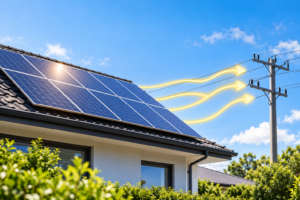

If you have solar panels in New South Wales, your feed-in tariff (FiT) can have a significant impact on the financial return you get from your solar system.
But there is an important point many homeowners miss:
The highest feed-in tariff isn’t necessarily the best electricity plan.
A retailer might offer a higher export rate but charge more for electricity, have higher daily supply charges, cap the higher FiT, or impose other conditions.
In 2026, NSW solar owners should look beyond the headline cents-per-kWh feed-in rate and compare the complete electricity plan, their solar self-consumption and whether a battery could provide greater value.
This guide explains NSW feed-in tariffs in 2026, typical rates, IPART benchmarks, how much your exports may be worth, why self-consumption can be more valuable than exporting, how batteries change the equation, and how to compare electricity plans before switching.
Quick Answer: What Is a Good Solar Feed-In Tariff in NSW in 2026?
There is no single “best” NSW feed-in tariff because retailers set their own offers.
As a broad market guide, NSW solar owners may encounter:
| Feed-In Tariff Type | Indicative Rate |
|---|---|
| Lower/basic FiT | ~2–4¢/kWh |
| Common flat FiT | ~4–7¢/kWh |
| Competitive/promotional FiT | ~8–10¢/kWh |
| Higher time-based/VPP offers | Potentially 10¢+/kWh at specific times |
Important: Rates, caps and eligibility conditions vary by retailer, postcode and electricity plan. Always check the current Energy Price Fact Sheet before switching.
What Is a Solar Feed-In Tariff?
A solar feed-in tariff is the amount your electricity retailer credits you for electricity your solar system exports to the grid.
For example, if your solar system produces:
20kWh
and your home consumes:
12kWh
you may export:
8kWh
If your feed-in tariff is 6¢/kWh:
8 × $0.06 = $0.48
You would receive approximately 48 cents of bill credit for that day’s exports, subject to your plan’s terms.
NSW Does Not Have a Mandatory Minimum Feed-In Tariff
This is one of the most important things NSW solar owners need to understand.
Unlike jurisdictions where a regulated minimum FiT applies, NSW retailers generally determine the feed-in tariff they offer under their individual electricity plans.
IPART provides benchmarks for NSW customers, but these are benchmarks rather than a mandatory minimum payment that every retailer must provide.
That means two households in the same suburb can potentially receive very different export rates depending on their electricity retailer and plan.
NSW Solar Feed-In Tariff Benchmark 2025–26
For 2025–26, IPART’s benchmark for flat-rate solar feed-in tariffs is approximately:
4.8–7.3¢/kWh
This benchmark is useful when evaluating whether an offer appears competitive.
However, don’t interpret the benchmark as:
“My retailer must pay me at least 4.8¢/kWh.”
It is a benchmark designed to help consumers assess the value of solar export offers.
What Are NSW Retailers Paying for Solar in 2026?
The actual market is more complicated.
You may find plans offering:
Basic FiTs
Approximately 2–4¢/kWh
These may be less attractive if you export a significant amount of solar.
Standard FiTs
Approximately 4–7¢/kWh
These are commonly encountered in NSW electricity plans.
Promotional FiTs
Some plans may advertise 8–10¢/kWh or more, but these offers can have:
- Export limits
- Daily caps
- Eligibility conditions
- Higher electricity rates
- Time restrictions
- Promotional periods
Time-Based FiTs
Some plans offer different export rates depending on when electricity is exported.
A battery can potentially help take advantage of these structures by shifting stored solar into higher-value export periods.
Why the Highest Feed-In Tariff Isn’t Always the Best Deal
Imagine two electricity plans.
Plan A
10¢/kWh FiT
but:
- Higher usage rates
- Higher supply charge
- Export cap
Plan B
5¢/kWh FiT
but:
- Lower usage rates
- Lower supply charge
- No restrictive export conditions
If you consume a lot of electricity but export relatively little solar, Plan B could potentially produce the lower annual bill.
That’s why you should compare:
Usage rate
Feed-in tariff
Daily supply charge
Solar export limits
FiT caps
Discounts
Other fees
rather than focusing on one number.
How Much Is Your Exported Solar Actually Worth?
Consider a simple example.
Suppose you export:
15kWh per day
At:
5¢/kWh
Your export credit would be:
15 × $0.05 = $0.75 per day
Over 365 days:
$273.75 per year
At 10¢/kWh:
$547.50 per year
That’s a difference of approximately:
$274 per year
But there is an even more important comparison.
Self-Consumption vs Feed-In Tariff
Suppose your electricity retailer charges:
30¢/kWh
for electricity you purchase from the grid.
If you use 1kWh of your own solar electricity, you potentially avoid purchasing that 1kWh from the grid.
That’s approximately:
30¢ of avoided electricity cost
But if you export that same 1kWh at:
5¢/kWh
you receive only:
5¢
So:
Using your solar yourself can be worth substantially more than exporting it.
This is one of the most important concepts for NSW solar owners.
Why Solar Self-Consumption Matters in 2026
Solar export prices are generally much lower than retail electricity purchase prices.
Therefore, your objective shouldn’t necessarily be:
“Export as much solar as possible.”
Instead, it may be:
“Use as much of my solar electricity as possible before exporting the surplus.”
You can increase self-consumption by:
✔ Running appliances during daylight hours
✔ Heating water when solar generation is high
✔ Charging an EV during solar production
✔ Running pool pumps during the day
✔ Using smart energy management
✔ Installing a battery where financially appropriate
How a Solar Battery Changes the Feed-In Tariff Equation
A battery allows you to store excess solar electricity instead of immediately exporting it.
Without a battery
Solar → Home → Excess → Grid → FiT
With a battery
Solar → Home → Battery → Evening/Night → Reduced grid purchases
This can be valuable when:
- Your daytime solar exports are high
- Your evening electricity consumption is high
- Your FiT is low
- Your electricity purchase rate is significantly higher than your FiT
Example: Solar + Battery vs Exporting
Imagine your solar system produces an additional:
10kWh
during the middle of the day.
If you export all 10kWh at:
5¢/kWh
you receive:
$0.50
If a battery stores that energy and you later use 8kWh that would otherwise have been purchased from the grid at 30¢/kWh, the avoided purchase cost could be approximately:
8 × $0.30 = $2.40
There are battery losses and battery costs to account for, so this is not a guaranteed $2.40 saving.
But it demonstrates why self-consumption can be significantly more valuable than low-value solar exports.
Should You Get a Battery Just Because Your FiT Is Low?
Not necessarily.
A low feed-in tariff can strengthen the case for battery storage, but the battery still needs to make financial sense.
Consider:
- Battery purchase price
- Usable capacity
- Warranty
- Expected cycles
- Round-trip efficiency
- Electricity prices
- Your evening consumption
- Solar generation
- Available government incentives
- Battery lifespan
The question shouldn’t simply be:
“Is my FiT low?”
It should be:
“How much additional value can a battery create compared with its installed cost?”
NSW Feed-In Tariff Types
1. Flat Feed-In Tariff
You receive the same rate for every exported kWh.
Example:
6¢/kWh all day
Advantages
✔ Simple
✔ Easy to understand
✔ Predictable
Disadvantage
You don’t receive a higher rate when grid demand is higher.
2. Tiered Feed-In Tariff
You may receive one rate for a certain amount of exports and another rate after reaching the threshold.
For example:
First 10kWh/day → higher rate
Additional exports → lower rate
Always check the fine print.
3. Time-Based Feed-In Tariff
Your export rate changes depending on when you export.
For example:
Midday → lower rate
Evening → higher rate
This can be particularly interesting for battery owners.
A battery can potentially store daytime solar and discharge/export it during higher-value periods, depending on the retailer’s rules and the battery/VPP arrangement.
4. VPP Feed-In Tariffs
A Virtual Power Plant (VPP) connects participating batteries so they can be managed as a networked energy resource.
Some VPP programs may provide:
- Higher export rewards
- Participation payments
- Battery incentives
- Access to specific electricity plans
But VPP contracts can involve additional terms.
Before joining, check:
- Who controls the battery?
- How frequently can it be dispatched?
- Are there minimum participation periods?
- Is there a VPP payment?
- Can you leave the program?
- Does it affect battery warranty?
- What happens during a blackout?
What Is the Best Feed-In Tariff in NSW?
There is no permanent “best” FiT.
A good offer depends on your household.
If you export a lot:
A higher FiT may be valuable.
If you use a lot of electricity:
A lower usage rate may matter more.
If you have a battery:
Time-based or VPP tariffs may become more interesting.
If you have an EV:
A plan with cheap charging periods may be more valuable than the highest FiT.
If you use most of your solar yourself:
The FiT may have relatively little impact on your total bill.
Feed-In Tariff vs Electricity Price
This is where many homeowners make a mistake.
Suppose:
Grid electricity = 30¢/kWh
Solar FiT = 5¢/kWh
The difference is:
25¢/kWh
So if you can use your solar electricity instead of buying electricity from the grid, the economic value can be much higher than exporting it.
This is why modern solar design increasingly focuses on:
Self-consumption → Battery storage → Smart energy use → Export
rather than simply maximising exports.
How to Increase Your Solar Self-Consumption
You don’t necessarily need a battery to improve self-consumption.
Try:
Run appliances during solar hours
Use:
- Washing machine
- Dishwasher
- Dryer
- Pool pump
during the day.
Heat water with solar
If your hot-water system allows suitable control, heating during solar production can increase self-consumption.
Charge your EV during the day
If your vehicle is home during solar hours, EV charging can consume significant excess solar.
Use smart energy management
Smart timers and energy management systems can automatically coordinate electricity consumption with solar production.
Should NSW Solar Owners Change Electricity Retailers?
Potentially.
If you’ve had the same electricity plan for several years, your current plan may no longer be competitive.
Compare:
✔ Feed-in tariff
✔ Usage rates
✔ Daily supply charge
✔ Conditional discounts
✔ Solar export limits
✔ FiT caps
✔ Contract conditions
✔ Time-of-use pricing
✔ EV charging rates
✔ VPP compatibility
Don’t switch simply because another company advertises a bigger FiT.
How to Read Your Electricity Bill
Look for:
1. Solar exports
How many kWh are you sending to the grid?
2. Feed-in credit
How much are you receiving for those exports?
3. Grid imports
How much electricity are you buying?
4. Usage rate
What are you paying per kWh?
5. Supply charge
What are you paying every day regardless of usage?
This information can reveal whether your current plan is genuinely competitive.
What If Your Solar System Exports Too Much?
If your system regularly exports large amounts of electricity at a low FiT, you may be leaving potential value on the table.
Possible strategies include:
Solar → Appliance
Solar → Hot Water
Solar → EV
Solar → Battery
before:
Solar → Grid
The ideal solution depends on your household.
NSW Solar Battery Rebates in 2026
If you’re considering adding a battery, you may also need to assess eligibility for the Australian Government’s Cheaper Home Batteries Program.
For eligible systems, federal support is delivered through the SRES.
Importantly, the incentive isn’t simply a flat percentage of your battery’s retail price.
The support is calculated using the applicable STC rules and battery capacity.
From 1 May 2026, the federal program’s STC treatment provides different incentive factors across battery capacity:
| Usable Battery Capacity | Applicable STC Factor |
| Up to 14kWh | 100% |
| >14–28kWh | 60% |
| >28–50kWh | 15% |
This means homeowners should compare the net installed battery price after the current incentive, rather than assuming a larger battery automatically receives proportionally more rebate.
Are NSW Solar Rebates Reducing Year by Year?
This requires an important distinction.
Solar panels
The federal SRES is subject to a scheduled phase-down and is legislated to end for new small-scale systems after 2030.
The STC support factor reduces over time as the scheme approaches its end.
Batteries
The federal Cheaper Home Batteries Program introduced different STC treatment by battery capacity from 2026, so the rebate should not be described as simply “30% every year.”
Don’t rely on a fixed percentage such as “30% today, 20% next year, 10% the year after.”
The actual incentive depends on the applicable rules, capacity, installation date and STC market conditions.
For a purchase decision, the most useful comparison is:
Current eligible rebate → current installed price → expected savings → payback
rather than assuming a future rebate percentage.
Is a High Feed-In Tariff Better Than a Solar Battery?
Not automatically.
Consider two households.
Homeowner A
Exports:
20kWh/day
FiT:
5¢/kWh
This homeowner may have a strong reason to investigate battery storage.
Homeowner B
Exports:
3kWh/day
and consumes most solar electricity during the day.
A battery may provide much less additional value.
Therefore, the decision should be based on your actual solar export profile, not simply the FiT advertised by your retailer.
How Much Could a Better FiT Save You?
Suppose you export:
8,000kWh per year.
At:
4¢/kWh → $320/year
At:
6¢/kWh → $480/year
At:
10¢/kWh → $800/year
The difference between 4¢ and 10¢ would therefore be:
$480/year
But if changing plans also increases your electricity usage rate or daily supply charge, some or all of that additional FiT benefit could disappear.
That’s why comparing the estimated annual bill, rather than just FiT rates, is the smarter approach.
What Should You Look for in a NSW Solar Electricity Plan?
Before switching, ask:
Feed-in tariff
How much is paid per exported kWh?
Export cap
Is there a maximum amount that receives the advertised rate?
Usage rate
How much does electricity cost when you buy it?
Supply charge
What is the daily fixed cost?
FiT conditions
Are there eligibility requirements?
Solar system size
Does the plan have system-size restrictions?
Battery compatibility
Can you use a battery?
VPP requirements
Are you required to participate in a VPP?
Contract
Can the retailer change rates or conditions?
2026 NSW Solar Feed-In Tariff Checklist
Before changing your electricity plan:
☐ Check your annual electricity consumption
☐ Check your annual solar exports
☐ Check your current FiT
☐ Check your electricity usage rate
☐ Check your daily supply charge
☐ Check export limits
☐ Check FiT caps
☐ Check promotional conditions
☐ Compare the estimated annual bill
☐ Consider whether a battery could increase self-consumption
Frequently Asked Questions
What is the NSW solar feed-in tariff in 2026?
NSW does not have one universal FiT. Retailers set their own rates. In 2026, homeowners may encounter offers ranging from a few cents per kWh to promotional or time-based rates above 10¢/kWh under certain conditions.
What is a good feed-in tariff in NSW?
As a general guide, 4–7¢/kWh can be considered a common range, while 8–10¢/kWh or higher may be competitive depending on conditions. But the best plan depends on your complete electricity costs.
What is the IPART feed-in tariff benchmark for NSW?
For 2025–26, IPART’s flat-rate benchmark is approximately 4.8–7.3¢/kWh. This is a benchmark, not a mandatory minimum FiT.
Does NSW have a minimum solar feed-in tariff?
No universal mandatory minimum applies in the same way as a regulated minimum tariff. Retailers generally set their own FiT offers.
Which NSW electricity retailer has the best solar feed-in tariff?
There isn’t one retailer that is permanently the best for every household. Offers change and depend on postcode, usage, solar exports, plan conditions and promotional periods.
Is 10¢/kWh a good feed-in tariff?
It can be competitive, but check the entire electricity plan. A 10¢ FiT may not save you more if the plan has substantially higher usage charges or supply fees.
Is 5¢/kWh a bad feed-in tariff?
Not necessarily. If your self-consumption is high and the electricity usage rate is competitive, a 5¢ FiT can still form part of a good overall electricity plan.
Should I maximise solar exports?
Not necessarily. Because grid electricity can cost substantially more than the FiT, using your solar electricity yourself can often provide greater value than exporting it.
Is a battery worth it with a low feed-in tariff?
It can be, particularly if you have significant excess solar and high evening electricity consumption. However, battery economics depend on the installed price, incentives, electricity rates, usage and battery performance.
Can a battery increase solar self-consumption?
Yes. A battery can store excess solar during the day and make that energy available later, potentially reducing grid electricity purchases.
Should I install a battery or change my electricity plan first?
Ideally, assess both. A cheaper electricity plan can reduce your bills immediately, while a battery changes how much solar energy you consume versus export.
Do batteries receive a government rebate in NSW in 2026?
Eligible battery installations may qualify for the federal Cheaper Home Batteries Program, subject to current eligibility and SRES requirements. NSW households may also need to consider any applicable state programs.
Are battery rebates reducing?
Battery incentives are subject to program rules and capacity-based calculations. From 1 May 2026, the federal incentive treatment differs across the first 14kWh, 14–28kWh and 28–50kWh capacity bands. The exact dollar benefit depends on the applicable STC value and installation circumstances.
Can I get a higher FiT if I have a battery?
Potentially. Some retailers and VPP programs offer time-based or battery-related export arrangements. However, eligibility and conditions vary.
Does an EV affect which electricity plan is best?
Yes. EV owners may benefit from plans with cheap charging periods, even if another plan advertises a higher solar feed-in tariff.
How can I get more value from my solar system?
Focus on self-consumption first, then consider battery storage, EV charging, hot-water optimisation and electricity-plan selection.
Final Verdict: Don’t Chase the Highest FiT — Chase the Lowest Annual Energy Cost
For NSW solar owners in 2026, the solar market is changing.
Feed-in tariffs are only one part of the equation.
The bigger opportunity is to make every unit of solar electricity work harder:
Use solar directly
↓
Shift appliances to solar hours
↓
Charge EVs with excess solar
↓
Store surplus in a battery
↓
Use stored energy during expensive periods
↓
Export only the electricity you don’t need
The right electricity plan combined with the right solar and battery system can potentially deliver significantly more value than simply choosing the retailer advertising the biggest feed-in tariff.
Want to Maximise Your NSW Solar Savings?
Solar Authority can help NSW homeowners assess their solar generation, electricity usage, battery requirements and available energy options.
✔ Solar system assessment
✔ Solar + battery design
✔ Feed-in tariff considerations
✔ Battery incentive assessment
✔ Self-consumption optimisation
✔ Professional installation through appropriately accredited installers
Get Your Free NSW Solar & Battery Assessment →
Find out whether changing your electricity plan, adding a battery, upgrading solar—or combining all three—could make better financial sense for your home.