
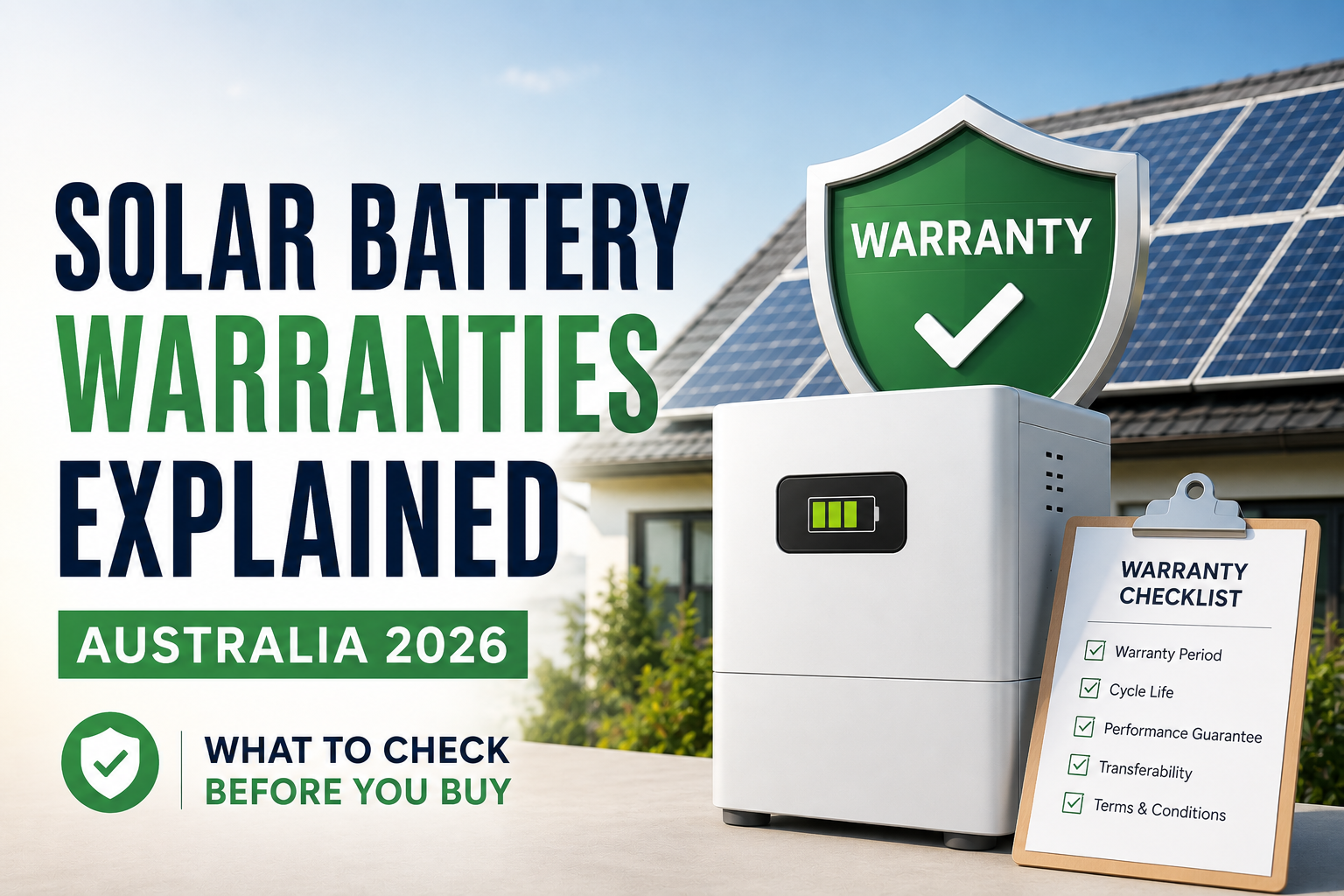
Considering a solar battery for your home in Australia?
A solar battery can be a major investment, and the warranty is one of the most important parts of the purchase.
Two batteries might both advertise a 10-year warranty, but that doesn’t necessarily mean they offer the same level of protection.
The real questions are:
How long is the warranty? What capacity is guaranteed? How many cycles are covered? What happens if the battery fails? Does the warranty cover labour? Who handles the claim? And what conditions could void your warranty?
This Australian-focused guide explains how solar battery warranties work, what to look for, and how to compare battery warranties before making a decision.
Looking for a Solar Battery Quote?
Don’t compare batteries on price and capacity alone.
👉 Get a Free Solar Battery Quote
What Is a Solar Battery Warranty?
A solar battery warranty is a manufacturer’s commitment covering specified faults, performance and/or capacity for a defined period.
Depending on the battery, the warranty may cover:
- Manufacturing defects
- Hardware failures
- Battery module failures
- Minimum capacity retention
- Specified charge/discharge cycles
- Certain performance conditions
However, warranty terms vary considerably between manufacturers and models.
That’s why simply seeing “10-year warranty” on a sales quote isn’t enough.
You need to understand exactly what the 10 years covers.
Why Solar Battery Warranty Matters
A battery may operate for thousands of charge and discharge cycles over its lifetime.
Over time, battery capacity naturally declines.
For example, a battery that starts with:
10 kWh usable capacity
may not provide the same usable energy after several years.
A good warranty provides a minimum performance commitment from the manufacturer.
This can give homeowners greater confidence that the battery will continue delivering useful storage capacity throughout the warranty period.
But remember:
Warranty length ≠ warranty quality.
A 10-year warranty with weak capacity protection may be less attractive than another 10-year warranty with stronger performance guarantees.
The 5 Most Important Parts of a Battery Warranty
When comparing solar batteries, focus on these five areas:
- Warranty duration
- Capacity retention
- Cycle or energy throughput
- Hardware coverage
- Warranty support and exclusions
These details tell you much more than the headline warranty period.
Solar Battery Warranty Length
The warranty period is the simplest part to understand.
Many residential batteries come with warranties around 10 years, although coverage varies by manufacturer and product.
Some products may offer different warranty periods for:
- Battery modules
- Inverters
- Energy management equipment
- EV chargers
- Other system components
Don’t assume everything has the same warranty.
For example:
Battery: 10 years
Inverter: Different warranty
EV charger: Separate warranty
Installation: Installer warranty
These can all be different.
Ask your installer:
“Can you provide the warranty period for every major component in writing?”
Battery Capacity Warranty — The Part Many Buyers Miss
One of the most important warranty conditions is capacity retention.
Battery capacity naturally declines with use.
A manufacturer may guarantee that the battery retains a specified percentage of its original capacity after a particular period, subject to the warranty conditions.
For example:
10 kWh battery → guaranteed minimum capacity after 10 years
The percentage can vary significantly between products.
Why this matters
Imagine two batteries:
Battery A
10-year warranty
60% minimum capacity
Battery B
10-year warranty
70% minimum capacity
Both say “10-year warranty”, but they don’t provide the same capacity guarantee.
This is why you should always compare the capacity guarantee, not just the number of warranty years.
What Does Battery Capacity Retention Mean?
Capacity retention describes how much energy storage capability the battery is expected to retain under the warranty conditions.
For example, if a manufacturer guarantees:
70% capacity after 10 years
a battery originally providing 10 kWh under the relevant warranty definition would have a guaranteed capacity threshold of approximately:
7 kWh
The exact calculation depends on the manufacturer’s warranty terms and whether the guarantee is based on nominal or usable capacity.
Ask:
“Is the capacity guarantee based on nominal capacity or usable capacity?”
This can make a meaningful difference when comparing products.
Battery Cycle Warranty Explained
A cycle generally refers to a full charge and discharge equivalent.
Some battery warranties include a cycle or energy-throughput limit.
For example, a warranty may specify:
5,000 cycles
or
6,000+ cycles
depending on the product.
However, you shouldn’t assume that a cycle warranty means the battery will necessarily reach that number under every operating condition.
Warranty conditions can also specify:
- Depth of discharge
- Operating temperature
- Charge rate
- Discharge rate
- Installation conditions
- Energy throughput
- Other operating limits
Ask your installer:
“Does the warranty have a cycle or energy-throughput limit, and which condition applies first?”
Time Warranty vs Cycle Warranty
This is an important distinction.
A battery warranty may effectively be limited by:
Time
or
Cycles / energy throughput
or potentially a combination of conditions.
For example:
10 years OR 5,000 cycles
means the applicable warranty condition may be reached through either time or usage, depending on the manufacturer’s terms.
If you expect to cycle your battery heavily every day, the cycle or throughput condition becomes particularly important.
Solar Battery Warranty Comparison
When comparing battery warranties, look beyond the headline number.
| Warranty Feature | What It Means | What to Check |
|---|---|---|
| Warranty Period | How long coverage lasts | 10 years? Longer? |
| Capacity Guarantee | Minimum capacity retained | % at end of warranty |
| Cycle Limit | Number of cycles covered | Cycle count |
| Energy Throughput | Total energy covered | kWh/MWh limit |
| Hardware Coverage | What components are protected | Battery modules/electronics |
| Installation Conditions | Requirements for valid warranty | Accredited installer |
| Operating Conditions | Temperature and usage limits | Manufacturer requirements |
| Labour Coverage | Who pays installation labour | Manufacturer/installer/customer |
| Replacement | What happens after a failure | Repair/replacement terms |
| Transferability | Whether warranty follows the property | Check conditions |
What Does a Solar Battery Warranty Usually Cover?
Warranty coverage varies, but battery warranties commonly address certain manufacturing and performance issues.
Manufacturing Defects
Problems caused by defects in materials or workmanship may be covered.
Hardware Failure
Depending on the warranty, failed battery modules or internal components may qualify for repair or replacement.
Capacity Loss
If the battery falls below the manufacturer’s guaranteed capacity threshold under the applicable conditions, the warranty may provide a remedy.
System Components
Some complete energy storage systems include separate warranties for:
- Battery
- Inverter
- Energy management equipment
- Communication equipment
- EV charging equipment
Always check each component separately.
What Doesn’t a Solar Battery Warranty Usually Cover?
Warranty exclusions can be just as important as what is covered.
Depending on the manufacturer, exclusions may include:
- Incorrect installation
- Improper system configuration
- Physical damage
- Misuse or abuse
- Unauthorised modifications
- Failure to follow operating instructions
- Extreme environmental conditions outside specifications
- Electrical damage caused by external events
- Damage caused by flooding or other site conditions
- Unapproved repairs
- Failure to maintain required operating conditions
The exact exclusions depend on the manufacturer’s warranty.
Ask:
“What are the main conditions or exclusions that could invalidate this warranty?”
Does Installation Affect Your Battery Warranty?
Yes, installation requirements can be important.
Manufacturers may specify requirements around:
- Installer qualifications
- Electrical compliance
- System configuration
- Approved equipment
- Installation location
- Commissioning
- Registration
For Australian installations, using appropriately qualified and accredited professionals is important for both compliance and warranty requirements.
Ask your installer:
“Is this installation being completed by an appropriately accredited installer, and does the installation meet the manufacturer’s warranty conditions?”
Don’t assume accreditation alone guarantees every warranty condition is satisfied.
Do You Need to Register Your Battery?
Some manufacturers require or recommend product registration after installation.
Registration can help establish:
- Installation date
- Product serial number
- Warranty start date
- Owner details
- Installer details
If registration is required under the manufacturer’s terms, failing to complete it could create unnecessary problems when making a claim.
After installation:
Keep a copy of:
- Purchase invoice
- Installation certificate
- Warranty document
- Product serial numbers
- Commissioning information
- Registration confirmation
- Installer details
Store everything in one place.
Does the Warranty Cover Labour?
This is one of the most important questions to ask.
A manufacturer may agree that a battery component has failed, but that doesn’t automatically mean every cost associated with replacing it is covered.
You need to understand whether the warranty covers:
Parts + Labour + Travel + Removal + Reinstallation
or only the replacement component.
Ask:
“If the battery fails in year seven, who pays for the technician, removal, replacement and recommissioning?”
This question can reveal a major difference between apparently similar warranties.
Who Handles the Warranty Claim?
A warranty is only useful if you can actually access the support.
Find out whether warranty claims are handled by:
- The manufacturer
- Your installer
- An Australian distributor
- A third-party service provider
The process should be clear before you purchase.
Ask:
“If something fails five years from now, who do I contact first?”
You should have a clear answer.
What Happens If Your Installer Closes Down?
This is an important consideration when buying a battery that could remain in your home for a decade or longer.
If your installer is no longer operating, you may need to deal directly with:
- The manufacturer
- Distributor
- Australian service network
- Another authorised installer
Before purchasing, check what support options exist if the original installer is no longer available.
Ask:
“Can I make a manufacturer’s warranty claim if my original installer is no longer trading?”
Does the Warranty Transfer If You Sell Your Home?
This can vary between manufacturers.
Some warranties may be transferable to a subsequent homeowner, while others may have specific requirements.
If you’re considering selling your property, warranty transferability can add value.
Ask:
“Is the battery warranty transferable to the next homeowner?”
Also check whether there is:
- A transfer fee
- Registration requirement
- Time limit
- Change-of-ownership process
Battery Warranty and Australian Conditions
Australia presents different operating environments, from cooler southern regions to very hot conditions in many parts of the country.
Battery manufacturers specify operating temperature ranges and installation requirements.
The location of your battery can therefore matter.
Your installer should consider:
- Direct sunlight
- Ambient temperature
- Rain exposure
- Ventilation
- Flood risk
- Clearance
- Wall structure
- Accessibility
A battery installed in a poorly selected location may experience conditions outside the manufacturer’s specified operating environment.
Ask:
“Is this installation location within the manufacturer’s approved operating conditions?”
Solar Battery Warranty and Backup Systems
If your battery is being installed for blackout protection, don’t only check the battery warranty.
You also need to understand the warranty and support arrangements for the equipment responsible for backup operation.
This may include:
- Hybrid inverter
- Backup gateway
- Automatic transfer equipment
- Switchboard equipment
- Monitoring equipment
A battery can have a strong warranty while another critical component has different coverage.
Ask:
“Is the entire backup system covered, or does each component have a separate warranty?”
Solar Battery Warranty and EV Charging
If you’re buying an integrated energy system with an EV charger, the EV equipment may have its own warranty.
Check:
- Charger warranty
- Installation warranty
- Communication equipment
- Smart charging functionality
- Replacement process
Don’t assume the battery warranty automatically covers the EV charger.
Warranty vs Expected Battery Life
A 10-year warranty does not necessarily mean the battery will stop working after 10 years.
The warranty is the period during which the manufacturer provides specified protection.
The actual service life can be longer or shorter depending on:
- Usage
- Cycling
- Temperature
- Depth of discharge
- System configuration
- Installation
- Maintenance
- Product design
Similarly, a battery may continue operating after its warranty expires, but the manufacturer may no longer provide the same performance guarantee.
How Battery Degradation Affects Savings
Battery degradation matters because usable capacity affects how much solar energy you can store and use later.
For example:
New battery
10 kWh usable capacity
↓
After years of operation
Lower usable capacity
↓
Less energy available for evening consumption
This doesn’t automatically mean the battery becomes uneconomic.
Your overall savings still depend on:
- Electricity prices
- Solar generation
- Battery cycling
- Household consumption
- Feed-in tariffs
- Battery efficiency
- Installation cost
That’s why warranty capacity guarantees should be considered alongside the financial return of the system.
How to Compare Two Solar Battery Warranties
Imagine you’re comparing:
Battery A
10-year warranty
65% capacity guarantee
Cycle limit applies
Battery B
10-year warranty
70% capacity guarantee
Higher cycle/throughput allowance
At first glance, both have:
10-year warranties.
But Battery B may provide stronger long-term protection depending on the complete terms and price.
This demonstrates why you should never compare batteries using warranty years alone.
Common Solar Battery Warranty Mistakes
Mistake 1: Looking Only at “10 Years”
A 10-year warranty doesn’t tell you the whole story.
Solution: Check capacity, cycles, throughput and exclusions.
Mistake 2: Ignoring Labour
A replacement battery component may be covered while labour costs are treated separately.
Solution: Ask exactly who pays labour and associated service costs.
Mistake 3: Assuming Every Component Has the Same Warranty
Battery, inverter and EV charger warranties may differ.
Solution: Request a complete warranty schedule.
Mistake 4: Not Checking Installation Requirements
Incorrect installation can create warranty problems.
Solution: Use an appropriately qualified and accredited installer and follow manufacturer requirements.
Mistake 5: Losing Your Documentation
Warranty claims can become harder if you cannot prove purchase, installation or registration details.
Solution: Keep all documentation digitally and physically.
Mistake 6: Choosing Based on Warranty Length Alone
A longer warranty isn’t automatically a better warranty.
Solution: Compare the actual protection provided.
10 Questions to Ask Before Buying a Solar Battery
Before signing your battery contract, ask your installer:
- How many years is the battery warranty?
- What minimum capacity is guaranteed at the end of the warranty?
- Is there a cycle or energy-throughput limit?
- Is the warranty based on nominal or usable capacity?
- What happens if the battery fails during the warranty period?
- Are labour, travel and replacement costs covered?
- Who handles the warranty claim in Australia?
- What installation conditions must be met?
- Can the warranty transfer if I sell my home?
- What happens if the installer is no longer trading?
Getting clear answers to these questions can make battery comparisons much easier.
Solar Battery Warranty Checklist
Before buying, make sure you can answer:
| Question | What You Want to Know |
|---|---|
| Warranty period | How many years? |
| Capacity guarantee | What % is guaranteed? |
| Cycle limit | How many cycles? |
| Throughput | Is there an energy limit? |
| Hardware | Which components are covered? |
| Labour | Is labour included? |
| Installation | What installer requirements apply? |
| Registration | Is registration required? |
| Support | Who handles claims? |
| Transferability | Can warranty transfer with the property? |
| Exclusions | What could void coverage? |
| Backup equipment | Is backup equipment separately warranted? |
Is a 10-Year Solar Battery Warranty Good?
A 10-year warranty can be a strong starting point, but it shouldn’t be the only factor you consider.
A good battery warranty should provide reasonable protection across:
Time + Capacity + Cycles/Throughput + Hardware + Support
You should also consider the manufacturer’s reputation, Australian support network, installer experience and the overall cost of the system.
The cheapest battery with a long headline warranty isn’t necessarily the best value.
Should Warranty Influence Which Battery You Buy?
Absolutely.
A solar battery is a long-term energy asset.
If two systems have similar:
- Capacity
- Efficiency
- Power
- Price
but one provides stronger warranty protection and better local support, that can be an important differentiator.
However, warranty should be considered alongside:
Battery performance → Usable capacity → Efficiency → Power → Safety → Price → Installation → Support → Warranty
The best battery is the one that provides the right combination for your home.
Get Help Comparing Solar Battery Warranties
Reading battery warranty documents can be confusing, especially when manufacturers use different definitions for:
- Usable capacity
- Nominal capacity
- Cycles
- Throughput
- Capacity retention
- Warranty conditions
At Solar Authority, we can help Australian homeowners compare battery options based on the complete system, rather than simply the advertised warranty period.
We can help you assess:
✔ Battery capacity and performance
✔ Warranty terms and capacity guarantees
✔ Installation requirements
✔ Backup requirements
✔ Solar compatibility
✔ Future EV requirements
✔ Rebates and incentives
✔ Installer experience
✔ Total installed cost
Get a Free Solar Battery Quote
Don’t choose a battery because the brochure says “10-year warranty.”
Compare what that warranty actually protects.
Battery → Usable Capacity → Power → Efficiency → Warranty → Installation → Support → Rebate → Final Price
Get a personalised solar battery quote and compare your options with confidence.