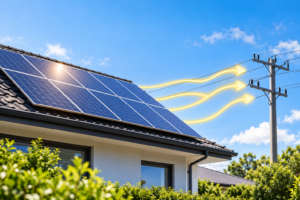

Most solar panels are tested at a standard temperature of around 25 °C — a benchmark known as Standard Test Conditions (STC). However, in real‑world conditions, especially in hot climates like much of Australia, solar panels often reach much higher surface temperatures when exposed to direct sunlight. When this happens, panel efficiency and power output decrease as temperatures rise.
Contrary to popular belief, more heat does not mean more electricity. While sunlight is essential for generating power, excessive heat causes the semiconductor materials inside panels to become less effective at converting sunlight into electrical energy.
Why Temperature Matters – Temperature Coefficient Explained
Each solar panel comes with a temperature coefficient, which measures how much its performance changes per degree Celsius above 25 °C. Most panels on the market have coefficients ranging roughly between –0.2 % and –0.5 % per °C. This means for every 1 °C increase above the testing temperature, the panel loses a small percentage of its rated output.
For example, if a panel has a temperature coefficient of –0.4 %/°C and its surface temperature reaches 60 °C on a hot day, the panel could lose roughly 14 % of its potential output compared to its rating at 25 °C.
Real‑World Impact of Heat in Australia
In Australia’s hot summer conditions — where ambient temperatures often exceed 35–40 °C — solar panel surfaces can heat up to 60 °C or more, resulting in noticeable output losses.
However:
· Solar panels still produce electricity in high heat — they just operate at slightly reduced efficiency.
· On cooler days, panels often run closer to their rated performance, sometimes even exceeding expectations if conditions are bright and ambient temperatures are mild.
So while heat reduces efficiency, it doesn’t stop solar panels from working altogether — it just affects how much power they can generate at peak times.
How Installation Affects Temperature Performance
How and where solar panels are installed can influence how hot they get and how much efficiency is lost:
Roof‑mounted systems with little airflow underneath can trap heat, raising panel temperature and reducing output. Rack‑mounted systems with adequate clearance allow airflow beneath the panels,
helping them run cooler and closer to optimal performance. Pole‑mounted solar panels usually benefit from maximum airflow around the array, offering the best natural cooling performance.
Tips to Minimise Heat‑Related Losses
Although you can’t avoid sunshine, there are ways to limit temperature‑related efficiency drops:
✔ Choose panels with a lower (less negative) temperature coefficient — these lose less performance in heat. ✔ Ensure adequate airflow beneath the panels to enhance passive cooling. ✔ Opt for higher‑quality panels — premium modules often handle heat better and degrade less over time. ✔ Regular maintenance such as cleaning reduces dust build‑up, which can cause panels to absorb more heat.
Conclusion – Balancing Heat and Performance
In sunny climates like Australia, hot temperatures are a reality — and they do impact solar panel performance. But with the right panel selection, installation design, and understanding of temperature coefficients, you can maximise your solar energy production even in heat. Panels remain effective and continue to generate clean energy — it’s just about optimising their performance to handle heat efficiently.