Home battery storage has become an increasingly important part of Australia’s residential energy market. With more households adding rooftop solar, electric vehicles and other electric appliances, storing daytime solar energy for evening and overnight use can be an attractive way to improve self-consumption and reduce reliance on grid electricity.
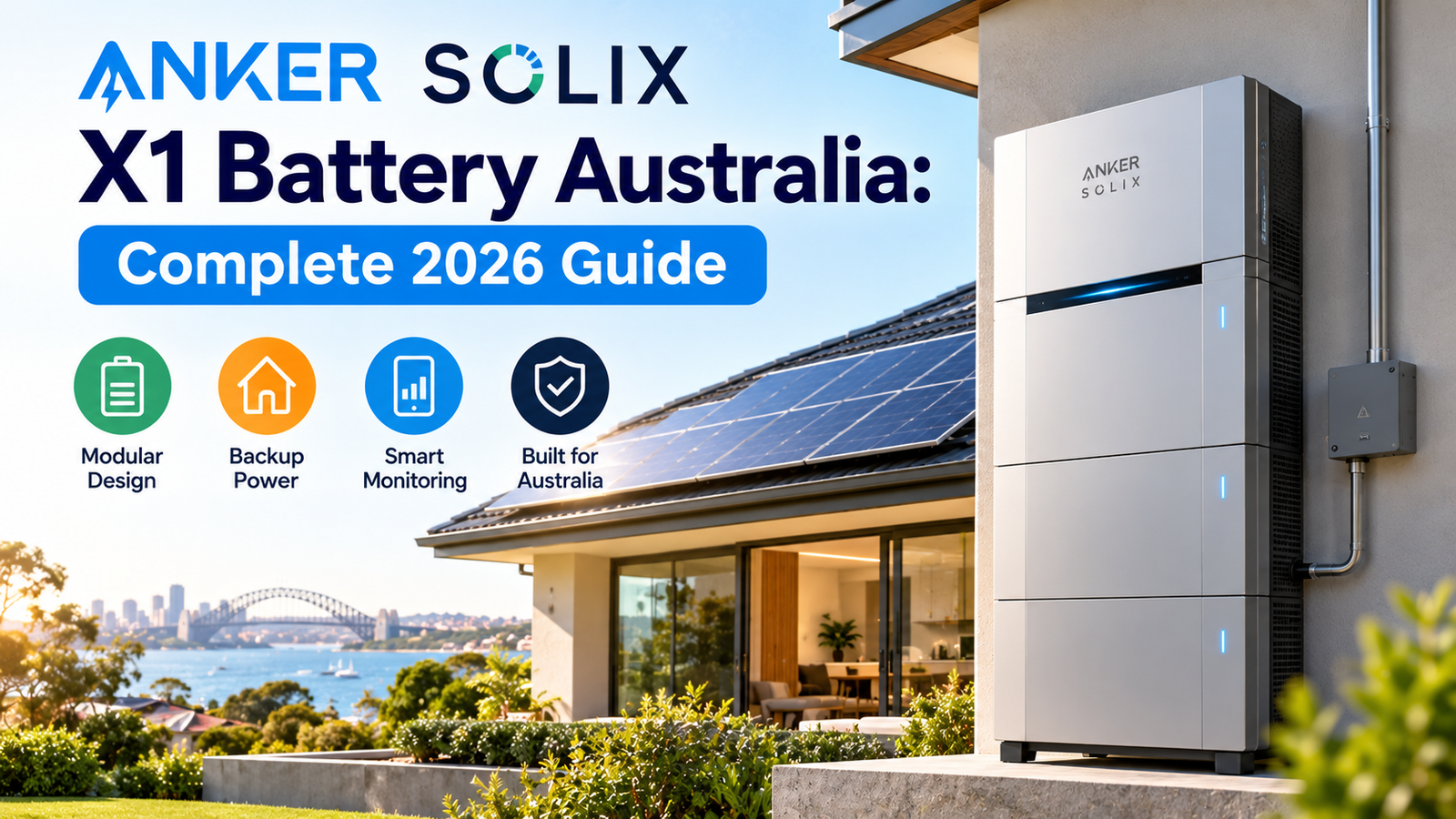
Among the battery systems available in Australia, Anker SOLIX has attracted attention with its modular SOLIX X1 Energy Storage System.
The X1 combines battery storage, power electronics, energy management and backup functionality in a modular platform. It is designed for both new solar installations and, in relevant configurations, retrofits to existing solar systems.
But is an Anker SOLIX battery suitable for your home?
The answer depends on your solar system, electricity consumption, backup requirements, available space, network requirements and the specific X1 configuration being offered.
This guide explains the Anker SOLIX X1 in Australia in 2026, including its battery technology, capacity, scalability, backup capability, monitoring, environmental protection, Australian compliance and the key factors to consider before installation.
What Is Anker SOLIX?
Anker SOLIX is Anker’s energy-storage product range, covering residential energy storage and related energy-management products.
For Australian homeowners considering a permanent home battery, the SOLIX X1 Energy Storage System is the key product to understand.
Unlike a conventional standalone battery that simply stores energy, the X1 is designed as a broader home energy system combining battery modules with power-conversion and energy-management functions.
Anker’s current X1 specifications describe a modular architecture with individual battery modules and power modules that can be configured for different household requirements. The platform supports single-phase and three-phase configurations, depending on the specific model and installation.
The Australian market also has specific compliance requirements. Anker announced in 2024 that its X1 AC-coupled system had achieved Clean Energy Council approval and AS/NZS 4777.2 certification for the Australian market.
However, homeowners should always verify the exact model being quoted against the current Clean Energy Council Approved Products List before installation because product listings and requirements can change.
How Does the Anker SOLIX X1 Work?
The basic concept is straightforward.
During the day, your solar panels generate electricity. Your home uses some of that electricity immediately. Excess energy can then be directed into the battery.
When solar generation falls, the stored energy can be discharged to help supply your home.
Depending on the system configuration and electricity plan, the battery can also be managed around different energy-use objectives.
Anker’s X1 platform includes energy modes such as:
- self-consumption
- time-of-use operation
- off-grid operation
- real-time energy monitoring.
The Anker app provides information about household energy generation, consumption and battery operation, allowing users to monitor the system and adjust supported settings.
The actual savings achieved will depend on your electricity usage, solar production, electricity tariff, battery size, system efficiency and operating settings. A battery should therefore be assessed using your household’s real energy data rather than a generic savings estimate.
Anker SOLIX X1 Battery Capacity and Modular Design
One of the defining features of the X1 is its modular architecture.
Anker’s current X1 information lists battery modules starting at 5 kWh, with configurations that can be scaled according to the required energy capacity and power output. For the single-phase configuration detailed by Anker, a system can scale to six 5 kWh battery modules, or up to 30 kWh, while multiple systems can be configured for larger applications.
Anker also describes larger three-phase and parallel configurations across the wider X1 platform.
This modular approach can be useful for households whose energy requirements may change.
For example, a homeowner could have relatively modest electricity consumption today but expect to add:
- an electric vehicle
- additional air conditioning
- a heat-pump hot-water system
- a larger home office load
- additional solar generation.
A modular battery architecture may provide more flexibility than selecting one fixed storage capacity from the beginning.
However, scalability doesn’t mean every home should install the maximum available capacity.
A battery that is substantially larger than your typical usable solar surplus and evening electricity demand may not be economically justified.
What Battery Chemistry Does Anker SOLIX Use?
The X1 uses lithium iron phosphate (LiFePO₄ or LFP) battery chemistry.
LFP batteries are widely used in modern stationary energy-storage systems because of their thermal and chemical stability compared with some other lithium-ion chemistries.
Anker specifically describes the X1’s battery chemistry as LiFePO₄ and incorporates battery-level protection and monitoring into its modular architecture.
For homeowners, chemistry is only one part of battery safety.
Installation location, enclosure design, electrical protection, thermal management, battery management systems, installation quality and compliance with Australian requirements all matter.
Australia’s battery product requirements are also evolving. The Clean Energy Council is transitioning its battery approval framework toward SA TS 5398, a newer technical specification for home batteries. Existing approved products have transition arrangements extending through 2027.
Backup Power During Blackouts
Backup capability can be one of the biggest reasons homeowners consider a battery.
The X1 is designed to support backup operation when configured with the appropriate equipment.
Anker states that the X1 can switch from grid-connected operation to backup operation in less than 10 milliseconds on specified configurations. The company’s published specifications also show different AC output ratings depending on the selected power module and system configuration.
However, homeowners should not assume that buying a battery automatically means the entire house will remain powered during a blackout.
Backup performance depends on:
- the selected X1 configuration
- backup output rating
- switchgear and installation design
- which circuits are backed up
- household load
- solar availability
- battery state of charge
- network and electrical requirements.
If blackout protection is important, ask the installer for a written explanation of exactly which circuits will remain powered and what loads can operate simultaneously.
High-load appliances such as air conditioners, induction cooktops, pumps and EV chargers can require substantial power, so backup capacity should be designed around the loads you actually want to operate.
Environmental Protection for Australian Conditions
Australia exposes outdoor energy equipment to a wide range of conditions, from high summer temperatures to humidity, coastal salt and heavy rainfall.
Anker’s current X1 specifications list an operating range around -20°C to 55°C and an IP66 assembly rating, along with C5 corrosion protection.
These specifications are relevant when considering battery placement, particularly for homes in hot, humid or coastal environments.
The X1’s enclosure and environmental ratings don’t mean installation location is irrelevant.
A qualified installer still needs to select a suitable location and follow the manufacturer’s installation requirements, local electrical rules and applicable Australian standards.
Smart Energy Management and Monitoring
A modern battery can do more than charge during the day and discharge at night.
The X1 supports different operating modes intended to manage how energy moves between solar, battery, home and grid.
For example, self-consumption mode is designed to prioritise using stored solar energy within the home.
Time-of-use operation can be used where appropriate electricity tariffs make it useful to shift battery charging and discharging around different price periods.
The Anker app provides real-time information and historical energy data, including views across different time periods.
This monitoring can help homeowners understand whether the battery is actually being used as intended.
However, software features and tariff optimisation do not guarantee a particular level of bill reduction. Your electricity retailer’s tariff and your household’s consumption pattern remain important.
Solar Compatibility: Existing System vs New Installation
Anker SOLIX can be considered for both new solar-and-battery projects and certain existing solar installations.
The AC-coupled X1 is particularly relevant when a homeowner already has solar and wants to add battery storage without necessarily replacing the existing solar inverter.
Anker has specifically documented the X1 AC-coupled system for the Australian market and announced its Clean Energy Council approval in 2024.
For a new solar installation, the system can instead be designed around the appropriate X1 power and solar-input configuration.
The correct choice depends on:
- your existing inverter
- solar panel capacity
- battery capacity
- phase configuration
- available roof space
- desired backup capability
- network requirements
- future solar expansion.
This is why battery compatibility should be checked before purchasing the battery rather than after the solar system has already been installed.
Is the Anker SOLIX X1 Scalable?
Scalability is one of the strongest practical features of the X1 architecture.
Anker’s published specifications describe individual battery modules with independent energy-management capabilities, allowing additional modules to be incorporated into supported configurations.
For a household, this could be useful if energy consumption grows over time.
For example:
Today:
8 kW solar + 10 kWh battery
Future:
8 kW solar + 15 or 20 kWh battery after adding an EV or increasing electricity consumption.
Whether additional battery modules can be added later depends on the specific X1 model, existing configuration, installation requirements and Anker’s applicable expansion rules.
Don’t assume every X1 installation can simply be expanded indefinitely.
Your installer should confirm the supported expansion pathway before installation if future scalability is important to you.
Warranty and Long-Term Ownership
Warranty terms are an important part of comparing home batteries.
Anker’s current X1 product information specifies a 10-year warranty for the X1 system.
The exact warranty terms, exclusions, performance conditions and coverage should still be checked against the Australian documentation supplied with the particular model.
Anker’s Australian warranty policy also states that warranty coverage depends on the product and purchase channel, and that its warranty applies to products purchased from Anker or authorised resellers, subject to the applicable terms.
For a large home energy investment, don’t compare warranty duration alone.
Also consider:
- who handles warranty claims
- whether the installer provides additional workmanship coverage
- battery performance conditions
- replacement procedures
- local technical support
- whether the exact model remains supported.
Is Anker SOLIX Eligible for Australian Battery Incentives?
Battery incentives in Australia are linked to specific product eligibility and installation requirements, rather than simply the battery brand.
The federal Cheaper Home Batteries Program operates through the Small-scale Renewable Energy Scheme and relies on eligible products and accredited installation arrangements.
The Clean Energy Council states that batteries need to be on its Approved Products List for participation in certain electricity-network and government programs, including SRES-related requirements.
Anker has announced Australian approval for the X1 AC-coupled system, but homeowners should verify the exact battery and inverter models being installed on the current approved list at the time of purchase.
This is especially important in 2026 because product listings and technical requirements can change.
Who Might Benefit From an Anker SOLIX Battery?
Anker SOLIX X1 may be worth considering for households that want:
- more solar self-consumption
- evening and overnight battery storage
- blackout backup
- a modular battery system
- monitoring through a dedicated app
- the ability to expand storage where supported
- integration with a new or existing solar system.
It can be particularly relevant for households with significant evening electricity consumption.
For example, a family that generates substantial solar energy during the day but uses air conditioning, cooking appliances, lighting and entertainment equipment at night may have a stronger reason to consider storage than a household that consumes most of its electricity while the sun is shining.
When an Anker SOLIX Battery May Not Be the Right Choice
A battery isn’t automatically suitable for every solar household.
You may need to reconsider or resize the system if:
- your electricity consumption is very low
- your existing solar system produces little surplus energy
- your roof has limited solar generation
- the battery would remain underused
- your network has constraints affecting the proposed system
- the installation cost doesn’t make sense for your expected usage
- you don’t need backup power and have limited evening consumption.
You should also compare the X1 against other batteries rather than choosing a brand based only on specifications.
Important comparison points include usable capacity, continuous output, warranty, chemistry, backup functionality, inverter architecture, monitoring, network approval, installer support and total installed price.
Anker SOLIX vs Other Home Battery Systems
There is no single battery that is ideal for every Australian household.
When comparing Anker SOLIX with other home battery solutions, consider the complete system rather than battery capacity alone.
| Factor | What to Compare |
|---|---|
| Usable capacity | How much stored energy is actually available for household use |
| Power output | How many appliances can operate simultaneously |
| Chemistry | LFP and other battery chemistries |
| Scalability | Whether additional capacity can be added later |
| Backup | Whole-home or selected-circuit backup and switching performance |
| Solar integration | AC-coupled, hybrid or other architecture |
| Monitoring | App functionality and energy visibility |
| Environmental protection | Temperature, water and corrosion ratings |
| Warranty | Duration, conditions and performance coverage |
| Australian approval | Current CEC/network eligibility |
| Installer support | Local installation and after-sales service |
| Total cost | Equipment, installation, switchgear and other required components |
This comparison is more useful than simply asking which battery has the largest capacity or longest advertised warranty.
What to Check Before Installing Anker SOLIX in Australia
Before signing a contract, ask your installer to confirm:
1. Exact model numbers
Make sure the quote identifies the precise X1 battery and power-module configuration.
2. CEC approval
Check the current Clean Energy Council Approved Products List rather than relying only on an older product announcement.
3. Battery capacity
Confirm the usable capacity and how it is treated for any applicable incentive.
4. Backup configuration
Ask exactly which circuits will operate during an outage and what maximum loads can be supported.
5. Existing solar compatibility
If you already have solar, confirm how the X1 will connect to your existing inverter.
6. Network requirements
Your electricity distributor may have specific connection and export requirements.
7. Future expansion
If you expect your electricity consumption to increase, ask how additional X1 modules can be added later.
8. Warranty
Obtain the Australian warranty documentation for the exact product configuration.
The Clean Energy Council’s approved-product lists are dynamic, and products can be added, suspended or removed. In September 2026, the CEC reported more than 3,500 approved battery products, highlighting how quickly the Australian battery market is changing.
Frequently Asked Questions
Is Anker SOLIX X1 a good battery for Australian homes?
The X1 has features that can suit many Australian households, including modular capacity, LFP chemistry, backup capability, monitoring and Australian compliance for relevant configurations. Whether it is appropriate for a particular home depends on system design, electricity consumption, budget and installation requirements.
What size Anker SOLIX battery do I need?
There is no universal battery size. Your installer should consider your daily electricity consumption, solar exports, evening usage, backup requirements and future loads. The X1’s modular design allows supported configurations to be built around different capacity requirements.
Is Anker SOLIX X1 suitable for existing solar systems?
Yes, the X1 includes an AC-coupled configuration designed for integration with existing solar systems. Compatibility with your particular inverter and electrical setup should be confirmed before installation.
Does Anker SOLIX use lithium iron phosphate batteries?
Yes. The X1 uses LiFePO₄ battery chemistry, commonly known as LFP.
Can Anker SOLIX provide backup power during a blackout?
The X1 supports backup operation when installed in an appropriate configuration. Anker states that supported configurations can switch to backup in less than 10 milliseconds. The actual backup capability depends on the installed system, supported circuits, output rating and installation design.
Does Anker SOLIX have a 10-year warranty?
Anker’s current X1 specifications state a 10-year warranty. Always review the Australian warranty documentation for the exact model and installation because coverage conditions can apply.
Can I expand an Anker SOLIX X1 battery later?
The X1 is designed around modular battery expansion, and Anker lists supported configurations of up to six battery modules in the detailed single-phase system specifications. Expansion should be planned with the installer because limits depend on the specific configuration.
Is Anker SOLIX eligible for the Australian battery rebate?
Eligibility depends on the exact product listing, installation date and applicable government rules. Anker has announced Australian CEC approval for the X1 AC-coupled system, but homeowners should verify the exact models on the current Approved Products List before installation.
Anker SOLIX X1: Is It Worth Considering in 2026?
The Anker SOLIX X1 is a modular home energy storage platform rather than simply a standalone battery.
Its combination of LFP chemistry, modular capacity, backup capability, app-based monitoring, environmental protection and multiple system configurations makes it relevant to Australian households considering solar-plus-storage in 2026.
Its suitability still depends on the individual property.
A home with high evening electricity consumption, significant solar generation and a need for backup power may have a different storage requirement from a household with low electricity use and limited daytime solar surplus.
The best approach is therefore to compare the X1 against alternative battery systems using the same criteria: usable capacity, power output, solar compatibility, backup performance, warranty, Australian approval, installation requirements and total installed cost.
Solar Authority can help homeowners assess these factors when designing a solar-and-battery system, including whether an Anker SOLIX configuration fits the property’s existing solar setup, energy consumption and future requirements.
Before installation, verify the exact Anker SOLIX model, current Australian product approval, warranty documentation and applicable battery incentive requirements. The Australian market and approved-product lists continue to evolve, so current model-level verification is more reliable than relying on older product specifications or generic battery comparisons.