For many Australians, solar power means installing rooftop panels and remaining connected to the electricity grid. But for homes in remote areas, properties with difficult grid access, or households that place a high value on energy independence, a different option exists: off-grid solar energy.
An off-grid solar system, also called a stand-alone power system (SAPS), is designed to supply a property without relying on a normal electricity-grid connection.
Unlike a typical grid-connected solar system, an off-grid system cannot rely on the grid when solar production is low or a battery is empty. It therefore needs enough generation, battery storage and energy-management capability to keep essential loads operating through nights, cloudy weather and seasonal changes in solar production.
That makes off-grid solar a fundamentally different design exercise from simply installing a larger rooftop solar system.
This 2026 guide explains how off-grid solar works in Australia, what equipment is required, how systems are sized, what they can cost, how current federal incentives may apply, and when going off-grid makes practical sense.
What Is an Off-Grid Solar System?
An off-grid solar system generates and stores electricity locally rather than depending on an electricity retailer and distribution network.
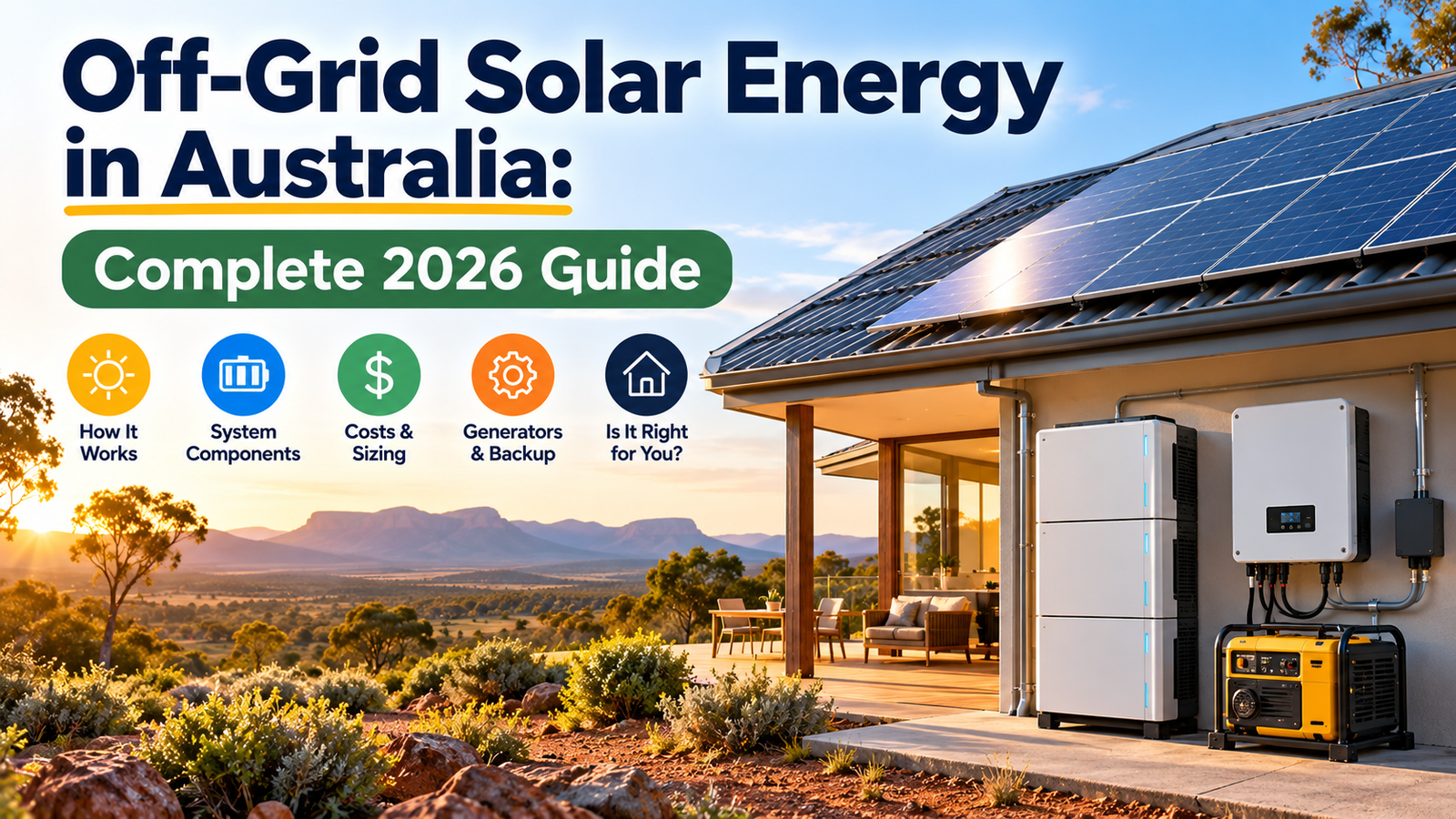
A typical system includes:
- Solar panels to generate electricity during daylight
- Battery storage to store excess energy
- An off-grid or hybrid inverter to manage electrical supply
- An energy-management system to balance generation, storage and household loads
- Backup generation, commonly a diesel or petrol generator, where appropriate
- Electrical protection, switchgear, cabling and monitoring equipment.
During sunny periods, solar panels supply household loads and charge the battery.
After sunset, the battery supplies electricity.
During periods of poor solar generation, the system may reduce or manage non-essential loads and, where installed, start a backup generator.
The key difference is that an off-grid property must be able to operate without the grid being available as a fallback.
The Australian Government describes off-grid systems as completely self-sufficient and notes that they generally require a larger battery and control system, with a backup generator often used during prolonged cloudy periods.
How Off-Grid Solar Works
The basic energy flow looks like this:
Solar panels → inverter/energy management → household loads
At the same time:
Solar panels → battery → evening and overnight loads
When solar production is insufficient:
Battery → household loads
And when battery reserves become too low:
Backup generator → system loads and/or battery
The exact arrangement depends on the inverter and battery architecture.
An energy-management system continually monitors factors such as solar generation, battery state of charge, household demand and generator availability.
This becomes particularly important during winter.
A grid-connected homeowner can simply import electricity when solar generation is low. An off-grid homeowner cannot. The system therefore needs enough generation and storage — or another source of electricity — to cover periods when the sun doesn’t provide enough energy.
The Main Components of an Off-Grid Solar System
Solar panels
Solar panels are the primary electricity-generation source.
The required panel capacity depends on:
- daily electricity consumption
- location
- roof or ground-mount orientation
- shading
- seasonal solar availability
- battery losses
- inverter efficiency
- desired charging rate
- expected future electricity demand.
More panels are not necessarily the complete solution.
An off-grid system must be designed around the amount of energy available during the lowest-production periods, not just the average output on a sunny summer day.
Battery storage
The battery is one of the most important components because it bridges the gap between solar generation and household demand.
A battery needs enough usable capacity to provide electricity after sunset and during periods of low solar production.
Modern off-grid systems commonly use lithium-ion batteries, particularly lithium iron phosphate (LiFePO₄/LFP) technology, although the appropriate chemistry depends on the equipment and system design.
Battery capacity is measured in kWh, but capacity alone doesn’t tell the whole story.
You also need to consider:
- usable capacity
- maximum continuous output
- peak output
- depth of discharge
- round-trip efficiency
- operating temperature
- warranty
- expected cycling
- battery-management system
- expandability.
A 20 kWh battery does not necessarily mean that 20 kWh will always be available to the home’s appliances.
Off-grid or hybrid inverter
The inverter converts DC electricity from the solar array and battery into AC electricity that household appliances can use.
For a true stand-alone system, the inverter also needs to establish and manage the local AC electricity supply because there is no external grid waveform to follow.
This is an important distinction from many conventional grid-connected solar inverters.
The inverter must also be capable of handling the household’s electrical loads.
That includes not only normal running power but potentially large starting loads from equipment such as:
- pumps
- refrigerators
- air conditioners
- compressors
- workshop equipment
- bore pumps.
Backup generator
A generator is not required in every off-grid system, but it can provide valuable redundancy.
Extended periods of poor weather can reduce solar generation enough to drain the battery.
A correctly integrated generator can then provide additional electricity and, depending on the system architecture, recharge the battery.
For remote properties where electricity is essential, generator backup can provide another layer of resilience.
The goal isn’t necessarily to run the generator every day. Ideally, it acts as a backup resource for periods when solar and stored energy are insufficient.
How Do You Size an Off-Grid Solar System?
Sizing is one of the most important parts of an off-grid installation.
A grid-connected system can tolerate some mismatch between generation and consumption because the grid supplies the shortfall.
An off-grid system cannot.
The design should therefore begin with a detailed energy profile.
Start by calculating:
Daily energy consumption (kWh/day)
Then separate that demand into:
- daytime loads
- evening loads
- overnight loads
- occasional high-demand appliances
- seasonal loads.
For example, a property might use 15 kWh on a typical day but 25 kWh on a hot summer day because of air conditioning.
Designing only around the 15 kWh average could leave the system under-sized during high-demand periods.
Battery Autonomy: How Many Days Should an Off-Grid Battery Last?
Battery autonomy describes how long a system can continue supplying loads without sufficient solar generation.
For example:
- 1 day of autonomy: battery is designed around approximately one day of stored energy.
- 2 days: greater reserve for poor weather.
- 3+ days: more resilience, but generally requires substantially more storage and/or generation.
There is no universal number of autonomy days suitable for every Australian property.
The right target depends on:
- local climate
- winter solar availability
- household demand
- generator availability
- critical-load requirements
- budget
- acceptable level of energy conservation.
A remote property with no generator and frequent winter cloud may require a very different design from a property with reliable winter solar and automatic generator backup.
Why Seasonal Solar Production Matters
One of the biggest mistakes in off-grid system design is sizing around annual average solar generation.
A system might produce plenty of energy during summer but struggle during winter.
Solar generation changes according to:
- season
- latitude
- weather
- panel orientation
- shading
- temperature
- system losses.
For an off-grid home, winter performance can be particularly important because several consecutive low-generation days can place significant pressure on battery reserves.
A professional design should therefore examine expected production across the year rather than relying on one average daily generation figure.
What Happens During Several Cloudy Days?
Cloudy weather is one of the biggest differences between grid-connected and off-grid solar.
A grid-connected household can simply import electricity when its solar panels aren’t producing enough.
An off-grid household has to manage the energy deficit.
Possible strategies include:
- Oversizing the solar array.
- Increasing battery capacity.
- Reducing discretionary electricity use.
- Installing a backup generator.
- Combining several of these approaches.
A smart energy-management system can also prioritise essential loads when battery reserves become low.
For example, refrigeration, lighting, communications equipment and water pumps may be prioritised while discretionary loads are temporarily reduced.
The objective isn’t necessarily to guarantee unlimited electricity under every weather condition. It is to design a system that manages foreseeable conditions reliably and safely.
Appliance Loads Matter More Than Many Homeowners Expect
Energy consumption is only one side of off-grid design.
Power demand also matters.
An appliance may consume relatively little energy over a full day but require substantial instantaneous power.
For example, a pump or air conditioner can create a large short-term load.
This means an off-grid designer needs to consider both:
Energy capacity — kWh
and
Power capacity — kW
A battery may have enough stored energy but still be unable to operate several high-power appliances simultaneously if the inverter’s output rating is insufficient.
This is why appliance schedules and starting loads should be included in the design.
Off-Grid vs Grid-Connected vs Hybrid Solar
Not every property that wants energy independence needs to disconnect completely from the grid.
There are three broad approaches.
| Feature | Grid-Connected Solar | Hybrid Solar + Battery | Fully Off-Grid Solar |
|---|---|---|---|
| Grid connection | Yes | Yes | No |
| Solar panels | Yes | Yes | Yes |
| Battery | Optional | Usually included | Essential |
| Grid backup | Available | Available | Not available |
| Generator | Usually unnecessary | Optional | Often considered |
| Feed-in tariff | Potentially available | Potentially available | Not applicable |
| Upfront complexity | Lower | Moderate | Highest |
| Energy independence | Limited | High | Highest |
| Cloudy-weather planning | Less critical | Important | Critical |
| Suitable for remote properties | Sometimes | Sometimes | Often |
| Maintenance requirements | Lower | Moderate | Higher |
For most properties that already have a reliable and reasonably priced grid connection, the Australian Government notes that remaining grid-connected is generally the more cost-effective arrangement. Off-grid systems become more compelling where grid access is unavailable, unreliable or particularly expensive.
A hybrid system can therefore be an attractive middle ground for homeowners who want battery backup and greater solar self-consumption without giving up grid access.
What Does Off-Grid Solar Cost in Australia in 2026?
There is no reliable single national price for an off-grid solar system.
The final cost depends on the property’s electricity demand, location, access, system size, battery capacity, generator requirements and installation complexity.
A remote property may also require additional work that would not appear in a standard rooftop-solar quote, such as:
- long cable runs
- ground-mounted solar
- equipment shelters
- difficult site access
- trenching
- additional electrical protection
- generator integration
- communications equipment
- larger battery banks.
As a broad planning guide, a small residential off-grid system may cost tens of thousands of dollars, while larger properties with substantial battery storage, high-power inverters and generator backup can move considerably beyond that.
The old price bands often quoted online — such as a fixed “$15,000–$30,000” for a small system or “$50,000–$80,000” for a large system — should not be treated as current national pricing.
A better approach is to obtain a site-specific design and compare the complete installed system rather than comparing panel or battery prices separately.
Are Government Rebates Available for Off-Grid Solar in 2026?
This is an important area where older information can be misleading.
The Australian Government’s Small-scale Renewable Energy Scheme (SRES) can support eligible solar PV and battery installations, including qualifying off-grid systems.
For solar PV, systems generally need to meet the relevant capacity and eligibility requirements. The Clean Energy Regulator currently lists solar PV systems up to 100 kW as small-scale systems under the SRES, subject to the applicable requirements.
Off-grid battery incentives
Since 1 July 2025, eligible batteries have also been supported under the SRES through the Cheaper Home Batteries Program.
The Clean Energy Regulator states that eligible batteries must generally have 5–100 kWh nominal capacity, be installed with a new or existing solar PV system, use approved products, meet relevant Australian standards and be installed by an appropriately accredited SAA installer.
Importantly, off-grid batteries have specific rules.
For an off-grid installation, the battery must be installed at a dwelling that is actually lived in, such as a remote farmhouse. Structures such as sheds or bore pumps do not qualify simply because they use electricity.
There are also requirements relating to the property’s distance from the electricity grid.
For off-grid properties more than 1 km from the grid, VPP capability is not required under the relevant battery rules.
For properties within 1 km of the grid, the battery generally needs to be VPP-capable or the homeowner must have evidence that connecting to the main grid would cost more than $30,000, excluding certain additional connection-extension costs.
The incentive should therefore be checked against the exact property and battery configuration before installation.
Do not assume that every off-grid battery automatically qualifies for the federal battery incentive.
What About STCs for Off-Grid Solar?
Eligible solar PV systems can generate Small-scale Technology Certificates (STCs), subject to the SRES rules.
The exact number depends on factors including system size, location and installation date.
For batteries, STCs are calculated using usable battery capacity, with the current rules allowing STCs on the first 50 kWh of usable capacity even though the battery’s nominal capacity can be up to 100 kWh.
Only eligible new systems and components can receive certificates, and previous STC claims affect whether expansions or replacement components can qualify.
This is one reason it is important to have the installer provide a written breakdown of:
- solar STCs
- battery STCs
- system price before incentives
- incentive value included in the quote
- final installed price.
The federal battery support is delivered through the SRES and is commonly reflected as an upfront discount by the installer or retailer.
Installation and Accreditation Requirements
Off-grid solar is more technically demanding than a standard grid-connected solar installation.
The Clean Energy Regulator states that qualifying off-grid solar PV and battery systems must be designed and installed by a Solar Accreditation Australia (SAA)-accredited designer and installer with the appropriate accreditation type.
The system must also comply with applicable Australian and New Zealand standards, electrical safety requirements and local, state or territory rules.
For battery systems participating in the federal SRES, product eligibility also matters. The battery and relevant equipment need to meet the applicable approved-product requirements.
This is particularly important for remote properties because a poorly designed system can be difficult and expensive to rectify after installation.
When choosing an installer, ask specifically about their stand-alone/off-grid accreditation and experience, rather than assuming that experience with ordinary grid-connected solar is sufficient.
The Australian accreditation framework moved to Solar Accreditation Australia as the scheme operator in 2024, so older articles referring to new installer accreditation applications being handled directly by the Clean Energy Council are outdated.
Maintenance of an Off-Grid Solar System
Off-grid systems require ongoing attention.
Maintenance can include:
- checking solar-panel condition
- inspecting battery and inverter equipment
- reviewing system alerts
- checking generator operation
- maintaining fuel supplies where applicable
- monitoring battery state of health
- inspecting electrical equipment
- keeping vegetation away from panels
- reviewing energy consumption as household needs change.
Monitoring is especially important.
If solar production unexpectedly falls or battery performance changes, identifying the problem early can reduce the risk of running out of stored energy.
Generator maintenance should also not be overlooked. A backup generator that hasn’t been tested or serviced may not be dependable when it is actually required.
How to Make an Off-Grid System More Efficient
The cheapest electricity is often the electricity you don’t need to generate or store.
Before increasing solar or battery capacity, consider reducing unnecessary consumption.
Practical strategies include:
- choosing efficient refrigeration
- using LED lighting
- improving insulation
- selecting efficient air conditioning
- shifting flexible loads into sunny periods
- using timers for pumps
- managing hot-water heating around solar availability
- avoiding unnecessary overnight loads
- monitoring high-consumption appliances.
If an EV is part of your future plans, include it in the initial system design.
An EV can become a significant electricity load, although some vehicles and charging systems also offer bidirectional capabilities that may eventually provide additional energy-management options.
Is Off-Grid Solar Worth It for Your Property?
Off-grid solar can make excellent practical sense for some Australian properties, particularly where grid connection is unavailable, unreliable or prohibitively expensive.
It can also appeal to homeowners who place a high value on energy independence.
However, going off-grid is not simply a way to eliminate an electricity bill.
You are effectively replacing the grid with your own private electricity infrastructure.
That means you take responsibility for:
- generation
- storage
- backup
- equipment maintenance
- system upgrades
- fuel, if a generator is used
- managing electricity consumption.
For a suburban property with a reliable grid connection, a grid-connected solar-and-battery system may provide many of the desired benefits with considerably less system complexity.
For a remote property, the economics can look very different.
Off-Grid Solar: A Practical Example
Consider a remote rural home using approximately 20 kWh per day.
The homeowner wants:
- solar power during daylight
- enough battery storage for overnight use
- several days of resilience during poor weather
- backup for refrigeration and water pumping
- generator support for extended low-solar periods.
A suitable design would not simply install 20 kWh of solar and a 20 kWh battery.
The designer would need to assess:
- Actual daily and seasonal electricity consumption.
- Winter solar production at the property.
- Battery usable capacity and maximum discharge power.
- Critical and non-critical loads.
- Expected periods of low solar generation.
- Generator capacity and fuel requirements.
- Inverter surge and continuous power capability.
- Future loads such as an EV or additional appliances.
The final system might therefore contain considerably more solar generation and battery capacity than the household’s average daily electricity consumption suggests.
This is normal for a stand-alone system because reliability during difficult conditions is part of the design objective.
Frequently Asked Questions
What is an off-grid solar system?
An off-grid solar system is a stand-alone electricity system that operates without relying on the electricity grid. It normally combines solar panels, battery storage and an off-grid inverter, with a generator often included as backup.
How many solar panels do I need for an off-grid home?
There is no universal panel count. The required capacity depends on daily electricity use, location, winter solar availability, shading, battery losses, inverter requirements and desired resilience.
How much battery storage does an off-grid home need?
Battery size depends on daily energy consumption and the amount of autonomy required during low-solar periods. A property with high overnight consumption or frequent cloudy weather may need considerably more storage than a similar home in a high-solar location.
Do off-grid homes need a generator?
Not always, but a generator can provide useful redundancy during prolonged periods of low solar production. Whether one is necessary depends on system sizing, local climate, battery capacity, critical loads and the homeowner’s tolerance for energy conservation during poor weather.
Can I get the federal battery rebate for an off-grid system?
Eligible off-grid batteries can qualify for STCs under the current SRES rules, subject to specific requirements. The battery must be installed at an eligible lived-in dwelling, meet capacity and product requirements and satisfy the applicable off-grid and installation conditions. Properties within 1 km of the grid also have additional VPP or grid-connection-cost requirements.
Can an off-grid solar system receive STCs?
Potentially, yes. Eligible off-grid solar PV and battery systems can receive STCs when the relevant SRES requirements are met. The installation must be designed and installed by appropriately accredited professionals and use eligible components.
Is off-grid solar cheaper than staying connected to the grid?
Not necessarily. Off-grid systems generally require more equipment and more careful design because the property cannot rely on the grid during periods of low solar production. The Australian Government notes that remaining grid-connected is generally the more cost-effective option for most properties where a reliable grid connection is available.
Can I run air conditioning from an off-grid solar system?
Yes, provided the solar, battery and inverter system has been designed for the air conditioner’s energy and power requirements. Large air-conditioning loads can significantly increase system size, particularly if cooling is required during periods when solar production is low.
Can an off-grid system power a water pump?
Yes, but pump starting current and operating power must be included in inverter sizing. Bore pumps and other motors can create substantial short-term loads.
Final Thoughts on Off-Grid Solar in Australia
Off-grid solar energy can provide genuine energy independence, but it requires more planning than a conventional rooftop solar installation.
The system needs to be designed around the entire energy picture:
solar generation + battery storage + inverter capacity + household demand + seasonal conditions + backup strategy.
For a remote Australian property without practical grid access, a well-designed stand-alone system can be a reliable way to generate and store electricity.
For a property with a reliable grid connection, however, staying connected while adding solar and battery storage may provide a simpler solution.
The right choice should therefore be based on the property’s location, connection costs, electricity consumption, climate, future energy requirements and budget — not simply the desire to have more solar panels or a larger battery.
Before committing to an off-grid installation, request a detailed system design that shows expected solar generation, battery capacity, inverter output, critical loads, seasonal performance and backup arrangements.
Solar Authority can help assess the solar and storage requirements for a property and connect homeowners with appropriately accredited professionals for system design and installation. For any project relying on federal incentives, confirm the current Clean Energy Regulator requirements, approved products and SAA accreditation before signing the final contract. Government incentive rules and eligible product lists can change over time.