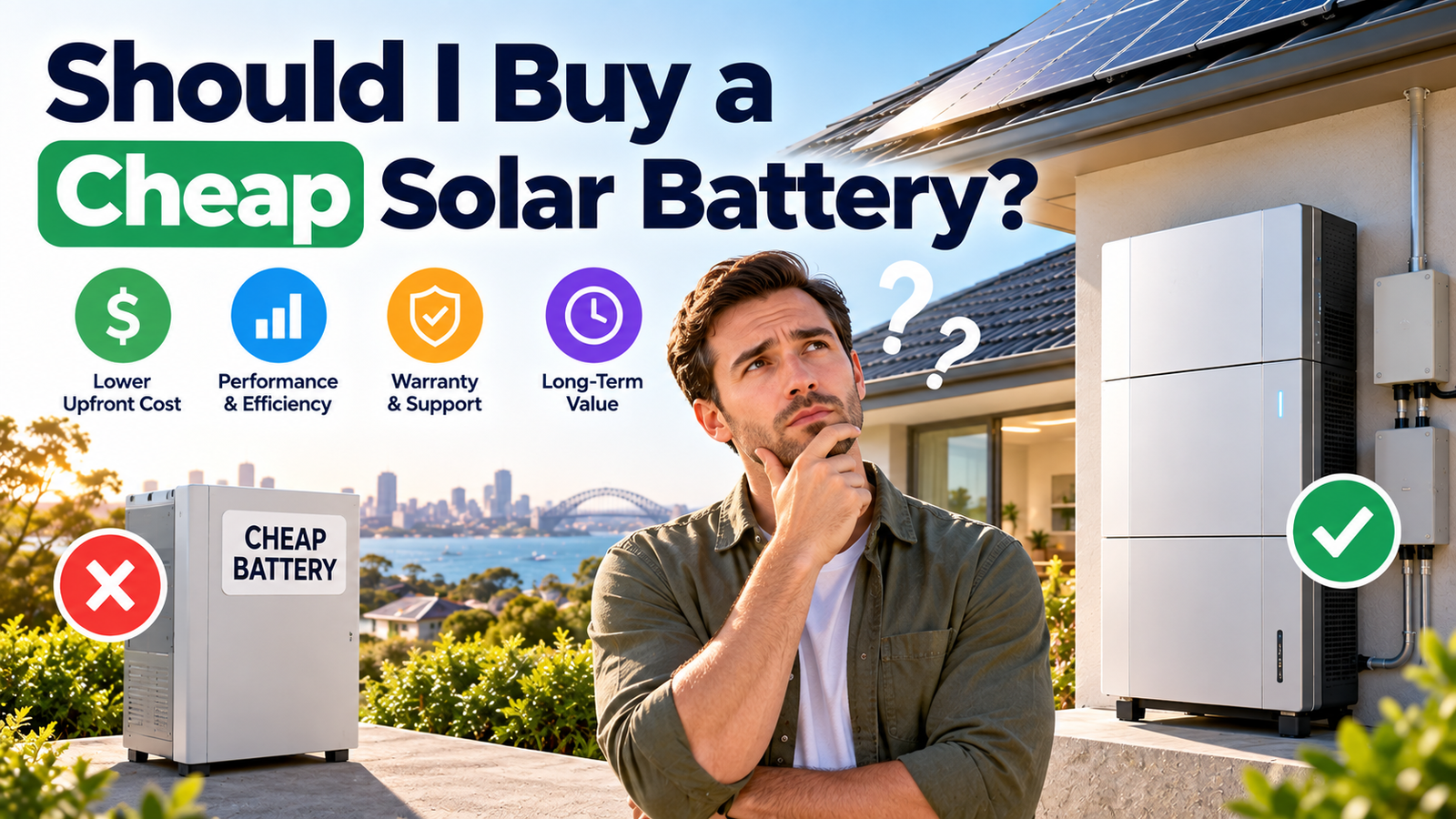
A cheap solar battery can look attractive when you are comparing quotes. With battery prices becoming more competitive and the Australian Government’s Cheaper Home Batteries Program reducing the upfront cost of eligible systems, it can be tempting to choose the lowest-priced option available.
But the cheapest battery is not necessarily the best-value battery.
The important question is not simply “How much does the battery cost?” It is:
“What am I getting for the price, and how is that battery likely to perform over its useful life?”
A lower-cost battery can be a sensible choice if it has appropriate capacity, good efficiency, suitable safety credentials, a strong warranty, compatible hardware and reliable local support. On the other hand, a battery that is cheap because of weak support, restrictive warranty conditions or poor integration can become expensive if it needs early repair or replacement.
This 2026 guide explains what Australian homeowners should check before accepting a cheap solar battery quote.
What Does “Cheap Solar Battery” Actually Mean?
There is no official definition of a “cheap” solar battery.
In most cases, the term simply describes a battery with a lower upfront purchase and installation price than other options being considered.
That lower price may come from several factors:
- Smaller usable capacity
- Lower-cost battery components
- Different battery chemistry
- Fewer included features
- Shorter or more restrictive warranty terms
- Less established manufacturer support
- Lower installation costs
- A simpler inverter or monitoring arrangement
None of these automatically makes a battery bad.
For example, a smaller battery can be excellent value for a household that only needs to shift a modest amount of solar energy into the evening. Paying for a much larger battery that regularly sits underused may not make financial sense.
The key is to distinguish between low price and low value.
Cheap vs Good-Value Solar Battery: What’s the Difference?
A good-value battery should be assessed across its entire system and expected operating life rather than by its advertised price alone.
| Factor | What to Check | Why It Matters |
|---|---|---|
| Usable capacity | kWh actually available for use | Determines how much energy can be shifted from daytime to later |
| Battery power | Maximum continuous/peak output in kW | Determines which appliances can run at the same time |
| Chemistry | Usually lithium-ion for modern home systems | Affects performance, safety characteristics and expected life |
| Efficiency | Round-trip or system efficiency | Determines how much stored energy is available later |
| Warranty | Years, cycles, throughput and end-of-warranty capacity | Shows what the manufacturer actually guarantees |
| Degradation | Guaranteed capacity retention | Helps assess longer-term performance |
| Compatibility | Solar inverter, hybrid inverter and switchboard | Prevents unexpected upgrade costs |
| Monitoring | App, alerts and performance data | Helps identify faults and track operation |
| Installation | Qualified, accredited installer | Important for safety, compliance and program eligibility |
| Support | Australian manufacturer/distributor support | Important if something goes wrong |
| Replacement | Battery, inverter and other hardware costs | Helps estimate longer-term ownership costs |
A battery that costs less but has weak warranty support or requires additional hardware may not remain the cheapest option once the complete installation is considered.
1. Look at Usable Capacity, Not Just Battery Size
Battery capacity is normally advertised in kilowatt-hours (kWh).
However, nominal capacity and usable capacity are not always the same.
Usable capacity tells you how much stored energy is actually available for normal operation. The Australian Government’s battery guidance notes that usable capacity is lower than total capacity because batteries cannot normally be completely discharged.
For example, two batteries could both be marketed around the same nominal size but provide different usable energy.
When comparing a cheap battery quote, ask:
- What is the nominal capacity?
- What is the usable capacity?
- Is the advertised capacity available from day one?
- Is usable capacity expected to decline over time?
- What capacity does the manufacturer guarantee at the end of the warranty?
A smaller battery with a strong usable-capacity specification can be more appropriate than a larger battery that is poorly matched to your household.
2. Check the Battery Chemistry
Most modern household batteries in Australia use lithium-ion technology. The Australian Government notes that lithium-ion batteries have largely replaced older lead-acid systems in the residential market because of their performance, lifetime and relatively low maintenance requirements.
Within lithium-ion technology, different chemistries and product designs can have different characteristics.
Rather than choosing a battery solely because a salesperson says it is “premium” or “cheap,” ask for the manufacturer’s technical documentation covering:
- Battery chemistry
- Operating temperature range
- Safety features
- Recommended installation conditions
- Maximum charge and discharge rates
- Warranty conditions
- Expected operating life
The chemistry is only one part of battery quality. Cell quality, battery management, thermal management, enclosure design and installation also matter.
3. Efficiency Matters
A battery does not return every unit of energy that goes into it.
Energy is lost during charging, storage and conversion. The Australian Government’s battery guidance notes that lithium-ion systems typically experience efficiency losses of around 10% of stored energy, although actual performance varies by system and operating conditions.
When comparing quotes, ask whether the quoted efficiency figure is:
- Cell efficiency
- Battery round-trip efficiency
- Inverter efficiency
- Or complete system efficiency
A higher-efficiency system can make better use of the solar energy you generate, but efficiency should still be considered alongside capacity, power output, warranty and price.
4. Don’t Ignore Cycle Life and Degradation
All rechargeable batteries degrade.
The question is how that degradation is measured and what the manufacturer actually guarantees.
Battery warranties can be based on:
- A number of years
- A number of charge/discharge cycles
- Energy throughput
- A combination of these
- Minimum capacity remaining at the end of the warranty
The Australian Government specifically recommends checking these warranty measures before purchasing a battery.
For example, a “10-year warranty” does not necessarily mean the battery will retain its original capacity for all 10 years.
A warranty might instead specify a minimum remaining capacity at the end of the warranty period, subject to operating conditions.
Ask for the actual warranty document rather than relying on a salesperson’s summary.
5. Read the Warranty Carefully
Warranty quality is one of the biggest differences between simply buying a cheap battery and buying a good-value battery.
Look for:
- Product warranty duration
- Guaranteed capacity at warranty end
- Cycle or throughput limits
- Maximum daily cycles
- Temperature restrictions
- Installation requirements
- Exclusions
- Labour and replacement arrangements
- Who handles warranty claims
- Whether the manufacturer has Australian support
The Australian Government notes that battery warranties can contain conditions relating to charging and discharging frequency, operating conditions and other usage requirements.
A “10-year warranty” can therefore mean very different things from one manufacturer to another.
6. Safety Should Never Be the Place to Cut Costs
A low price should never come at the expense of electrical safety.
For batteries receiving support under the Australian Government’s SRES-based program, the battery must meet applicable requirements including Australian and New Zealand standards and state or territory electrical safety laws.
The Clean Energy Regulator currently states that eligible battery systems must be between 5 kWh and 100 kWh nominal capacity, use an approved battery, comply with AS/NZS 5139:2019, and be installed by an SAA-accredited installer with battery endorsement.
Before signing a cheap battery quote, confirm the exact model being installed rather than accepting a generic product description.
7. Check the Approved Product List
This is particularly important if the quote includes the Australian Government’s battery incentive.
The Clean Energy Regulator maintains the relevant Clean Energy Council (CEC) approved solar battery list, which is used for SRES eligibility. The current list is published through the CER and includes product-level information.
Do not assume that:
“This battery is eligible for the rebate”
simply because the salesperson says so.
Ask for:
Brand + exact model number + approved product-list confirmation.
Product eligibility can change, and individual battery models can be suspended or removed from an approved list.
8. Understand the Cheaper Home Batteries Program in 2026
The Australian Government’s Cheaper Home Batteries Program began on 1 July 2025 and provides around a 30% discount on eligible small-scale battery systems connected to new or existing rooftop solar. The program is delivered through an expansion of the Small-scale Renewable Energy Scheme (SRES).
However, the discount does not mean every inexpensive battery is automatically a good purchase.
Current SRES battery requirements include:
- Battery nominal capacity between 5 kWh and 100 kWh
- Installation with a new or existing solar PV system of no more than 100 kW
- An eligible approved battery product
- Compliance with relevant standards and electrical safety requirements
- Installation by an SAA-accredited installer with battery endorsement
- Other program requirements, including VPP capability in applicable circumstances
There have also been changes to how battery STCs are calculated. From 1 May 2026, the STC treatment is tiered by usable battery capacity, with different factors applying across capacity bands. The Clean Energy Regulator introduced these changes to keep the discount broadly aligned with battery costs and encourage appropriately sized systems.
That makes it even more important to compare the net installed price, not simply the advertised battery price.
9. Make Sure the Battery Works With Your Existing Solar System
A cheap battery can become expensive if it requires additional equipment.
Before accepting a quote, check:
- Existing solar inverter compatibility
- Whether AC or DC coupling is being used
- Hybrid inverter requirements
- Switchboard capacity
- Backup hardware
- Metering requirements
- Communications/internet requirements
- Export limitations
- Whether additional electrical work is included
For some homes, adding a battery to an existing system may require more than simply mounting a battery on the wall.
Ask the installer to provide a complete scope of works rather than a battery-only price.
10. Don’t Overlook Monitoring and Energy Management
A battery should not simply charge and discharge without a sensible operating strategy.
Modern systems can use battery management software to control charging and discharging based on solar generation, household demand, electricity pricing and other settings. Some systems can also support VPP participation.
A useful monitoring system should allow you to see information such as:
- Solar generation
- Battery charging
- Battery discharge
- Household consumption
- Grid imports and exports
- Battery state of charge
- Faults or warnings
Monitoring is particularly valuable because it can help identify performance problems before they become larger issues.
11. Local After-Sales Support Can Be Worth Paying For
One of the biggest risks with an ultra-cheap product is not necessarily the battery itself — it can be what happens after installation.
Ask:
- Who is the Australian distributor?
- Who handles warranty claims?
- Is there Australian technical support?
- How long has the manufacturer operated in Australia?
- Can replacement components be sourced locally?
- What happens if the installer stops trading?
- Is remote troubleshooting available?
The Australian Government specifically recommends checking whether manufacturers have local technical support and whether they have appropriate arrangements for recalls and warranty responsibilities.
12. Installation Quality Is Part of Battery Quality
Even a well-designed battery can perform poorly if it is installed incorrectly or integrated badly with the rest of the solar system.
The installer should consider:
- Battery location
- Ventilation and clearances
- Protection from environmental conditions
- Switchboard requirements
- Cabling
- Inverter configuration
- Backup circuits
- Electrical safety requirements
- Manufacturer installation instructions
For systems receiving SRES support, the Clean Energy Regulator requires installation by an appropriately accredited SAA battery installer and compliance with applicable installation requirements.
In other words, a cheap battery installed badly is not a cheap system.
What Should You Compare Before Accepting a Cheap Battery Quote?
Use this checklist when comparing two or more battery offers:
Battery specification
- Exact battery brand and model
- Nominal capacity
- Usable capacity
- Continuous power output
- Peak power output
- Battery chemistry
- Efficiency specification
- Expected degradation
Warranty and support
- Product warranty
- End-of-warranty capacity
- Cycle or throughput limit
- Warranty exclusions
- Australian support contact
- Installer workmanship warranty
Installation
- SAA-accredited installer with battery endorsement
- Approved battery model
- Relevant electrical compliance
- Inverter compatibility
- Switchboard work included
- Backup capability clearly specified
- Monitoring included
Pricing
- Full installed price
- Government incentive clearly identified
- Any additional electrical costs
- Future expansion costs
- Warranty/service costs
- Potential replacement costs
Comparing these items can reveal whether a low quote is genuinely competitive or simply missing important components.
A Simple Example: Cheap vs Good Value
Imagine two households are offered similar-sized batteries.
Battery A has a lower upfront price but limited local support, a restrictive warranty and requires additional inverter equipment.
Battery B costs more initially but includes compatible hardware, stronger warranty protection, better monitoring and established Australian support.
Battery A may still be the appropriate choice if its specifications and warranty suit the household. But comparing only the headline price would not provide enough information to make that decision.
The better comparison is:
Net installed cost + usable capacity + expected performance + warranty + compatibility + support.
This is the difference between buying a cheap battery and buying a battery that represents good value.
Is a Cheap Solar Battery Worth Buying in 2026?
Yes, a lower-cost solar battery can be worth buying if it meets the technical, safety and warranty requirements and is appropriately sized for your household.
The mistake is assuming that the lowest quote automatically represents the lowest long-term cost.
Before choosing, consider how much electricity you use, when you use it, how much solar you generate, the battery’s usable capacity, its power output, warranty terms, degradation, compatibility and the quality of installation.
The Australian Government also recommends considering your electricity usage, solar system size, electricity prices and battery cost when deciding whether a battery is appropriate for your home.
For some households, a smaller and less expensive battery may be sensible. For others, paying more for better capacity, compatibility, warranty protection or support may make more sense.
Final Takeaway
Don’t buy a solar battery simply because it is cheap. Buy it because the complete system offers good value for your needs.
In Australia in 2026, the Cheaper Home Batteries Program can substantially reduce the upfront cost of eligible battery installations, but buyers still need to compare the product, installation and long-term ownership factors carefully.
Before signing a quote, confirm the exact battery model, usable capacity, chemistry, efficiency, warranty, degradation terms, approved-product status, inverter compatibility, monitoring, installation scope and after-sales support.
A low-cost battery can be a smart purchase when the numbers and specifications make sense. A battery that is merely cheap on paper can be a very different proposition.
At Solar Authority, homeowners can compare battery options based on system requirements, usage patterns, available incentives and long-term value rather than simply choosing the lowest advertised price. A properly sized and professionally installed system can help you make better use of your solar energy while keeping safety, performance and future support in consideration.