Considering a Sigenergy battery for your home in Australia?
Sigenergy’s SigenStor has quickly attracted attention in the Australian battery market because it takes a different approach to residential energy storage.
Instead of treating the battery, inverter and energy management system as completely separate components, SigenStor brings key parts of the system together in a modular, all-in-one platform.
Depending on the configuration, the system can combine:
- Battery storage
- Hybrid inverter
- Energy management system
- Solar integration
- Backup power
- EV charging capability
This makes Sigenergy particularly interesting for homeowners looking for a future-ready solar, battery and EV energy system.
But advanced features don’t automatically make a battery the right choice.
The important questions are:
How much does Sigenergy cost? Is it reliable? How does SigenStor perform? What happens during a blackout? Can it work with your existing solar? And is the premium worth paying?
This Australian-focused Sigenergy battery review looks at the key factors you should consider before buying.
Looking for a Sigenergy Battery Quote?
Compare the complete system — not just the battery price.
👉 Get a Free Sigenergy Battery Quote
What Is the Sigenergy SigenStor Battery?
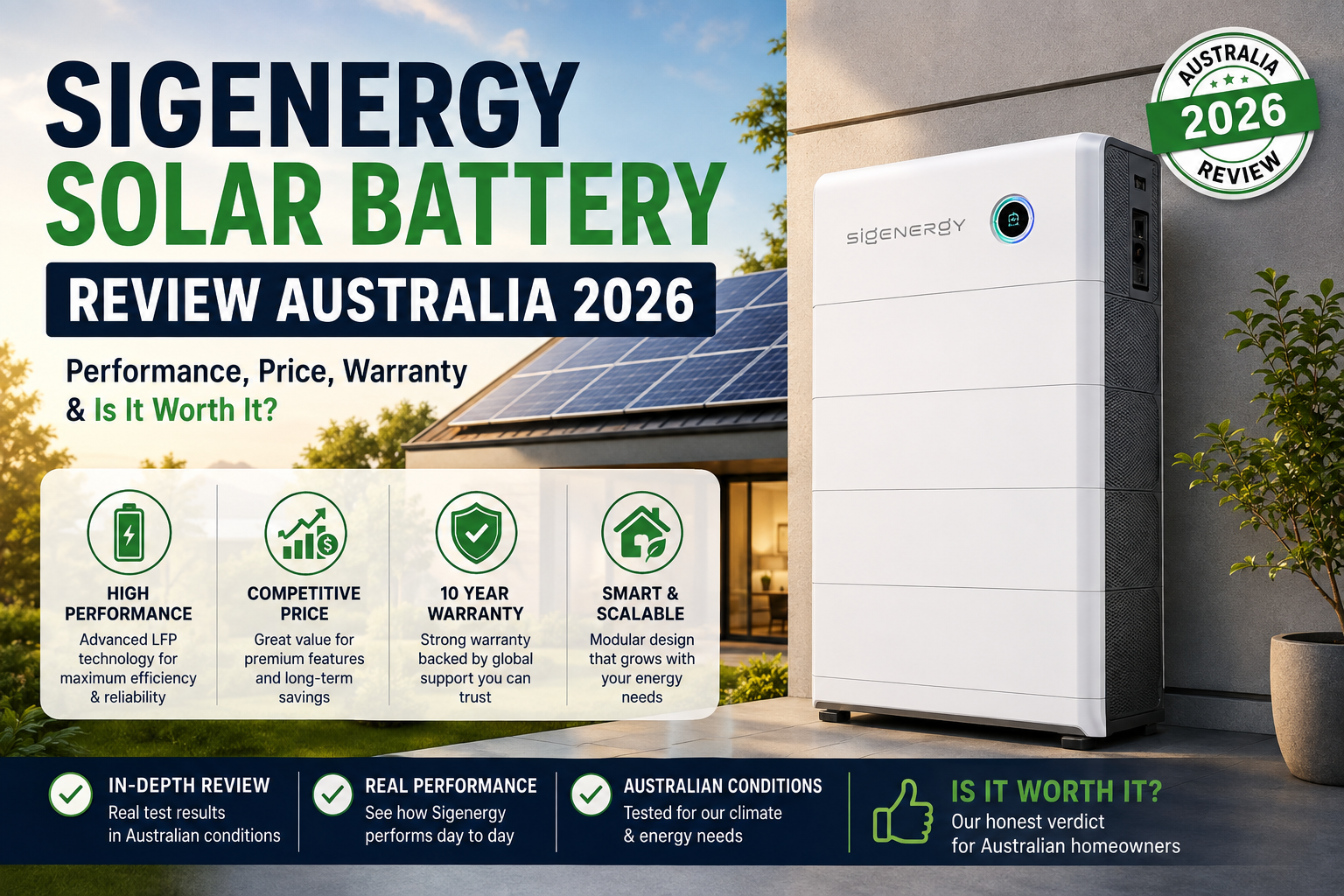
The Sigenergy SigenStor is a modular energy storage platform designed to combine battery storage, power conversion and intelligent energy management.
Depending on the configuration, the system can include:
- Stackable battery modules
- Hybrid inverter
- Smart Energy Management System (EMS)
- EV charging capability
- Backup power
- Solar integration
The modular architecture allows the system to be configured around the energy requirements of a particular property.
This can be particularly attractive for households that expect their energy needs to grow.
For example, you may eventually:
- Purchase an EV
- Add more solar
- Increase electricity consumption
- Add more battery storage
- Require stronger backup capability
Instead of designing only for today’s energy requirements, the system can be configured with future energy needs in mind.
What Makes Sigenergy Different?
The biggest difference is the all-in-one approach.
Traditional solar and battery systems can involve several separate components:
Solar Panels → Inverter → Battery → Energy Management → EV Charger
SigenStor is designed to bring several of these functions into an integrated platform.
This can potentially simplify system design and provide a more unified approach to:
- Solar generation
- Battery storage
- Household consumption
- Grid interaction
- Backup power
- EV charging
- Energy management
For homeowners who want multiple energy technologies working together, this is one of Sigenergy’s strongest selling points.
Sigenergy Battery Capacity and Scalability
One of the key advantages of SigenStor is its modular architecture.
Battery modules can be combined to create larger storage systems, with configurations capable of reaching tens of kilowatt-hours of storage depending on the system design.
The exact capacity available depends on the specific SigenStor configuration and components selected.
Why modularity matters
Your electricity requirements today may not be the same in five or ten years.
You might start with a smaller battery and later need more storage because you:
- Buy an EV
- Add additional solar
- Increase household electricity consumption
- Install a pool
- Add more air conditioning
- Want greater backup capacity
Ask your installer:
“How much battery capacity can this system support, and can I expand it later?”
Don’t assume every configuration has unlimited expansion capability.
Sigenergy Battery Chemistry: LiFePO₄
SigenStor uses Lithium Iron Phosphate (LiFePO₄/LFP) battery technology in its battery modules.
LFP chemistry is widely used in stationary energy storage because of its combination of:
- Thermal stability
- Safety characteristics
- Long-term cycling potential
- Suitability for residential energy storage
However, battery chemistry is only one part of overall system safety.
Installation quality, equipment placement, electrical protection and system design are equally important.
For an Australian installation, make sure the complete system is designed and installed according to applicable Australian requirements.
Sigenergy All-in-One Design
One of the strongest reasons homeowners consider Sigenergy is the integrated design.
Rather than installing completely separate equipment for every function, SigenStor can integrate:
Battery + Hybrid Inverter + Energy Management
with optional EV charging depending on the configuration.
Potential advantages include:
- More integrated system architecture
- Fewer separate major components
- Centralised energy management
- Easier coordination between solar, battery and household loads
- Future EV integration
- Backup capability
- Modular expansion
This approach can be particularly attractive to homeowners building an energy ecosystem rather than simply buying a battery.
Sigenergy Smart Energy Management
Energy management is a major part of the SigenStor proposition.
The system is designed to intelligently manage energy flows between:
Solar → Home → Battery → EV → Grid
Depending on the configuration and operating settings, smart energy management can help optimise when electricity is:
- Generated
- Stored
- Consumed
- Exported
- Used for EV charging
The goal is to make better use of available solar generation and manage energy according to household requirements.
Ask your installer:
“How will the energy management system be configured for my electricity usage and solar generation?”
A smart system still needs to be correctly configured to deliver useful results.
Sigenergy Battery and EV Charging
One of the most interesting aspects of SigenStor is its ability to integrate with EV charging as part of the wider energy system.
For homeowners considering an electric vehicle, this can be an important advantage.
Instead of treating your EV as a completely separate electricity load, the system can be designed around the relationship between:
Solar + Battery + Home + EV
This can potentially allow you to use more of your own solar generation for vehicle charging and better coordinate household energy use.
If you own or plan to buy an EV, ask:
“Can the Sigenergy system manage my solar, battery and EV charging together?”
Also ask about the specific EV charger and charging configuration included in your quote.
Sigenergy Battery Backup and Blackout Protection
Backup power is another major reason homeowners consider Sigenergy.
When correctly designed and configured, the system can provide backup electricity during a grid outage.
However, battery backup does not automatically mean your entire home will operate normally during a blackout.
Backup performance depends on:
- System configuration
- Inverter capacity
- Battery capacity
- Backup equipment
- Electrical switchboard configuration
- Essential-load requirements
- Household demand
A properly designed system can potentially keep important loads operating, such as:
- Refrigeration
- Lighting
- Internet
- Security systems
- Selected power circuits
Larger systems may support substantially greater loads depending on the configuration.
Ask your installer:
“What exactly will my Sigenergy system power during a blackout?”
Don’t accept a general statement such as “full-home backup” without understanding the actual system design and load limitations.
How Fast Does Sigenergy Switch to Backup?
SigenStor is designed to provide rapid transition to backup power during grid outages.
For households in areas affected by power interruptions, fast backup switching can be an important consideration.
However, actual backup performance depends on the complete installation.
When comparing systems, ask about:
- Backup switching
- Maximum backup power
- Single-phase or three-phase operation
- Essential vs whole-home backup
- Motor-starting loads
- Air conditioning
- Pool pumps
- EV charging during outages
The battery capacity and inverter power are both important.
A large battery doesn’t necessarily mean the system can operate every appliance in your home simultaneously.
Is Sigenergy Suitable for Australian Conditions?
SigenStor is designed for outdoor environments and uses an enclosure rated for demanding environmental conditions, with IP66 protection cited for relevant components/configurations.
The combination of suitable enclosure protection and LFP battery technology makes the system potentially suitable for a range of Australian environments.
However, the actual installation location still matters.
Your installer should consider:
- Direct sunlight
- Heat exposure
- Rain
- Ventilation
- Flood risk
- Access
- Clearance requirements
- Distance from living areas
Ask:
“Where will the SigenStor system be installed, and why is that location suitable?”
Sigenergy Monitoring and App
SigenStor provides app-based monitoring and control, allowing homeowners to see how energy is moving through the system.
Depending on the configuration, you can monitor areas such as:
- Solar generation
- Household consumption
- Battery charging
- Battery discharge
- Grid imports
- Grid exports
- EV charging
- System status
The integrated approach can make it easier to understand how your home energy system is performing.
For a technology-heavy system like Sigenergy, the software experience is an important part of the overall product.
Sigenergy Battery Efficiency and Performance
When comparing batteries, don’t focus on battery capacity alone.
You should also consider:
- Usable capacity
- Round-trip efficiency
- Charge power
- Discharge power
- Inverter efficiency
- Operating temperature
- Battery degradation
- Warranty conditions
A battery with a large capacity may not deliver better financial results if your household doesn’t use enough electricity to justify it.
The right battery should match your actual energy profile.
Ask your installer:
“Based on my electricity usage, how much energy will the battery realistically cycle each day?”
This is a much more useful question than simply asking how many kWh the battery holds.
Sigenergy Battery Price Australia
Sigenergy is positioned toward the feature-rich and premium end of the residential battery market.
However, there is no single price that applies to every installation.
The final installed price can depend on:
- Battery capacity
- Inverter configuration
- EV charging requirements
- Backup requirements
- Solar system size
- Existing solar equipment
- Switchboard requirements
- Electrical work
- Installation location
- Labour
- Additional equipment
- Government incentives
Why comparing the total system price matters
One Sigenergy quote may include:
- Battery
- Hybrid inverter
- Backup equipment
- Installation
- Energy management
- EV charging hardware
Another quote may price these components separately.
Therefore, comparing price per kWh alone can be misleading.
Ask:
“What exactly is included in the total installed price?”
Sigenergy Battery Rebates and Incentives
Battery incentives can materially affect the upfront cost of an eligible installation.
Depending on the current Australian incentive framework, eligibility can depend on factors including:
- Battery model
- System configuration
- Installation requirements
- Location
- Installation date
- Installer eligibility
Don’t assume that every Sigenergy quote receives the same incentive.
Ask your installer:
“Which battery incentive applies to my system, and how much has been deducted from the quoted price?”
Then compare quotes using the final out-of-pocket cost.
Sigenergy Battery Warranty: What Should You Check?
Sigenergy offers warranty coverage on its products, but the exact terms depend on the specific component and configuration.
Don’t simply compare:
“10-year warranty”
against another brand’s:
“10-year warranty.”
The important details are what the warranty actually guarantees.
Check:
Battery warranty
How many years are covered?
Capacity retention
How much capacity is guaranteed at the end of the warranty?
Throughput
Is there a maximum energy throughput or cycle condition?
Inverter warranty
What warranty applies to the inverter?
EV equipment
If an EV charging component is included, what warranty applies?
Labour
Does the installer cover labour associated with a warranty claim?
Warranty support
Who handles the claim if something goes wrong?
This last point is particularly important with a newer brand.
Sigenergy Is a Newer Brand: Does That Matter?
This is one area where prospective buyers should be realistic.
Sigenergy is a relatively young company compared with long-established solar and battery brands.
That doesn’t automatically mean the technology is inferior.
However, a newer brand has less long-term Australian field history than manufacturers that have been supplying the local market for many years.
For a battery that could remain in your home for a decade or longer, this is worth considering.
Ask your installer:
“Who will support this system if I have a warranty issue several years from now?”
Also consider:
- Local installer capability
- Australian support arrangements
- Spare parts availability
- Warranty claim process
- Installer experience with the product
The quality of the installer can be especially important with a sophisticated integrated energy system.
Sigenergy Battery Installation: Why the Installer Matters
A feature-rich battery system requires careful system design.
The installer should understand:
- Solar design
- Battery sizing
- Inverter configuration
- Backup requirements
- Electrical protection
- Switchboard requirements
- EV charging
- Energy management
- Applicable Australian standards
For a system intended to provide backup power, installation design becomes even more important.
Don’t simply compare the cheapest installation price.
Compare the experience and quality of the complete installation.
Sigenergy Battery Pros and Cons
Sigenergy Pros
✔ Integrated battery and hybrid inverter architecture
✔ Modular and scalable storage
✔ Smart energy management
✔ Strong integration potential for solar + battery + EV
✔ Backup power capability when correctly configured
✔ LFP battery technology
✔ Modern monitoring and control
✔ Suitable for homeowners planning future energy upgrades
✔ Can be attractive for households wanting an integrated energy ecosystem
Sigenergy Cons
✘ Typically positioned at a premium price point
✘ Relatively new compared with some established battery brands
✘ Long-term Australian field history is more limited
✘ Complex systems require careful installation and configuration
✘ Support experience may vary by installer
✘ Not necessarily the best option for homeowners simply looking for the cheapest battery
Sigenergy vs Traditional Solar Battery Systems
The biggest distinction is the system architecture.
A conventional system may look like:
Solar Panels → Hybrid Inverter → Battery
An integrated Sigenergy approach can be closer to:
Solar + Battery + Inverter + Energy Management + EV
This can make SigenStor particularly attractive to households that want multiple energy technologies working together.
But if you only want a simple battery to store excess solar, you may not need every feature.
The question is:
“Will I actually use the additional functionality I’m paying for?”
If you’re planning an EV, whole-home backup or future battery expansion, the integrated architecture may provide greater value.
How Big a Sigenergy Battery Do You Need?
Don’t buy the largest battery simply because you can.
The correct battery size depends on:
- Daily electricity consumption
- Solar generation
- Evening electricity usage
- Daytime electricity usage
- Feed-in tariff
- Electricity tariff
- EV charging
- Pool consumption
- Air conditioning
- Future energy requirements
- Backup requirements
For example, a household with high evening electricity consumption may benefit from more storage than a household that uses most of its electricity during daylight hours.
Ask your installer:
“What battery size gives me the best balance between energy savings, backup and payback?”
This encourages the installer to design around your actual requirements rather than simply selling the largest available system.
How Much Can a Sigenergy Battery Save?
A battery can potentially reduce grid electricity purchases by allowing you to use more of your solar generation later in the day.
For example:
Without battery:
Solar → Home → Excess → Grid
With battery:
Solar → Home → Battery → Evening consumption
The financial result depends on:
- Solar generation
- Household consumption
- Electricity prices
- Feed-in tariff
- Battery capacity
- Battery efficiency
- Battery cycling
- Installation cost
- Government incentives
Don’t rely on generic claims about a guaranteed payback period.
Ask for a personalised calculation:
“What annual bill saving are you forecasting for my home, and what assumptions are behind that estimate?”
Who Is Sigenergy Best Suited To?
Sigenergy may be a particularly interesting option if you:
✅ Want an integrated solar + battery system
✅ Plan to purchase an EV
✅ Want battery and EV energy management in one ecosystem
✅ Want backup power
✅ Expect your energy consumption to grow
✅ Want modular battery expansion
✅ Prefer advanced monitoring and energy management
✅ Are willing to pay more for additional functionality
Sigenergy May Not Be the Best Fit If:
⚠ Your main priority is the lowest upfront battery price
⚠ You want a brand with decades of Australian battery history
⚠ You only need a basic battery storage solution
⚠ You don’t expect to use EV or advanced energy-management features
⚠ Your local installer has limited experience with the system
Is Sigenergy Battery Worth It in Australia?
For the right homeowner, it can be.
Sigenergy’s strongest proposition isn’t simply its battery capacity.
It’s the idea of creating an integrated home energy platform:
Solar → Battery → Home → EV → Grid
The system can be particularly compelling for homeowners who want to combine solar storage, backup power, smart energy management and EV charging.
However, the premium price and relatively shorter Australian track record mean you should look beyond the technology.
Before buying, compare:
Capacity → Usable Energy → Power → Inverter → Backup → EV → Efficiency → Warranty → Support → Installation → Rebate → Final Price
A sophisticated system is only valuable if it matches your household’s actual energy needs.
12 Questions to Ask Before Buying a Sigenergy Battery
Before signing your contract, ask your installer:
- Which exact SigenStor configuration am I getting?
- What is the total and usable battery capacity?
- What inverter capacity is included?
- Can I expand the battery later?
- What happens during a blackout?
- Which appliances can operate during backup?
- Can the system integrate with my EV?
- What solar system size is recommended?
- What government incentives have been applied?
- What exactly is covered by the warranty?
- Who handles warranty claims and support?
- What is my estimated annual saving and expected payback?
Getting clear answers to these questions makes it much easier to compare Sigenergy against other battery brands.
Get a Sigenergy Battery Quote
A battery is a long-term investment, so don’t choose a system based on brand, capacity or advertised price alone.
Compare the complete system:
Battery → Usable Capacity → Inverter → Solar → EV → Backup → Performance → Warranty → Support → Installation → Rebate → Final Price
At Solar Authority, we can help you assess your electricity usage, existing solar system, future EV requirements and backup needs before comparing battery options.
👉 Get a Free Sigenergy Battery Quote
Tell us about your home and energy requirements and compare a system designed around your needs.