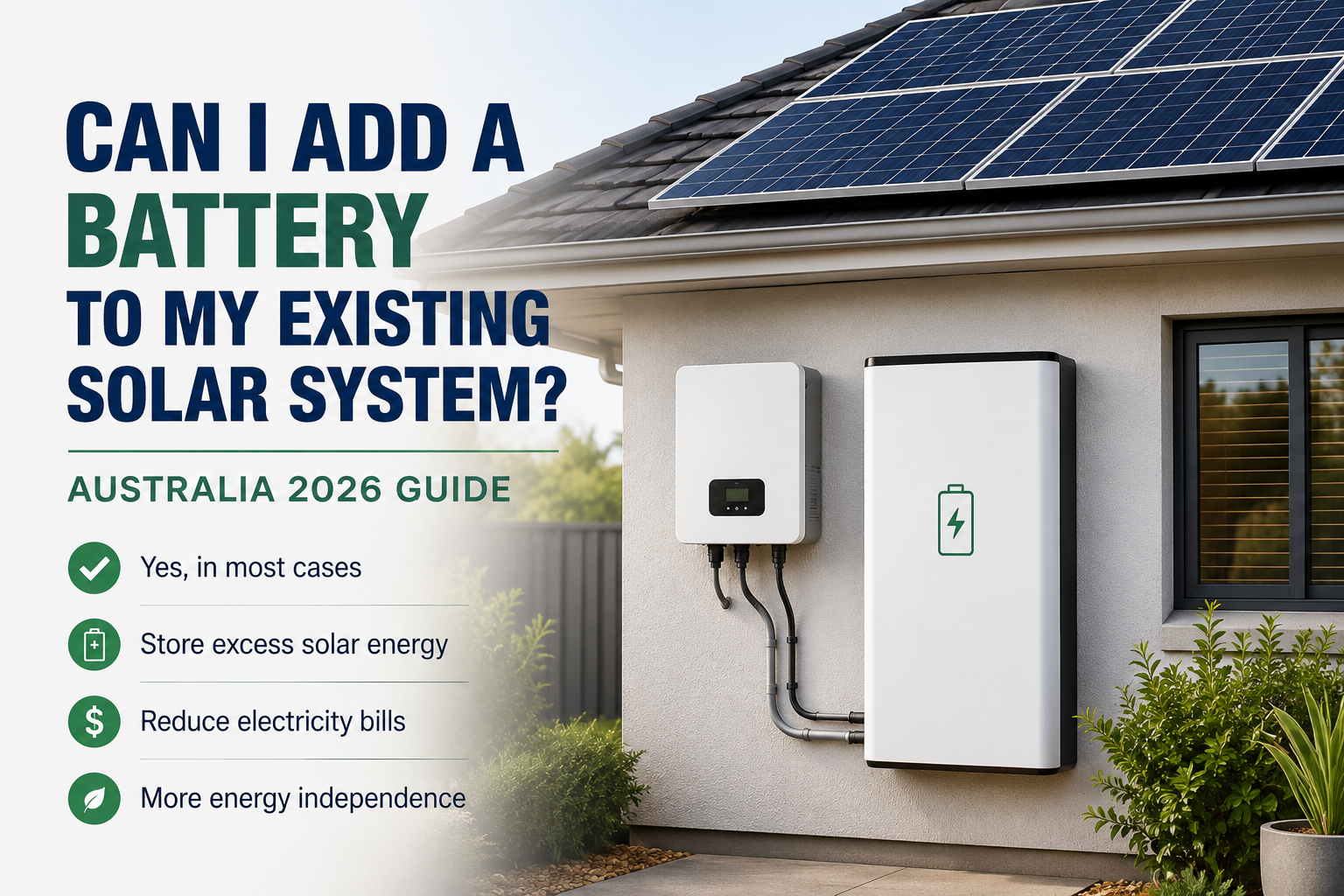
Already have solar panels and wondering if you can add a battery? In most cases, you don’t need to replace your entire solar system. However, your existing inverter, solar system size, electricity usage, switchboard, battery compatibility and future energy requirements will determine the best approach.
This complete 2026 guide explains how to add a battery to an existing solar system in Australia, when you may need a solar inverter upgrade, whether you need additional solar panels, how AC-coupled and hybrid batteries compare, what the Cheaper Home Batteries Program means for existing solar owners, and how to determine whether a battery is financially worthwhile.
Already have solar? Don’t guess whether your system is battery-ready. Get a professional compatibility assessment and a free personalised quote from Solar Authority.
Quick Answer: Can I Add a Battery to My Existing Solar System?
Yes — many Australian homes can add a battery to an existing solar system without replacing the entire system.
However, your installer should assess:
- Existing solar panel capacity
- Solar inverter model and age
- Whether the inverter is battery-compatible
- Daily electricity consumption
- Daytime solar generation
- Evening electricity usage
- Battery size
- Switchboard condition
- Network requirements
- Backup power requirements
- Future energy needs
- Government battery incentive eligibility
The Australian Government’s Cheaper Home Batteries Program specifically allows eligible batteries to be installed with existing solar PV systems.
The key question isn’t:
“Can I install a battery?”
It’s:
“What battery solution will work best with my existing solar system?”
Why Add a Battery to Existing Solar?
Your solar panels generally generate the most electricity during the day.
But many Australian households use more electricity:
- In the afternoon
- During the evening
- Overnight
Without a battery, excess solar electricity may be exported to the grid for a feed-in tariff.
With a battery, you can potentially change the energy flow:
☀️ Solar panels → 🏠 Home → 🔋 Battery → 🌙 Home at night
This allows you to use more of your own solar generation rather than buying electricity from the grid later.
A battery can help you:
✔ Increase solar self-consumption
✔ Reduce grid electricity purchases
✔ Use stored solar at night
✔ Reduce exposure to electricity price increases
✔ Potentially improve the value of an existing solar system
✔ Prepare for an EV or additional electrification
✔ Potentially participate in a VPP
✔ Potentially access backup power with the right system
Do I Need to Upgrade My Solar Inverter to Add a Battery?
Not necessarily.
Your existing inverter is one of the most important components to assess.
There are three common scenarios.
1. You Already Have a Hybrid or Battery-Ready Inverter
If your existing inverter is designed to work with batteries, you may be able to add a compatible battery without replacing the inverter.
However, compatibility still needs to be confirmed.
Your installer should check:
- Inverter model
- Battery compatibility
- Maximum battery capacity
- Software requirements
- Communication compatibility
- Network requirements
- Current approval status
Potential result:
Existing solar + compatible hybrid inverter + compatible battery = simpler battery retrofit
2. You Have a Standard String Inverter
If your existing solar system has a conventional string inverter, you may still be able to add a battery.
One option is an:
AC-Coupled Battery
An AC-coupled battery has its own battery inverter and can operate alongside your existing solar inverter.
This can be particularly useful when:
- Your existing solar inverter is still in good condition
- You don’t want to replace functioning equipment
- Your preferred battery supports AC coupling
- You want to retrofit storage to an older solar system
3. Your Existing Inverter May Need Replacement
Sometimes an inverter upgrade makes more sense.
For example, your installer may recommend replacing the inverter if:
- It isn’t compatible with the preferred battery
- It is old
- It is approaching the end of its expected service life
- It isn’t suitable for your planned solar expansion
- It doesn’t meet applicable requirements
- You want a new hybrid system
- You want specific backup functionality
Don’t assume that adding a battery means replacing your inverter.
A good installer should compare the options and explain why an upgrade is or isn’t necessary.
AC-Coupled vs Hybrid Battery: Which Is Better?
There isn’t one answer for every home.
| Feature | AC-Coupled Battery | Hybrid Inverter + Battery |
|---|---|---|
| Existing solar inverter | Can often remain | May be replaced |
| Retrofit potential | Excellent | Depends on inverter |
| Existing solar system | Often easier to retain | May require changes |
| New solar system | Suitable | Often attractive |
| Equipment integration | Separate components | More integrated |
| Inverter replacement | May not be required | Often required if existing inverter isn’t compatible |
| Best for | Many retrofits | New systems or suitable upgrades |
Which should you choose?
Choose based on your existing equipment and energy profile — not simply the cheapest advertised battery.
Do I Need More Solar Panels Before Installing a Battery?
Not automatically.
But this is an important question.
A battery stores energy — it doesn’t create energy.
If your solar system doesn’t generate enough surplus electricity, a large battery may remain partially charged for much of the year.
Example
Imagine:
3 kW solar system + 20 kWh battery
If your solar system doesn’t regularly produce enough surplus energy to charge the battery, you’re paying for storage capacity that may not be fully utilised.
A better solution might be:
More solar generation + appropriately sized battery
The Australian Government specifically advises consumers that bigger isn’t always better and that battery size should be matched to solar generation, electricity use and inverter output.
What Size Battery Do I Need?
There is no universal “best battery size.”
The correct size depends on:
Your electricity consumption
How many kWh does your home use each day?
Your solar generation
How much excess solar do you currently export?
Your evening usage
How much electricity do you use after the sun goes down?
Your electricity tariff
How much are you paying for electricity imported from the grid?
Your feed-in tariff
How much are you receiving for exported solar?
Your future plans
Are you planning:
- An EV?
- Pool heating?
- More air conditioning?
- Electric hot water?
- More solar?
- Home electrification?
5 kWh, 10 kWh, 15 kWh or 20 kWh Battery?
| Battery size | Potentially suitable for | Key consideration |
| 5–8 kWh | Lower-energy households | Lower upfront cost |
| 10–15 kWh | Many households | Often a practical middle ground |
| 15–20 kWh | Higher-energy households | Requires sufficient solar generation |
| 20 kWh+ | High-consumption homes | Requires careful system design |
Don’t choose your battery based purely on the kWh number.
Compare:
✔ Usable capacity
✔ Power output
✔ Efficiency
✔ Warranty
✔ Cycle/life specifications
✔ Inverter compatibility
✔ Backup capability
✔ Installation cost
✔ Rebate eligibility
✔ Total system price
What Is the Difference Between Nominal and Usable Battery Capacity?
This is an important detail when comparing battery quotes.
Nominal capacity refers to the battery’s total stated storage capacity.
Usable capacity refers to the amount of energy that can actually be discharged for household use.
For example, a battery may have:
10 kWh nominal capacity
but:
9 kWh usable capacity
depending on its depth-of-discharge specification. The government specifically distinguishes between nominal and usable capacity when determining program eligibility.
Always ask:
“What is the usable capacity of this battery?”
—not just:
“How many kWh is the battery?”
Do I Need to Upgrade My Switchboard?
Possibly.
Your installer should inspect your existing electrical infrastructure.
An upgrade may be required depending on:
- Switchboard age
- Available space
- Existing protection equipment
- Electrical loads
- Battery configuration
- Metering
- Network requirements
- Applicable electrical standards
Ask your installer:
“Is switchboard work included in the quoted battery installation price?”
This can help prevent unexpected additional costs.
Can I Add a Battery to an Old Solar System?
Potentially, yes.
Having an older solar system doesn’t automatically mean you need to replace everything.
However, the older the system, the more important a compatibility assessment becomes.
Your installer should check:
✔ Solar inverter model
✔ Inverter condition
✔ Product approval status
✔ Solar panel condition
✔ System output
✔ Battery compatibility
✔ Network requirements
✔ Electrical compliance
For batteries installed with existing solar PV under the current federal program, the existing inverter needs to meet the applicable requirements, including being on the relevant CEC approved inverter list unless the relevant exception applies.
Can I Get the Federal Battery Rebate If I Already Have Solar?
Yes — potentially.
This is one of the biggest opportunities for existing solar owners.
The Cheaper Home Batteries Program supports eligible batteries installed alongside existing or new solar PV systems.
As of the current 2026 rules:
- Eligible battery systems are 5–100 kWh nominal capacity
- STCs apply to the first 50 kWh of usable capacity
- The battery must meet the program requirements
- The battery and inverter must be appropriately approved
- Installation must be undertaken by or supervised by an SAA-accredited battery installer
The program currently provides an around 30% upfront discount, although the actual discount varies according to battery capacity, STC Factor, STC value and the applicable rules.
Is the Battery Rebate Going Down?
Yes. This is important if you’re considering waiting.
The STC Factor is scheduled to decline progressively through 2030.
| Period | STC Factor |
| Jan–Apr 2026 | 8.4 |
| May–Dec 2026 | 6.8 |
| Jan–Jun 2027 | 5.7 |
| Jul–Dec 2027 | 5.2 |
| Jan–Jun 2028 | 4.6 |
| Jul–Dec 2028 | 4.1 |
| Jan–Jun 2029 | 3.6 |
| Jul–Dec 2029 | 3.1 |
| Jan–Jun 2030 | 2.6 |
| Jul–Dec 2030 | 2.1 |
The government says the discount will be reviewed at least annually and decrease over time in line with falling battery prices.
What does this mean?
Waiting doesn’t necessarily mean you’ll pay more overall because battery prices could also decline.
But the government incentive itself is scheduled to become smaller over time.
Therefore, if you’re considering a battery, compare:
Current installed price − current incentive + expected savings
against:
Potential future battery price − future incentive + savings lost while waiting.
That’s a much better way to make the decision than simply asking:
“Will batteries be cheaper next year?”
Important: The Rebate Is Not Simply 30% of Any Battery Price
This is where many homeowners get confused.
The program is based on STCs and eligible battery capacity, rather than a simple government cheque equal to 30% of whatever price a retailer advertises.
From 1 May 2026, the STC Factor is also tapered according to battery capacity:
- 0–14 kWh: 100% of the STC Factor
- Above 14–28 kWh: 60%
- Above 28–50 kWh: 15%
This makes battery sizing even more important.
A bigger battery does not automatically mean a proportionally bigger rebate.
Does the Battery Rebate Cover a 20 kWh Battery?
Potentially, yes — but the calculation is not simply:
20 kWh × full STC Factor.
Because capacity above 14 kWh receives a reduced factor under the current rules.
This is why your installer should provide a clear written breakdown of:
- Battery capacity
- Usable capacity
- Eligible capacity
- STCs
- Discount value
- Final installed price
Does a Solar Battery Automatically Give Me Backup Power?
No.
This is a major point homeowners should understand.
A battery can store electricity, but not every battery installation provides blackout protection.
Backup capability depends on:
- Battery
- Inverter
- Backup hardware
- Electrical configuration
- Essential-load circuits
- Installation design
If backup is important to you, ask:
“Which appliances will continue operating if the grid goes down?”
Get the answer in writing.
What About Virtual Power Plants?
A Virtual Power Plant (VPP) connects multiple household batteries so they can operate as a coordinated energy resource.
Under the current federal program, an on-grid battery system needs the technical capability to participate in a VPP to be eligible, but actual participation in a VPP is not compulsory.
This distinction is important:
VPP capability ≠ mandatory VPP participation.
If you’re considering a battery, ask whether the proposed system is:
VPP capable, VPP compatible and eligible under the current program requirements.
What Will It Cost to Add a Battery to Existing Solar?
There is no single Australian battery retrofit price.
Your total cost can depend on:
- Battery capacity
- Battery brand/model
- AC-coupled vs hybrid configuration
- Existing inverter
- New inverter requirement
- Switchboard upgrades
- Backup configuration
- Additional solar panels
- Installation complexity
- Network requirements
- Location
Instead of asking only:
“How much is a 10 kWh battery?”
ask:
“What is the total installed cost after all eligible incentives and upgrades?”
That’s the number that matters.
How to Calculate Whether a Battery Is Worth It
A simple way to think about battery economics is:
Annual battery benefit ≈
Solar energy shifted from export to later household use × avoided grid electricity cost
plus any applicable:
- VPP payments
- Time-of-use benefits
- Other energy-management benefits
minus:
- Battery losses
- Additional operating costs
- Financing costs, if applicable
Example
Suppose:
Grid electricity = 30c/kWh
and:
Feed-in tariff = 5c/kWh
Using 1 kWh of solar yourself could potentially avoid buying 1 kWh from the grid, whereas exporting it may only earn 5c.
The theoretical value difference is:
30c − 5c = 25c/kWh
But real-world battery savings are more complicated because of battery efficiency, charging behaviour, electricity tariffs, battery degradation and system costs.
Use this as a decision framework, not as a guaranteed savings figure.
When Is Adding a Battery to Existing Solar Most Attractive?
A battery may be particularly worth investigating if you:
✔ Export a lot of solar during the day
✔ Have significant evening electricity consumption
✔ Pay relatively high electricity import rates
✔ Receive a relatively low feed-in tariff
✔ Have sufficient solar generation
✔ Want greater energy independence
✔ Plan to buy an EV
✔ Have high air-conditioning usage
✔ Want backup capability
✔ Want to investigate VPP participation
When Might a Battery Not Be Worth It?
A battery deserves more careful financial analysis if:
✖ Your solar system is very small
✖ Your daytime consumption is already high
✖ You export very little solar
✖ Your household uses little electricity
✖ You are considering a battery that is much larger than your needs
✖ Installation requires significant additional electrical work
Sometimes the better investment is:
More solar → smaller battery
rather than:
Existing small solar → very large battery.
The 10 Questions You Should Ask Before Buying a Solar Battery
Before signing a battery contract, ask:
1. Is my existing solar system battery-compatible?
2. Do I need a new inverter?
3. Can I keep my existing solar panels?
4. What is the battery’s usable capacity?
5. How much excess solar do I currently export?
6. What battery size do you recommend — and why?
7. What is the total installed price after the government discount?
8. What upgrades are included?
9. What are my estimated annual savings and payback period?
10. Does the system provide blackout backup?
The federal government recommends consumers obtain multiple quotes and receive information about the discount, warranty, expected payback period, energy benefits and anticipated savings before purchasing.
Existing Solar + Battery: A Simple Decision Guide
If you have a modern hybrid inverter
➡️ Check battery compatibility first.
You may be able to add a battery without replacing the inverter.
If you have a standard string inverter
➡️ Compare AC-coupled vs inverter replacement.
Don’t assume a full system replacement is necessary.
If your solar system is small
➡️ Assess whether additional solar panels make sense first.
If you export lots of solar
➡️ A battery may help increase self-consumption.
If you use lots of electricity at night
➡️ Battery storage may provide greater value.
If your inverter is old
➡️ Compare the cost of keeping it against upgrading it.
If you want blackout protection
➡️ Specify backup requirements before choosing the battery.
Why You Should Get Your Existing Solar System Assessed First
A battery quote should be based on your actual home, not just a generic battery package.
A proper assessment should consider:
Solar system → inverter → electricity consumption → battery → network → future energy needs
The federal government also requires retailers/installers to provide information about appropriate battery sizing, expected energy benefits, savings and payback.
Get a Free Solar Battery Compatibility Check From Solar Authority
Already Have Solar? Find Out If Your System Is Battery-Ready.
Solar Authority can assess your existing solar system and help you understand:
✔ Whether you can add a battery
✔ Whether your inverter can be retained
✔ Whether an inverter upgrade is required
✔ AC-coupled vs hybrid battery options
✔ Recommended battery capacity
✔ Whether additional solar panels make sense
✔ Potential government incentive eligibility
✔ Possible switchboard requirements
✔ Backup power options
✔ Estimated savings and payback
Don’t Replace Your Solar System Without Checking Your Options First.
Get a FREE Solar + Battery Compatibility Assessment and Personalised Quote from Solar Authority.
Frequently Asked Questions
Can I add a battery to my existing solar system?
Yes. Eligible batteries can be installed with existing solar PV, subject to the program’s technical, product, electrical and installation requirements.
Do I need to replace my solar inverter?
Not always. If your inverter is battery-compatible, it may be retained. Otherwise, an AC-coupled solution or inverter replacement may be considered.
Can I add a battery to an old solar system?
Potentially. Your inverter, panels, compliance and network requirements should be assessed before installation.
Do I need more solar panels to add a battery?
No, not automatically. But your solar system needs to generate enough surplus energy to make the battery worthwhile.
What size battery should I get?
It depends on your electricity consumption, solar generation, evening usage, tariff, export profile and future energy plans.
Can I get the battery rebate if I already have solar?
Yes, potentially. The current program supports eligible batteries installed with existing solar PV.
How much is the battery rebate in 2026?
The program currently provides an around 30% upfront discount, but the actual amount depends on eligible capacity, STC Factor, STC value and applicable program rules.
Is the battery rebate reducing?
Yes. The STC Factor declines progressively through 2030, with changes occurring every six months under the current schedule.
Is a 20 kWh battery better than a 10 kWh battery?
Not necessarily. The best battery is the one appropriately sized for your solar production and electricity usage.
Does a battery provide power during a blackout?
Not automatically. You need a system specifically configured for backup power.
Can I participate in a VPP?
Potentially. Eligible on-grid systems need VPP capability under the current program, but participation itself isn’t mandatory.
How much does it cost to add a battery to existing solar?
It varies significantly depending on the battery, inverter configuration, installation and any required upgrades. The best way to determine the real cost is to obtain a personalised quote.
Should I install a battery now or wait?
Compare the current installed price, current incentive, expected energy savings and future battery pricing. Government support is scheduled to reduce over time, so waiting doesn’t automatically guarantee a better financial outcome.