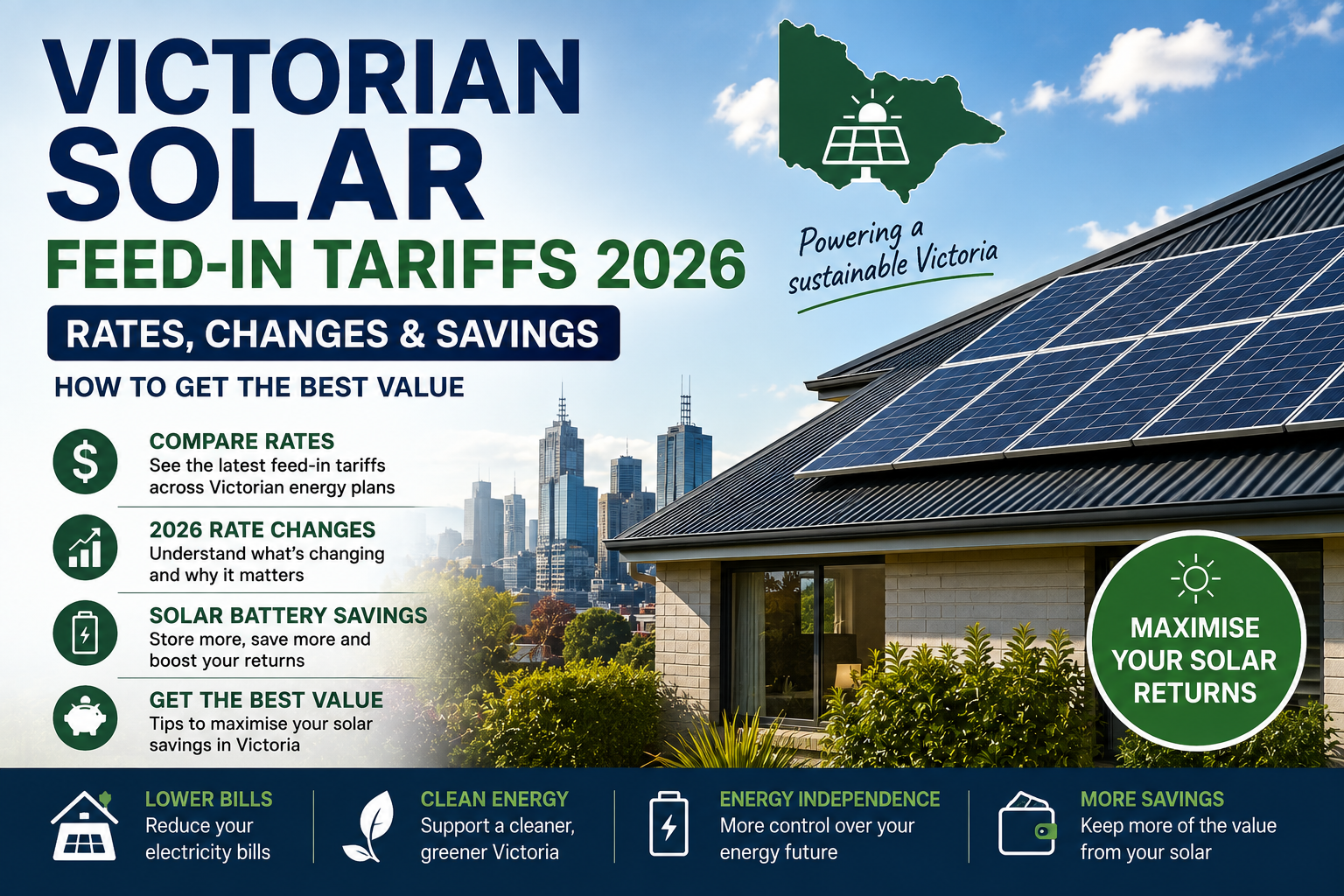
If you own or are considering installing solar panels in Victoria, understanding Victorian solar feed-in tariffs (FiTs) is essential if you want to maximise your electricity savings.
Victoria’s solar market has changed significantly since 1 July 2025, when the regulated minimum feed-in tariff was removed. Today, the solar feed-in tariff you receive depends largely on your electricity retailer and energy plan, which means choosing the right plan can make a meaningful difference to your solar returns.
But there is an important point many homeowners overlook:
The highest feed-in tariff isn’t always the best solar deal.
If your electricity retailer pays you only a few cents for exported solar while charging considerably more for electricity you import, increasing solar self-consumption or adding a solar battery may provide greater financial value.
This guide explains Victorian solar feed-in tariffs in 2026, how the rules have changed, what rates to look for, whether a battery makes sense, and how to choose a solar system based on your actual energy usage.
Victorian Solar Feed-In Tariffs at a Glance
| Factor | What Victorian Homeowners Need to Know |
|---|---|
| Feed-in tariff | Payment/credit for solar electricity exported to the grid |
| Minimum regulated FiT | No regulated minimum since 1 July 2025 |
| Retailer choice | Retailers set their own FiT offers |
| Typical market offers | Can vary significantly by retailer and plan |
| Best strategy | Compare FiT and the complete electricity plan |
| Battery benefit | Can increase self-consumption and reduce grid imports |
| Smart meter | Important for many modern solar and time-of-use plans |
| Key consideration | Your usage, export profile and electricity rates |
Important: Feed-in tariff rates change frequently and can depend on postcode, retailer, plan conditions, export limits and daily caps. Always check the current Energy Fact Sheet for the specific offer before switching.
What Is a Solar Feed-In Tariff?
A solar feed-in tariff is the amount your electricity retailer credits you for electricity your solar panels export to the grid.
For example, if your solar system generates 20 kWh during the day and your home uses 8 kWh, approximately 12 kWh may be exported, subject to system and network limits.
If your FiT is 8 cents per kWh:
12 kWh × $0.08 = $0.96 export credit
That credit is applied to your electricity account.
However, there’s a critical distinction:
Solar export income is not the same as solar savings.
If you use 1 kWh of your own solar electricity instead of buying 1 kWh from the grid, you avoid paying the retail electricity rate.
If grid electricity costs 30 cents/kWh and your FiT is 8 cents/kWh:
- Use 1 kWh yourself: potentially avoid ~30c of grid electricity cost
- Export 1 kWh: receive ~8c credit
That’s why solar self-consumption can be more valuable than exporting solar.
What Changed in Victoria From 1 July 2025?
One of the most important Victorian solar feed-in tariff changes occurred on 1 July 2025.
Victoria previously operated with a regulated minimum feed-in tariff framework overseen by the Essential Services Commission (ESC).
The regulated minimum was removed from 1 July 2025.
This means Victorian homeowners now need to pay much closer attention to the actual electricity plan they choose.
What this means for solar owners
✔ Retailers can establish their own feed-in tariff offers
✔ Different retailers can offer significantly different export rates
✔ Some plans may offer attractive promotional FiTs with conditions
✔ Some plans may offer very low export rates
✔ You should compare the complete electricity plan rather than looking only at the headline FiT
This change makes solar energy management and electricity-plan comparison increasingly important.
What Is a Good Feed-In Tariff in Victoria in 2026?
There is no single FiT that is automatically “best” for every Victorian household.
You may see plans offering different structures, including:
Flat Feed-In Tariffs
You receive the same credit for each eligible kWh exported.
For example:
8c/kWh × 10 kWh exported = $0.80 credit
Flat rates are simple and predictable.
Tiered Feed-In Tariffs
Some plans may provide a higher rate for an initial amount of daily exports and a lower rate afterwards.
For example:
- First 8 kWh: higher promotional rate
- Additional exports: lower standard rate
Always check the daily export cap and conditions.
Time-Varying Feed-In Tariffs
Some plans vary export payments according to the time electricity is exported.
This can potentially reward exports during periods when electricity has greater market value.
However, the plan needs to match your actual solar production and export profile.
Don’t Choose a Solar Plan Based Only on the Highest FiT
This is one of the biggest mistakes solar homeowners make.
Suppose:
Plan A
- FiT: 12c/kWh
- Electricity usage rate: 35c/kWh
- Higher daily supply charge
Plan B
- FiT: 7c/kWh
- Electricity usage rate: 27c/kWh
- Lower supply charge
If your household imports significant electricity from the grid, Plan B could potentially be cheaper overall, despite having a lower FiT.
That’s why you should compare:
Annual electricity imports + supply charges − solar export credits
rather than simply comparing the advertised feed-in rate.
Feed-In Tariff vs Solar Self-Consumption
Understanding this difference can help you make a much better solar decision.
| Solar Energy Use | Potential Value |
| Use solar directly in your home | Avoid buying electricity from the grid |
| Store solar in a battery | Use solar later instead of importing from grid |
| Export solar | Receive FiT credit |
| Export during low-value periods | May provide relatively little financial return |
For many households, the priority should be:
1. Use solar directly
2. Store excess solar if economically appropriate
3. Export remaining surplus
This is particularly relevant in Victoria because abundant rooftop solar can result in substantial daytime exports.
Why Solar Batteries Are Becoming More Important in Victoria
A solar battery in Victoria can change how you use your solar energy.
Without a battery:
Solar → Home → Grid
With a battery:
Solar → Home → Battery → Home later
Instead of exporting surplus solar during the day for a relatively low FiT, you can potentially store some of that energy and use it during the evening.
For example:
If your household generates excess solar at 1pm but has high electricity consumption at 7pm, a battery can shift some of that energy from 1pm to 7pm.
This can increase your solar self-consumption and reduce grid imports.
Does a Battery Make Sense for Your Victorian Home?
A battery may be worth investigating if:
✔ You already have solar panels
✔ You regularly export substantial solar energy
✔ Your household uses significant electricity in the evening
✔ Your electricity import rate is considerably higher than your FiT
✔ You want greater energy independence
✔ You want to reduce reliance on grid electricity
✔ You have an EV or high evening energy demand
✔ Your solar system produces more energy than your home uses during the day
However, a battery isn’t automatically the right choice for every household.
The correct battery size depends on:
- Daily electricity consumption
- Existing solar generation
- Solar export volume
- Evening electricity demand
- Battery usable capacity
- Battery efficiency
- Electricity tariffs
- Installation costs
- Available rebates/incentives
- Expected battery lifespan
How Much Solar Battery Storage Do You Need?
Don’t choose a battery simply because a larger battery sounds better.
For example, a household using approximately 15 kWh per day may not benefit financially from installing an oversized battery if there isn’t enough excess solar to charge it regularly.
A professional assessment should consider:
Solar generation + household consumption + export profile + evening usage
A simple starting point
| Household Profile | Battery Assessment |
| Low electricity usage | Smaller battery may be sufficient |
| Moderate usage + existing solar | Medium storage may be suitable |
| High evening usage | Larger battery may provide greater value |
| EV + solar + high consumption | Larger storage may be worth assessing |
| High daytime usage | Battery may provide less additional benefit |
These are starting points only. Your actual interval consumption data is much more useful than a generic battery-size recommendation.
How to Calculate the Value of Your Solar Exports
Let’s say your home exports:
15 kWh/day
At an 8c/kWh FiT:
15 × $0.08 = $1.20/day
Approximately:
$1.20 × 365 = $438/year
Now imagine that some of that exported electricity could instead be stored and later replace electricity costing 30c/kWh.
The potential value of that stored energy could be materially higher than the export credit, although actual savings depend on battery efficiency, usage, tariffs, battery capacity and other factors.
This is why battery economics should be calculated — not guessed.
What Victorian Homeowners Should Check Before Switching Electricity Plans
Before choosing a new solar electricity plan, check all of the following:
1. Feed-In Tariff
How much are you paid per exported kWh?
2. Daily Supply Charge
A high FiT can be offset by a higher fixed daily charge.
3. Electricity Usage Rate
What are you actually paying when you import electricity?
4. FiT Conditions
Check whether the advertised rate is:
- Capped
- Promotional
- Limited to certain export volumes
- Time-dependent
- Subject to eligibility conditions
5. Export Limits
Your electricity distributor may impose limits on how much power your system can export.
6. Smart Meter Requirements
Some plans require specific metering arrangements.
7. Contract Terms
Check discounts, fees, contract conditions and what happens when promotional periods expire.
Victoria Solar Feed-In Tariff Decision Checklist
Before switching plans or purchasing a battery, ask:
If You Already Have Solar
✔ How much electricity do I generate each day?
✔ How much do I consume during daylight hours?
✔ How much do I export?
✔ What FiT am I currently receiving?
✔ How much do I pay for imported electricity?
✔ What is my annual electricity bill after solar credits?
If You’re Considering Solar
✔ What size solar system should I install?
✔ How much electricity will it generate?
✔ How much should I consume directly?
✔ How much might I export?
✔ Should I install a battery now or later?
✔ What electricity tariff should I choose?
If You’re Considering a Battery
✔ How much excess solar do I have?
✔ How much electricity do I use after sunset?
✔ What battery size actually matches my consumption?
✔ Is my existing inverter compatible?
✔ Will my switchboard require upgrades?
✔ What rebates or incentives are currently available?
✔ What is the estimated payback period?
Victoria Solar Rebate & Battery Incentives: What You Should Know
Government incentives can materially change the upfront cost of a solar or battery installation.
For eligible battery installations, Australia’s Cheaper Home Batteries Program provides an upfront incentive through the Small-scale Renewable Energy Scheme (SRES), subject to the program’s eligibility rules, capacity limits and certificate calculations.
Important: Don’t assume the rebate is a fixed percentage forever.
The value of battery incentives can change over time because certificate values and eligibility factors change.
For the Cheaper Home Batteries Program, the certificate discount is scheduled to reduce progressively as the scheme’s deeming period changes.
A commonly referenced trajectory is approximately:
| Year | Approximate Remaining Incentive Level* |
| 2025 | 100% |
| 2026 | ~90% |
| 2027 | ~80% |
| 2028 | ~70% |
| 2029 | ~60% |
| 2030 | ~50% |
*This is a simplified indicative trajectory, not a guarantee of the dollar rebate you will receive. Actual savings depend on the battery’s eligible capacity, installation date, certificate calculations, market value and program rules.
Why this matters
Waiting several years can mean that the incentive contribution is lower than it is today.
However, don’t buy a battery purely because of a rebate.
The right decision should consider:
Upfront price − incentive + expected energy savings + battery life + electricity prices
That gives you a much more realistic picture of the investment.
Should You Install a Battery Now or Wait?
This is one of the most important questions homeowners ask.
Installing sooner may make sense if:
✔ You already export significant solar energy
✔ Your evening electricity consumption is high
✔ Your grid electricity costs are significant
✔ You can access an eligible incentive
✔ Your existing solar system is suitable for battery integration
Waiting may make sense if:
✔ Your solar system is small
✔ You have very little excess solar
✔ Your electricity consumption is already low
✔ Your current battery economics don’t stack up
✔ You expect your energy needs to change significantly
The best answer comes from your actual electricity data — not a generic battery recommendation.
How to Choose the Right Solar + Battery System in Victoria
A good solar system should be designed around your energy behaviour, not simply the biggest panel or battery package available.
A professional assessment should consider:
Your electricity bill
Your annual and quarterly electricity costs provide a useful starting point.
Your interval consumption
Smart-meter data can reveal exactly when you use electricity.
Your solar generation
Your existing solar output determines how much excess energy is available for storage.
Your evening consumption
High evening consumption can make battery storage more valuable.
Your future energy needs
Consider:
- EV charging
- Pool pumps
- Air conditioning
- Electric hot water
- Home extensions
- Additional appliances
Common Mistakes Victorian Solar Owners Should Avoid
❌ Choosing the highest FiT without comparing electricity rates
A high export payment doesn’t necessarily mean a cheaper electricity bill.
❌ Installing an oversized battery
A battery that rarely fills can deliver poor utilisation.
❌ Ignoring your existing inverter
Battery compatibility can affect installation cost.
❌ Looking only at upfront price
A cheaper system isn’t necessarily the best-value system.
❌ Assuming rebates will remain unchanged
Government programs and certificate values can change.
❌ Ignoring battery efficiency and usable capacity
Compare usable energy, not just the advertised battery size.
❌ Forgetting future energy consumption
Your current electricity use may not reflect your needs five years from now.
What Is the Best Strategy for Victorian Solar Owners in 2026?
For many households, the goal should not simply be:
“Find the highest feed-in tariff.”
Instead, aim to:
Generate → Use → Store → Export
1. Generate
Install enough solar to suit your electricity needs.
2. Use
Consume solar electricity directly during daylight hours.
3. Store
Use battery storage where the economics make sense.
4. Export
Send remaining surplus electricity to the grid and receive the available FiT.
This approach can help reduce your dependence on changing feed-in tariffs.
Get a Free Solar + Battery Assessment From Solar Authority
Every Victorian home has a different electricity consumption profile, roof configuration, solar generation potential and financial objective.
At Solar Authority, we can help you assess:
✔ Your current electricity usage
✔ Existing solar system performance
✔ Solar panel upgrade opportunities
✔ Battery compatibility
✔ Recommended battery size
✔ Potential electricity bill savings
✔ Current government incentives
✔ Feed-in tariff considerations
✔ Future EV and household energy requirements
✔ Installation and compliance requirements
Our SAA-accredited installation professionals can assess your property and help design a solar + battery solution around your actual energy requirements.
Don’t choose a solar system based on the biggest rebate or highest FiT headline. Choose based on the numbers that matter to your home.
Get your FREE personalised solar + battery quote from Solar Authority today and discover how much you could potentially save with a system designed around your electricity usage.
Frequently Asked Questions — Victorian Solar Feed-In Tariffs 2026
1. What is the Victorian solar feed-in tariff in 2026?
There is no single statewide retail FiT that applies to every household. Since 1 July 2025, retailers have been able to set their own feed-in tariff offers, so rates vary between retailers and plans.
2. Is there a minimum feed-in tariff in Victoria?
Victoria’s regulated minimum feed-in tariff was removed from 1 July 2025. Retailers now determine their own export credit structures, subject to applicable rules.
3. What is a good feed-in tariff in Victoria?
A “good” FiT depends on your complete electricity plan. A higher export rate isn’t necessarily better if the plan has significantly higher usage rates or supply charges.
4. Are Victorian feed-in tariffs going down?
Feed-in tariffs can change as retailers update their plans and market conditions change. There is no guarantee that today’s advertised rate will remain available indefinitely.
5. Is a solar battery worth it in Victoria?
A battery can be particularly useful for households that export significant solar during the day and consume substantial electricity in the evening. Whether it pays for itself depends on your individual energy profile and system cost.
6. Can I get a battery rebate in Victoria?
Eligible Victorian households may be able to access applicable federal or state incentives, depending on the program and eligibility requirements at the time of installation. Always verify the current rules before purchasing.
7. Should I choose a high feed-in tariff or install a battery?
It depends on your circumstances. If your FiT is low and your household imports expensive electricity in the evening, storing excess solar may provide greater value than exporting it.
8. Do I need a smart meter for solar?
Smart metering is commonly used with modern solar and electricity plans and is particularly important for plans involving time-based electricity pricing or export arrangements. Your retailer and distributor can confirm your specific requirements.
9. Can I change my electricity retailer after installing solar?
Generally, solar owners can compare and switch electricity plans, subject to the terms and eligibility requirements of the new plan. Your solar system itself does not normally prevent you from changing retailers.
10. How can I find the best solar feed-in tariff in Victoria?
Compare the FiT, electricity usage rates, supply charges, discounts, export limits and plan conditions together. The cheapest overall electricity plan is more important than simply choosing the highest advertised FiT.
11. Should I install solar before a battery?
Not necessarily. Some homes may benefit from installing both together, while others with existing solar may be better suited to adding a battery later. A system assessment can determine the most appropriate approach.
12. How much can solar save me in Victoria?
Savings depend on your solar system size, electricity consumption, solar generation, self-consumption, FiT, electricity rates and battery use. A personalised estimate is far more reliable than a generic savings figure.