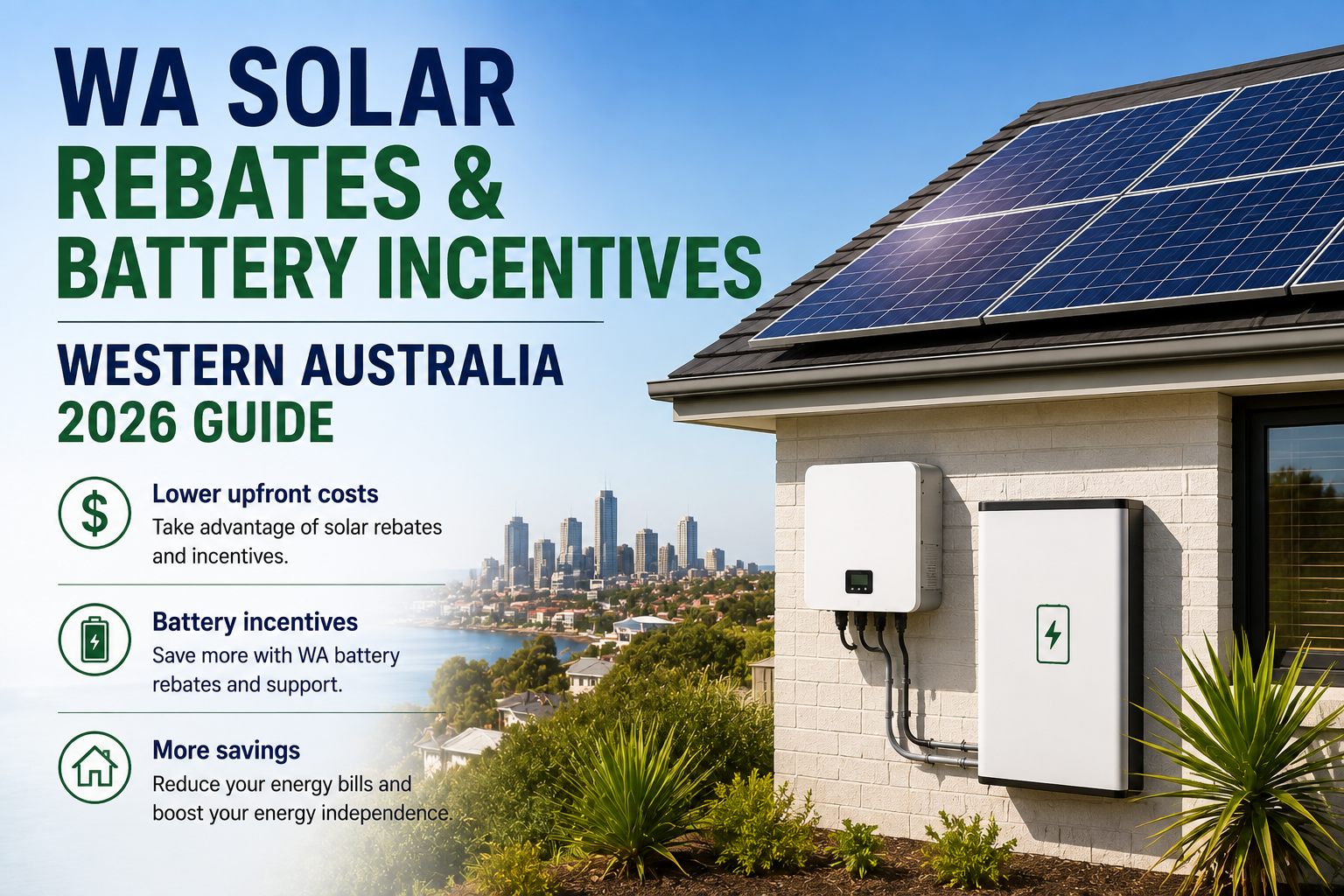
If you’re considering solar panels or a solar battery in Western Australia, understanding the available rebates, incentives, loans and eligibility rules can make a significant difference to your upfront cost and long-term savings.
Unlike some states, WA does not currently offer a broad state rebate for rooftop solar panels themselves. However, WA homeowners may be able to combine the federal Small-scale Renewable Energy Scheme (STCs) for solar with the WA Residential Battery Scheme and the Australian Government’s Cheaper Home Batteries Program.
The important part is timing: federal battery support is scheduled to reduce over time, with the STC factor now stepping down every six months from 1 May 2026.
This guide explains WA solar rebates, WA battery rebates, federal battery incentives, interest-free loans, VPP requirements, rebate reductions, eligibility and how to get a personalised solar + battery quote.
WA Solar Rebates & Incentives at a Glance
| Incentive | What it can help with | 2026 support |
|---|---|---|
| Federal STCs for solar | New eligible solar PV systems | Upfront discount varies |
| Federal Cheaper Home Batteries Program | Eligible batteries | Around 30% upfront discount, subject to STC rules |
| WA Residential Battery Scheme — Synergy | Battery | Up to $1,300 state rebate |
| WA Residential Battery Scheme — Horizon Power | Battery | Up to $3,800 state rebate |
| WA No-Interest Loan | Battery + eligible solar/inverter equipment | Up to $10,000 |
| VPP participation | WA battery scheme eligibility | Generally required |
The WA state battery rebate is capped at 10 kWh of usable battery capacity, while the federal program has different capacity rules and can support eligible batteries up to 100 kWh, with STCs calculated on the first 50 kWh of usable capacity.
1. Is There a WA Solar Panel Rebate in 2026?
There is no general WA state rebate specifically for residential solar panels comparable to the WA battery rebate.
However, eligible rooftop solar installations can still benefit from the federal Small-scale Renewable Energy Scheme (SRES).
Under the SRES, eligible solar systems can generate Small-scale Technology Certificates (STCs). These certificates can generally be assigned to an installer or retailer, who applies their value as an upfront discount.
Your actual discount depends on factors such as:
- System size
- Installation postcode
- Installation year
- STC market value
- Eligibility requirements
- Installer arrangements
What this means for WA homeowners
You don’t necessarily need a WA state solar rebate to reduce your solar installation cost.
A properly structured solar quote can include the applicable federal incentive at the point of sale.
2. WA Residential Battery Scheme
The WA Residential Battery Scheme is one of the most important incentives for WA households considering battery storage.
Eligible:
Synergy customers
Up to $1,300
The state rebate is calculated at $130 per usable kWh, capped at 10 kWh.
Horizon Power customers
Up to $3,800
The state rebate is calculated at $380 per usable kWh, capped at 10 kWh.
A battery larger than 10 kWh can still participate in the WA scheme, but the WA state rebate does not continue increasing beyond the 10 kWh cap.
3. Can WA Battery Rebates Be Combined With the Federal Battery Rebate?
Yes, eligible households can potentially combine the WA state battery rebate with the federal Cheaper Home Batteries Program.
This is where WA homeowners can potentially achieve substantial upfront savings.
For example, the WA Government states that a qualifying 10 kWh battery could receive:
Synergy customer
Up to $5,000 combined support
Horizon Power customer
Up to $7,500 combined support
The exact federal component depends on the battery’s eligibility, installation date, usable capacity and applicable STC factor.
Important: Don’t assume every battery quote will receive the same rebate. Your installer should calculate the actual incentive applicable to your system.
4. Federal Cheaper Home Batteries Program — 2026
The Australian Government’s Cheaper Home Batteries Program provides an upfront discount for eligible battery systems.
The program currently supports eligible battery systems from 5 kWh to 100 kWh nominal capacity, with STCs calculated on eligible usable capacity and subject to the program’s capacity tapering rules.
The government describes the support as being designed to provide around a 30% discount, but the actual dollar discount varies according to battery size, installation date and STC calculations.
Important 2026 change
From 1 May 2026, the federal battery STC factor began reducing every six months rather than annually.
This means the value of the federal battery incentive is not staying at today’s level indefinitely.
5. Federal Battery Rebate Reduction — 2026 to 2030
This is one of the most important things WA homeowners should understand before delaying a battery purchase.
The government has published the following STC factor schedule:
| Installation period | STC Factor | Change from previous period |
| Jan–Apr 2026 | 8.4 | — |
| May–Dec 2026 | 6.8 | ↓ 19.0% |
| Jan–Jun 2027 | 5.7 | ↓ 16.2% |
| Jul–Dec 2027 | 5.2 | ↓ 8.8% |
| Jan–Jun 2028 | 4.6 | ↓ 11.5% |
| Jul–Dec 2028 | 4.1 | ↓ 10.9% |
| Jan–Jun 2029 | 3.6 | ↓ 12.2% |
| Jul–Dec 2029 | 3.1 | ↓ 13.9% |
| Jan–Jun 2030 | 2.6 | ↓ 16.1% |
| Jul–Dec 2030 | 2.1 | ↓ 19.2% |
The published factor falls from 6.8 in May 2026 to 2.1 by July 2030 — a reduction of approximately 69% in the STC factor.
Why this matters
The STC factor is one of the inputs used to calculate the federal battery discount.
So while the government intends to keep the program broadly around a 30% discount as battery prices fall, the number of STCs available per kWh reduces over time.
In simple terms: waiting can mean receiving a smaller federal incentive.
6. Does the Federal Battery Rebate Drop by Exactly the Same Dollar Amount Every Year?
No.
This is an important distinction.
The government is reducing the STC factor, not announcing a fixed dollar amount that every battery will lose each year.
Your actual rebate depends on:
- Battery usable capacity
- Installation date
- STC factor
- Battery size tapering rules
- STC value
- Eligible capacity
- System configuration
From 1 May 2026, the STC factor is applied at:
- 100% for the first 14 kWh
- 60% for capacity above 14 kWh and up to 28 kWh
- 15% for capacity above 28 kWh and up to 50 kWh
This means a 30 kWh battery does not receive three times the federal support of a 10 kWh battery.
This is particularly important for homeowners considering larger 20 kWh, 30 kWh, 40 kWh or 50 kWh battery systems.
7. WA No-Interest Battery Loans
Eligible WA households may also be able to access a no-interest loan of up to $10,000.
The WA Government states that eligible households can access loans from $2,001 to $10,000, with repayment periods of up to 10 years.
The loan can help cover:
- Battery systems
- Solar + battery packages
- Hybrid inverter upgrades
- Eligible solar equipment installed with a battery
The household income eligibility threshold is currently less than $210,000 combined annual income.
Important
A loan is not a rebate.
You still repay the amount borrowed, although eligible applicants can avoid interest charges.
8. Is a Virtual Power Plant (VPP) Required?
For the WA Residential Battery Scheme, VPP participation is an important eligibility requirement.
WA Government information states that rebate and eligible loan participants must join an approved VPP product and enter into the relevant VPP agreement.
A VPP effectively connects multiple household batteries so they can be coordinated as a larger energy resource.
Does joining a VPP mean you lose control of your battery?
Not necessarily.
For example, WA Government information explains that some VPP arrangements may access stored energy only during specified grid-support events and can provide financial benefits to participating households.
Before signing, however, homeowners should understand:
- How often the battery can be controlled
- How much energy can be dispatched
- What financial credits are offered
- Contract length
- Exit conditions
- Battery warranty implications
9. Can I Add a Battery to My Existing Solar System?
Yes, in many cases.
You don’t necessarily need to replace your existing solar system.
However, your installer should assess:
Existing inverter
Is it battery-compatible?
Solar generation
Does your system generate enough excess solar to make the battery worthwhile?
Switchboard
Does your switchboard require upgrades?
Network requirements
Does your local network require additional equipment or export controls?
Battery compatibility
Is the proposed battery approved and compatible with your system?
WA Government guidance specifically notes that batteries can be installed on existing solar systems, although additional technology or system reconfiguration may sometimes be required.
10. WA Solar & Battery Installation Rules Changed in 2026
From 1 May 2026, new connection requirements came into effect for many new or upgraded solar and battery systems connected to the South West Interconnected System (SWIS).
These changes are designed to support more flexible exports, battery participation and future energy products while managing network stability.
This is another reason to have your system assessed by an appropriately accredited professional rather than selecting a battery purely on price.
11. How Much Could You Save With WA Solar + Battery Rebates?
Your actual saving depends on the system you choose.
For example, a homeowner could potentially combine:
Federal solar STCs
+
Federal battery incentive
+
WA battery rebate
+
Potential VPP benefits
+
No-interest loan, if eligible
For a qualifying 10 kWh battery, the WA Government gives examples of combined support of up to:
$5,000 for eligible Synergy customers
or
$7,500 for eligible Horizon Power customers.
However, don’t use these figures as a guaranteed quote. The actual incentive for your property should be calculated based on your specific battery, installation date, electricity retailer, postcode and eligibility.
12. Should You Buy a Battery Now or Wait?
This is one of the most important decisions for homeowners.
Buying sooner may make sense if:
✔ You currently have high electricity bills
✔ You have significant unused daytime solar
✔ You want greater energy independence
✔ You qualify for the WA battery rebate
✔ You qualify for the federal battery incentive
✔ You can benefit from a VPP
✔ You want to secure today’s available incentive before future reductions
Waiting may make sense if:
✔ Your existing solar system isn’t suitable yet
✔ Your electricity consumption is low
✔ You need to upgrade your inverter or switchboard first
✔ Your property circumstances are changing
✔ You want to compare emerging battery technologies
The key point is not simply “buy now because rebates are ending.”
Instead, compare:
Current system cost – current incentives – expected annual savings
against
Future system cost – future incentives – expected annual savings.
Because battery prices may also decline, the best decision depends on the net cost and expected savings, not the rebate percentage alone.
13. How to Maximise Your WA Solar & Battery Savings
Before signing a contract:
1. Compare the complete system price
Don’t compare only the advertised rebate.
Compare:
System price → incentives → final installed price.
2. Ask for the exact rebate calculation
Ask your installer:
“How much federal battery incentive am I receiving, and how was it calculated?”
3. Check the WA rebate
Confirm whether you’re a:
- Synergy customer
- Horizon Power customer
4. Check VPP requirements
Understand the VPP agreement before signing.
5. Check your battery’s usable capacity
Don’t compare batteries using nominal capacity alone.
6. Check inverter compatibility
Your existing solar inverter may affect installation cost.
7. Get multiple quotes
The cheapest advertised battery isn’t necessarily the cheapest complete system.
14. What Battery Size Is Right for a WA Home?
Bigger isn’t automatically better.
A battery should be sized around:
- Daily electricity consumption
- Existing solar generation
- Evening/night consumption
- Exported solar
- Electricity tariff
- Battery usable capacity
- Inverter capacity
- Future EV charging
- Backup requirements
For example:
| Household situation | Possible consideration |
| Low electricity usage | Smaller battery |
| Moderate evening usage | Medium battery |
| High electricity consumption | Larger battery |
| Large solar system + high exports | Larger storage may make sense |
| EV household | Consider future charging demand |
| High evening consumption | Battery can be particularly valuable |
A professional assessment is more useful than choosing a battery simply because it has the biggest capacity.
15. WA Solar + Battery Rebate Checklist
Before accepting a quote, ask:
Solar
☐ Is my system eligible for federal STCs?
☐ How much is the STC discount?
☐ Is the discount already included in the advertised price?
Battery
☐ Is the battery eligible under the federal program?
☐ What is its usable capacity?
☐ How many STCs will it generate?
☐ What STC factor applies on my installation date?
WA rebate
☐ Am I eligible for the Synergy or Horizon Power rebate?
☐ What state rebate will I receive?
☐ Is VPP participation required?
Installation
☐ Is the installer Solar Accreditation Australia (SAA)-accredited?
☐ Is the battery approved for the relevant program?
☐ Does my existing inverter need upgrading?
☐ Does my switchboard need upgrading?
☐ Are network connection requirements included?
Finance
☐ Am I eligible for the WA no-interest loan?
☐ What is the total amount I will repay?
☐ Are there any administration or other fees?
16. WA Solar & Battery Rebate FAQs
1. Is there a WA solar panel rebate in 2026?
There is no general WA state rebate specifically for residential solar panels. However, eligible systems can receive support through the federal STC scheme.
2. How much is the WA battery rebate?
Eligible Synergy customers can receive up to $1,300, while eligible Horizon Power customers can receive up to $3,800 through the WA Residential Battery Scheme.
3. Can I combine the WA battery rebate with the federal battery rebate?
Yes, eligible households can potentially combine the WA state battery incentive with the federal Cheaper Home Batteries Program.
4. How much can the combined rebate be?
For a qualifying 10 kWh battery, the WA Government gives examples of up to $5,000 for Synergy customers and $7,500 for Horizon Power customers, subject to eligibility and applicable federal rules.
5. Is the federal battery rebate reducing?
Yes. The STC factor is scheduled to reduce every six months from 2026 through 2030. The factor is 6.8 for May–December 2026 and falls to 2.1 for July–December 2030.
6. How much does the federal rebate reduce each year?
There isn’t one fixed dollar reduction because the rebate depends on battery size and STC value. However, the published STC factor falls from 6.8 in May 2026 to 5.7 in January 2027, 4.6 in January 2028, 3.6 in January 2029 and 2.6 in January 2030.
7. Do I need solar before installing a battery?
Not necessarily. The federal program can support batteries connected to existing solar, new solar, and eligible standalone/off-grid configurations.
8. Do I need to join a VPP?
For the WA Residential Battery Scheme, VPP participation is required for rebate and eligible loan participation.
9. Can I get a WA battery rebate if I already have solar?
Yes. Existing solar can be compatible with the WA battery scheme, although your system may require additional equipment or reconfiguration.
10. Can I get an interest-free loan?
Eligible WA households may be able to access a no-interest loan of up to $10,000, subject to the scheme’s eligibility and lending requirements.
11. Is a bigger battery always better?
No. The correct battery size depends on your solar generation, electricity consumption, export profile, inverter and future energy needs.
12. How do I know how much I can save?
The best approach is to calculate your current electricity usage, solar generation, exports and evening consumption, then compare an appropriately sized battery against your available incentives.
17. Get Your WA Solar & Battery Rebate Assessment
WA homeowners have a unique opportunity to combine federal solar incentives, federal battery support and the WA Residential Battery Scheme where eligible.
But the value of these incentives can change over time — particularly the federal battery component, where the STC factor is scheduled to continue stepping down through 2030.
Instead of relying on a generic advertised price, get a personalised assessment based on your:
📍 WA postcode
⚡ Current electricity bill
☀️ Existing solar system
🔋 Desired battery capacity
🏠 Household energy consumption
🚗 Future EV requirements
💰 Available rebates and incentives
Get Your Free Solar + Battery Quote From Solar Authority
Find out what you could qualify for, what your final installed price could be, and which system size makes the most financial sense for your home.
👉 Request your free personalised WA solar & battery quote today.
Rebate amounts, eligibility, STC values and program rules can change. Final incentives should be confirmed against the applicable government requirements at the time of installation.