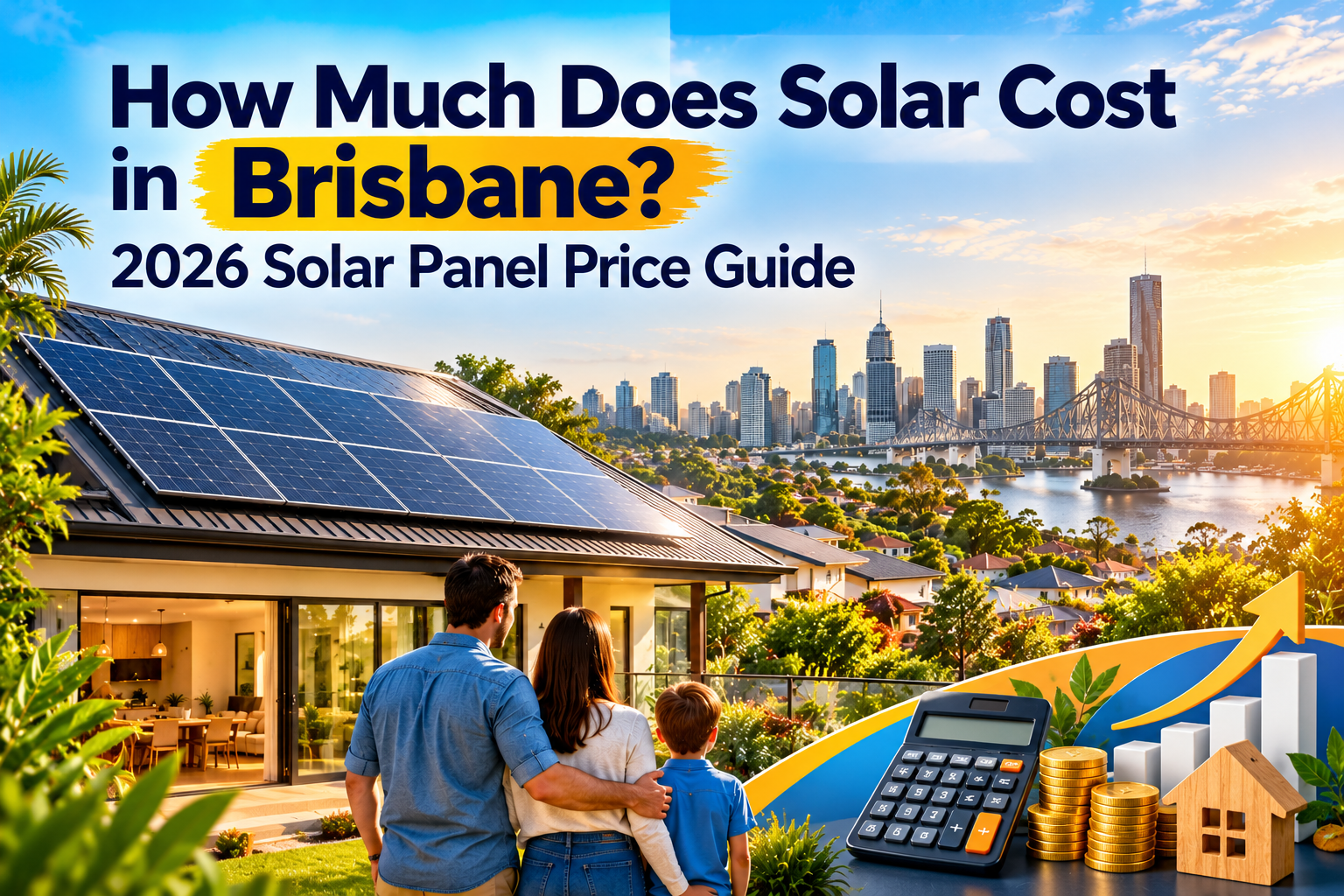
If you’re considering solar power for your Brisbane home, one of the first questions you’re likely to ask is:
How much do solar panels cost in Brisbane?
The answer depends on the size and quality of the system, your roof, installation requirements, equipment selected, available incentives and how much electricity your household uses.
A typical Brisbane residential system can range from a smaller system for lower electricity consumption to a much larger installation designed for high-energy households, batteries, electric vehicles or future electrification.
This 2026 guide explains the major costs involved in buying solar panels in Brisbane, what influences the final quote and how to compare solar systems without choosing purely on price.
Brisbane Solar Panel Prices in 2026
Published market guides provide useful benchmarks, but they should not be treated as universal quotes.
For example, a current Brisbane cost guide from hipages places a typical 6.6 kW system at around $5,530 after STCs, while noting that pricing varies according to system size and other factors.
Your actual price can be different.
Two homes in Brisbane can receive very different quotes for the same nominal system size because of differences in:
- Roof design
- Roof material
- Roof pitch
- Shading
- Electrical work
- Switchboard requirements
- Panel brand
- Inverter brand
- Mounting system
- Installation complexity
- Warranty
- Installer experience
- Battery integration
- Backup requirements
For this reason, it is better to think about solar pricing as a range rather than one fixed Brisbane price.
How Much Does a 6.6kW Solar System Cost in Brisbane?
A 6.6kW solar system remains a popular residential size because it can provide a useful balance between generation capacity and upfront cost for many households.
A current published Brisbane benchmark puts the average cost around $5,530 after STCs, although individual quotes can be higher or lower depending on equipment and installation requirements.
A 6.6kW system may be suitable for:
- Small to medium households
- Homes with moderate electricity consumption
- Properties with suitable roof space
- Households wanting to reduce daytime electricity purchases
However, the ideal system size should be determined by your electricity consumption and future plans.
How Much Does a 10kW Solar System Cost in Brisbane?
A 10kW solar system can be attractive for households with higher electricity consumption.
It may make sense if your home has:
- Multiple air conditioners
- A swimming pool
- Electric hot water
- An EV
- Large daytime electricity demand
- High annual electricity consumption
- Plans to electrify additional appliances
The final cost depends on the panel and inverter combination and installation conditions.
A 10kW system also requires enough suitable roof space and should be assessed against your property’s electricity connection and export arrangements.
What Is Included in a Solar Installation Quote?
A professional solar quote should clearly explain what you’re paying for.
A typical residential solar installation may include:
Solar panels
The panels generate DC electricity from sunlight.
Solar inverter
The inverter converts generated electricity into usable AC electricity and manages the flow of energy between the solar system, home and grid.
Mounting system
The mounting structure attaches the panels securely to the roof.
Electrical protection
The installation includes the relevant electrical protection, isolators and associated equipment required for a compliant installation.
Installation labour
This covers the labour involved in mounting panels, installing the inverter, electrical connections, commissioning and system setup.
Monitoring
Many modern solar systems provide an app or online portal to monitor generation and energy performance.
The exact inclusions vary between installers and system designs.
What Makes Solar Panels More Expensive?
The cheapest solar quote isn’t always the cheapest system over its lifetime.
Several factors can increase the initial price.
1. Premium solar panels
Higher-quality panels may cost more but can offer benefits such as higher efficiency, stronger warranties and better long-term performance.
2. Better inverter technology
The inverter is a critical component of your system.
Factors such as efficiency, warranty, monitoring, MPPT configuration and battery compatibility can influence the price.
3. Complex roof installation
A straightforward single-storey roof is generally simpler to install than a property with multiple roof sections, steep roof areas, difficult access or extensive shading.
4. Switchboard upgrades
Older electrical systems may require additional work before a new solar system can be installed.
5. Battery integration
If you want to add a battery now—or potentially later—you may want an inverter and system architecture that can support future storage.
Solar Rebates and STCs in Brisbane
One of the biggest factors affecting the upfront cost of rooftop solar in Australia is the Small-scale Renewable Energy Scheme (SRES).
Eligible solar installations can receive Small-scale Technology Certificates, commonly known as STCs.
The certificates are generally assigned to the installer or retailer in exchange for an upfront discount on the system price.
The value depends on factors including system size and the installation location.
This is why solar quotes should clearly show whether the advertised price is:
Before incentives or after incentives.
Always confirm exactly what is included.
Does Brisbane Still Make Sense for Solar in 2026?
For many homeowners, solar remains attractive because the system can generate electricity during daylight hours and reduce the amount of power purchased from the grid.
However, the value of solar depends on how the electricity is used.
For example, a household that consumes substantial electricity during the day may directly use a large portion of its solar generation.
Another household may generate a lot of solar power while everyone is at work and school, then use most electricity in the evening.
The second household may benefit from considering battery storage as well.
This is why system design should start with energy consumption, not simply the largest available panel package.
Should You Buy Solar Panels or Solar Panels Plus a Battery?
It depends on your energy profile.
Solar panels alone may be suitable if:
- You use a lot of electricity during the day
- You want lower upfront costs
- You have limited evening electricity consumption
- You prefer to add storage later
Solar plus battery may be worth considering if:
- You use significant electricity after sunset
- You have substantial excess solar generation
- You want higher solar self-consumption
- You want backup power
- You have an EV
- You want greater energy independence
The federal Cheaper Home Batteries Program currently provides around 30% support for eligible small-scale battery systems, subject to the program’s eligibility and STC rules.
What Solar System Size Do You Need?
There is no universal answer.
Your ideal solar system size depends on:
- Annual electricity consumption
- Daytime electricity usage
- Roof area
- Roof orientation
- Roof shading
- Budget
- EV ownership
- Battery plans
- Future electricity consumption
For example, a household with an EV may need substantially more solar generation than a similar household without one.
Likewise, a family with a pool and multiple air conditioners may require a larger system than a smaller household.
Solar Panel Quality Matters
When comparing solar panels in Brisbane, don’t judge products only by their wattage.
Consider:
- Panel efficiency
- Product warranty
- Performance warranty
- Temperature coefficient
- Degradation rate
- Manufacturer reputation
- Approved-product status
- Installer support
Solar Authority recommends considering CEC-approved solar panels, inverters and batteries where applicable to government incentive eligibility and industry requirements.
How Much Can Solar Save You?
Solar savings depend on how much electricity your system generates and how much of that electricity your household actually uses.
Savings are influenced by:
- Solar generation
- Electricity rates
- Feed-in tariff
- Self-consumption
- System size
- Household consumption
- Battery storage
- Future electricity prices
For this reason, avoid choosing a solar system based on a generic savings claim.
A personalised assessment should consider your actual electricity bills and consumption profile.
How Long Does Solar Take to Pay for Itself?
Solar payback can be estimated by comparing your net system cost with expected annual savings.
For example:
Payback period = Net system cost ÷ estimated annual savings
But this is only a simplified calculation.
Real-world performance can change because electricity prices, feed-in tariffs, household consumption and system output can vary.
A good solar quote should explain the assumptions used to calculate projected savings.
How to Compare Solar Quotes in Brisbane
When comparing installers, don’t simply choose the lowest number.
Compare:
| Factor | What to check |
|---|---|
| System size | kW of panels |
| Inverter | Brand, model and capacity |
| Panels | Brand, efficiency and warranties |
| Installation | What’s included |
| STCs | Is the incentive already deducted? |
| Warranty | Product and workmanship |
| Monitoring | App/online monitoring |
| Battery compatibility | Future upgrade potential |
| Installer | Accreditation and experience |
| After-sales service | Who handles support? |
A $5,000 system and a $7,000 system aren’t necessarily comparable if they use different equipment and installation standards.
Why Solar Authority?
Solar Authority is an independent platform focused on helping Australians make better-informed home energy decisions.
Instead of encouraging homeowners to choose a solar package simply because it is advertised as cheap, Solar Authority provides information about:
- Solar panel systems
- Solar battery storage
- Solar inverters
- Government incentives
- CEC-approved products
- SAA-accredited installers
- Electricity plans
- Solar savings
- Battery sizing
When you’re ready, Solar Authority can help connect you with trusted installers who can assess your property and energy requirements.
Is Solar Worth It in Brisbane in 2026?
For many Brisbane households, solar can be an effective way to generate electricity on-site and reduce reliance on purchased grid electricity.
But the best system isn’t necessarily the biggest or cheapest.
It should be appropriately sized for your home, use quality equipment and be installed correctly.
Before buying, compare the complete system specification—not just the advertised price.
Look at the panels, inverter, installation, warranties, incentives, monitoring and future battery compatibility.
Frequently Asked Questions
How much do solar panels cost in Brisbane?
The cost depends on system size, equipment, installation complexity and applicable incentives. A current published Brisbane benchmark places a typical 6.6kW system at around $5,530 after STCs, but individual quotes vary.
Is 6.6kW enough for a Brisbane home?
It can be suitable for many households, but the right size depends on electricity consumption, roof space and future energy requirements.
Is 10kW solar worth it in Brisbane?
It can be useful for higher-energy households, particularly those with EVs, pools, multiple air conditioners or significant electricity consumption.
Are solar rebates still available in Brisbane?
Eligible rooftop solar systems can benefit from the federal SRES through STCs. Eligibility and certificate values depend on the system and installation circumstances.
Should I install a battery at the same time?
Not necessarily. Some households benefit from adding a battery immediately, while others may prefer to install solar first and add storage later.
How do I choose a solar installer in Brisbane?
Compare accreditation, equipment, installation standards, warranties, reviews, quote transparency and after-sales support—not just price.
Are CEC-approved products important?
Yes. Approved products can be important for eligibility under relevant government incentive schemes and for meeting applicable industry requirements.