Solar panels are the backbone of residential renewable energy. But have you ever wondered how they’re actually made — from raw materials to the finished product on your roof? This page explains the full solar panel manufacturing process, key components, and why quality matters.
📌 What a Solar Panel Is Made Of
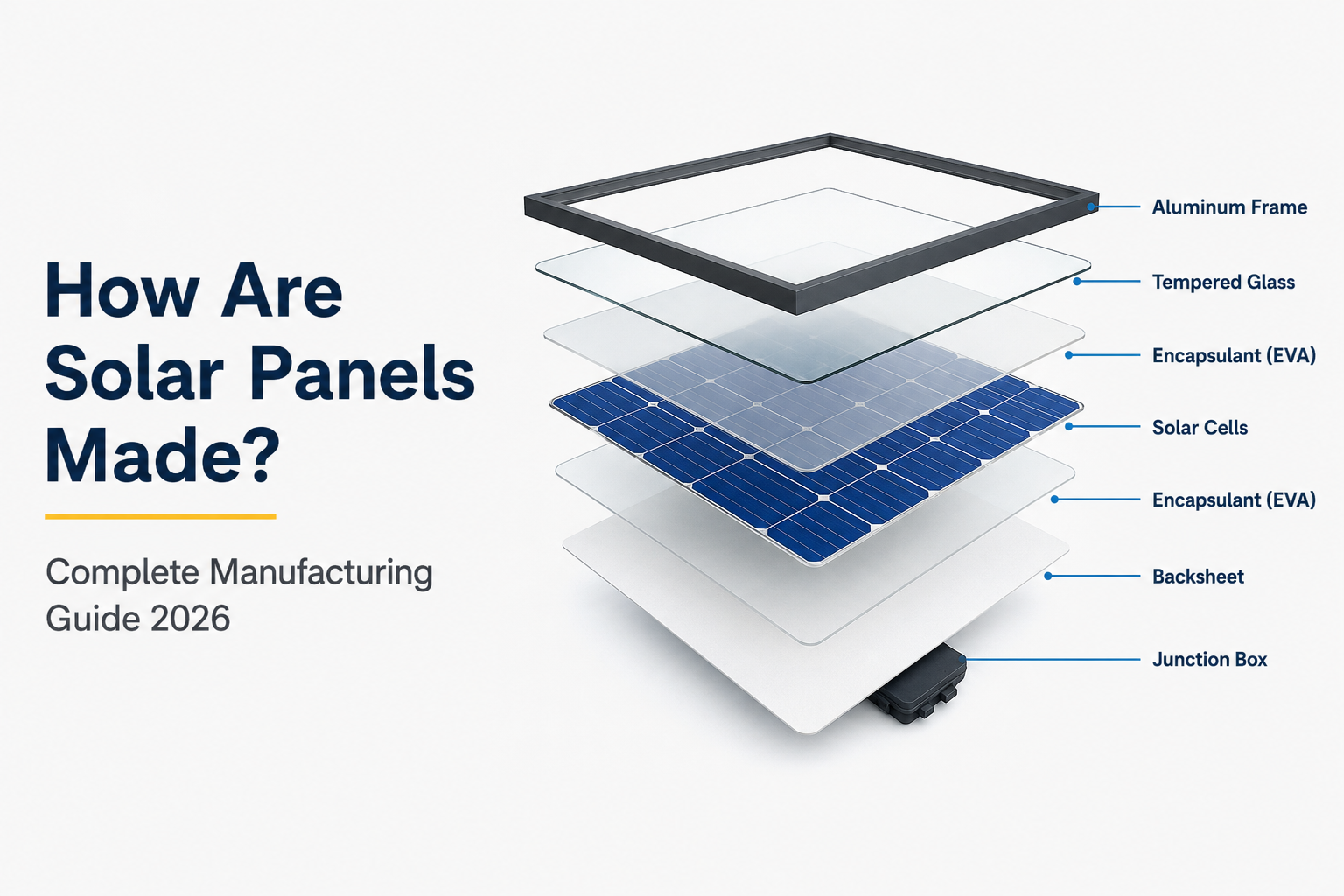
A solar panel (photovoltaic module) consists of multiple solar cells inside a protective structure that captures sunlight and converts it into electricity:
· Silicon cells (the electrical energy generators)
· Tempered glass on the front
· Encapsulant layers (EVA)
· Backsheet polymer layers
· Aluminium frame and junction box
🌞 Step-by-Step: How Solar Panels Are Made
- Making High-Purity Silicon
Solar panel production starts with silicon, one of the most abundant elements in the Earth’s crust. Raw silica sand is refined into high-purity silicon, often exceeding 99.9 % purity. This refined silicon forms cylindrical ingots, which are the basic material for solar cells.
- Cutting Silicon Wafers
The silicon ingots are sliced into very thin wafers — similar to cutting a loaf of bread — using precision diamond wire saws. These silicon wafers are the foundation of solar cells.
- Doping & Cell Production
To create electrical energy, wafers are doped with elements like boron and phosphorus, which create a positive and negative charge layer. This forms a p-n junction — the heart of photovoltaic action.
Microscopic metal contacts (called busbars and fingers) are added so electrons can flow efficiently when sunlight hits the cell.
- Assembling Solar Cells Into Panels
Solar cells are then arranged in rows and columns (usually 60 or 72 cells per panel) and connected with wiring. These cells are sandwiched between protective layers of EVA plastic and tempered glass, then sealed within an aluminium frame for rigidity and weather protection.
A junction box is added on the back to allow electrical connection to inverters and the home system.
- Lamination & Sealing
The panel undergoes lamination, where heat and pressure permanently bond the cell layers, encapsulants, and glass. This process creates a durable, weather-resistant module.
- Quality Control & Testing
Before leaving the factory, solar panels are tested for:
· Output power versus rating
· Physical defects (cracks, bubbles, impurities)
· Longevity and resistance to moisture or heat
Panels must meet strict manufacturing standards, which vary by region (including specific Australian certification rules if you want to sell or install them locally).
🏭 Where Are Solar Panels Made?
While small manufacturing exists in some countries, the majority of solar panel production happens in China and other Asian countries. Small-scale production and niche manufacturing also occur in regions including Europe and parts of North America and Australia.
🧠 Why the Manufacturing Process Matters
The way panels are made affects:
· Efficiency — how much solar energy is converted to electricity
· Durability — resistance to weather and degrading over decades
· Cost — automation and precision lower prices
Advanced manufacturing techniques, better materials, and strict testing protocols all contribute to higher quality and longer-lasting solar panels.
📈 SEO Keywords & Phrases to Target
To help this article rank well, include these top keywords:
· how are solar panels made
· solar panel manufacturing process
· solar panels made of what materials
· photovoltaic panel production steps
· how solar cells are manufactured
· solar panel factory process
· solar panel components explained
🔍 Recommended SEO Title & Meta
Title Tag: How Are Solar Panels Made? Complete Manufacturing Guide (2026)
Meta Description: Learn how solar panels are made — from raw silicon to a finished PV module. Discover the full manufacturing process, materials used, and why quality matters.
❓ FAQ (Great for Featured Snippets)
Q: What material are solar panels mostly made of?
A: Most solar panels use high-purity silicon cells enclosed in tempered glass and an aluminium frame.
Q: Are solar panels made in Australia?
A: While small manufacturing exists, most panels on the Australian market are produced overseas, especially in China and parts of Asia.
Q: Why is testing important in solar panel manufacturing?
A: Testing ensures panels meet performance and durability standards before installation.