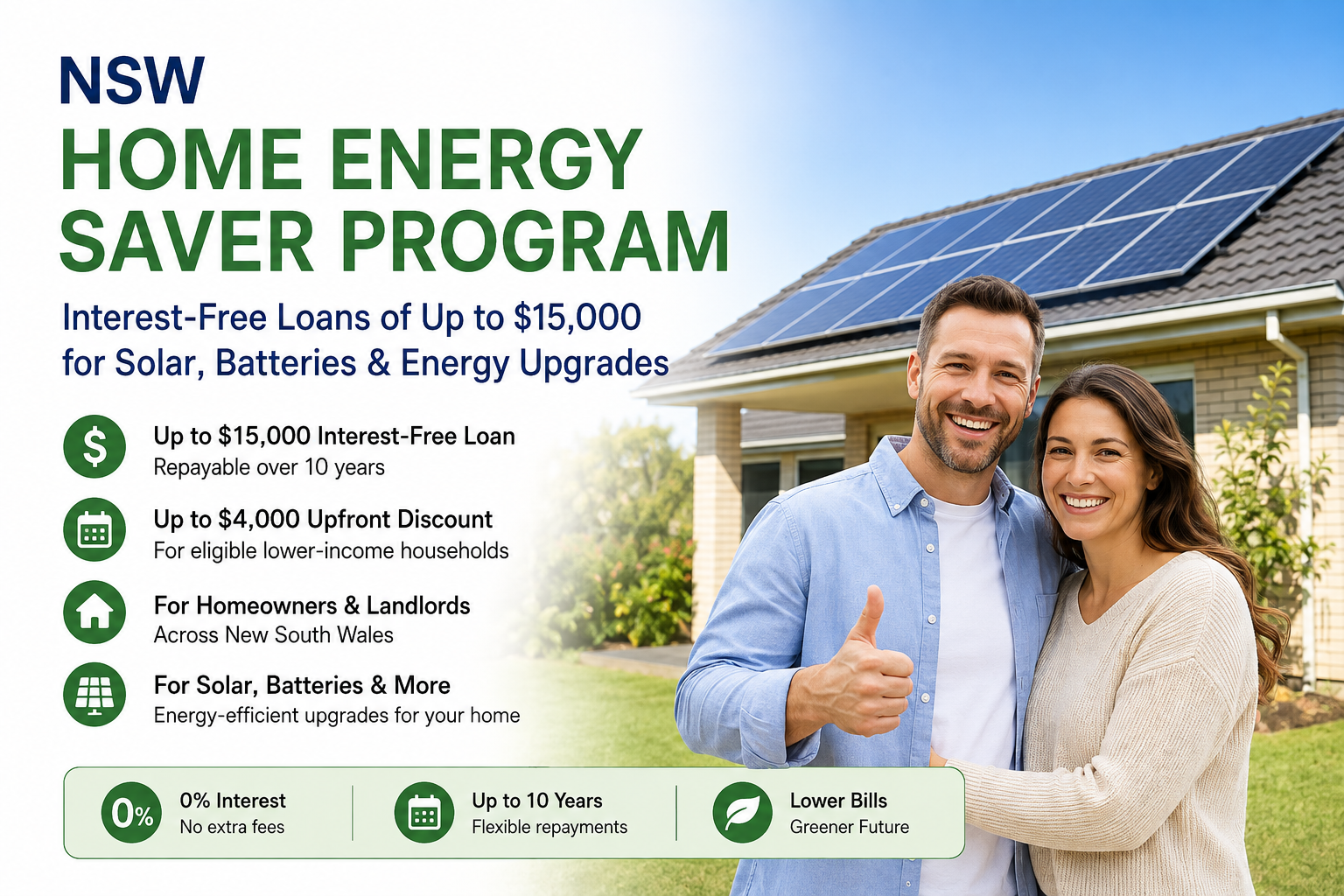
If you’ve been thinking about installing solar panels, a home battery, insulation, or other energy-efficient upgrades, the new NSW Home Energy Saver Program could make your project much more affordable.
Launched by the NSW Government, the program offers eligible homeowners and landlords access to interest-free loans of up to $15,000, repayable over 10 years, to help reduce the upfront cost of energy-saving improvements. In addition, some lower-income households may also qualify for up to $4,000 in upfront discounts, making the transition to cleaner energy even more accessible.
As electricity prices continue to rise across New South Wales, more households are looking for practical ways to reduce their energy bills while improving the comfort and value of their homes.
Installing rooftop solar, battery storage, efficient heating and cooling, insulation, and electric appliances can significantly reduce ongoing energy costs—but the initial investment has often been a barrier.
The Home Energy Saver Program is designed to remove that barrier by providing affordable, interest-free finance for eligible upgrades. Better still, the loan can often be combined with existing federal renewable energy incentives, allowing households to reduce both the upfront cost and long-term running costs of their home.
Whether you’re a homeowner wanting to cut electricity bills, a landlord looking to improve your property’s energy efficiency, or a family planning to install a battery before summer, this guide explains everything you need to know.
On This Page
- At a Glance
- What Is the NSW Home Energy Saver Program?
- Key Benefits of the Program
- How Much Financial Assistance Is Available?
- What Can the Loan Be Used For?
- Who Is Eligible?
- Why the NSW Government Introduced This Program
- How Much Could You Save?
- Frequently Asked Questions
- Next Steps
At a Glance
| Feature | Details |
|---|---|
| Program | NSW Home Energy Saver Program |
| Launch Date | June 2026 |
| Available Now | Yes |
| Loan Amount | Up to $15,000 |
| Interest Rate | 0% (Interest-Free) |
| Repayment Period | Up to 10 Years |
| Additional Discount | Up to $4,000 for eligible lower-income households |
| Available To | Eligible NSW homeowners and landlords |
| Eligible Technologies | Solar panels, battery storage, insulation, heat pump hot water, air conditioning, EV chargers and more |
What Is the NSW Home Energy Saver Program?
The NSW Home Energy Saver Program is a government initiative designed to help households invest in renewable energy and energy-efficient home improvements without paying large upfront costs.
Instead of requiring homeowners to pay thousands of dollars upfront for solar panels, battery storage, or other eligible upgrades, the program allows qualifying applicants to spread the cost over several years through an interest-free loan.
Unlike a standard personal loan, no interest is charged on the borrowed amount.
Homeowners simply repay the approved loan balance over the agreed repayment period, making energy upgrades more affordable for many households.
The program replaces and expands on the earlier Empowering Homes Program, offering:
- Higher loan limits.
- Higher household income thresholds.
- More eligible technologies.
- Longer repayment periods.
- Support for a wider range of NSW households.
The NSW Government introduced the program to help families lower electricity bills, improve energy efficiency, reduce greenhouse gas emissions, and support Australia’s transition to cleaner energy.
Why Is the Home Energy Saver Program Important?
Electricity prices have increased significantly over the past few years, placing pressure on household budgets across New South Wales.
Many homeowners know that installing solar panels or a battery can reduce their electricity bills, but the upfront investment has prevented many families from making the switch.
The Home Energy Saver Program helps overcome that challenge by reducing the financial barrier to investing in clean energy.
Some of the biggest benefits include:
- Lower electricity bills.
- Reduced dependence on rising energy prices.
- Improved home comfort.
- Increased property value.
- Reduced carbon emissions.
- Greater energy independence.
- Affordable interest-free repayments.
For many households, the monthly savings on electricity bills can help offset a significant portion of the loan repayments, making the upgrades more manageable from a cash-flow perspective.
Key Benefits of the NSW Home Energy Saver Program
The program offers several advantages compared with traditional financing options.
Interest-Free Finance
Unlike bank loans or personal finance products, borrowers pay 0% interest, meaning every repayment goes directly towards reducing the loan balance.
Higher Loan Limits
Eligible households can borrow up to $15,000, allowing them to finance larger renewable energy projects or combine multiple upgrades into one installation.
Flexible Repayment Periods
Loans can be repaid over up to 10 years, helping keep repayments affordable.
Support for Multiple Technologies
The program isn’t limited to solar panels. It supports a range of technologies designed to reduce household energy consumption and improve efficiency.
Potential Additional Discounts
Eligible lower-income households may also receive up to $4,000 in upfront discounts, reducing the amount that needs to be financed.
How Much Financial Assistance Is Available?
The financial assistance available depends on your eligibility and the upgrades you plan to install.
Interest-Free Loan
Eligible households may receive:
- Up to $15,000 in finance.
- 0% interest.
- Repayment terms of up to 10 years.
- No early interest charges.
The approved loan amount will depend on the cost of your project and the lending assessment completed by an approved finance provider.
Additional Upfront Discounts
Some lower-income households may also qualify for:
- Up to $4,000 in additional financial assistance.
- Reduced upfront installation costs.
- Lower overall borrowing requirements.
Eligibility for discounts is assessed under separate program criteria.
What Can the Loan Be Used For?
One of the biggest strengths of the NSW Home Energy Saver Program is its flexibility.
Rather than supporting only one technology, the program allows homeowners to finance a range of approved energy-saving upgrades that work together to reduce electricity consumption and improve comfort.
Solar Panels
Installing rooftop solar remains one of the most effective ways to lower electricity bills.
Solar panels generate clean electricity during daylight hours, allowing households to reduce the amount of electricity purchased from the grid.
Benefits include:
- Lower electricity bills.
- Reduced reliance on the grid.
- Lower carbon emissions.
- Increased property value.
- Long-term energy savings.
Home Battery Storage
Battery storage allows homeowners to store excess solar energy generated during the day for use during the evening or when electricity prices are higher.
Benefits include:
- Greater use of your own solar power.
- Reduced electricity imports from the grid.
- Protection against future electricity price increases.
- Potential participation in Virtual Power Plant (VPP) programs.
- Improved energy independence.
Heat Pump Hot Water Systems
Hot water is one of the largest energy users in many Australian homes.
Replacing an older electric or gas hot water system with an efficient heat pump can significantly reduce energy consumption while providing reliable hot water year-round.
Reverse-Cycle Air Conditioning
Modern reverse-cycle air conditioners provide highly efficient heating and cooling compared with older systems.
Eligible households may be able to finance the installation of energy-efficient units that improve comfort while lowering electricity usage.
Insulation
Proper insulation helps keep homes cooler during summer and warmer during winter.
Adding or upgrading insulation can:
- Reduce heating costs.
- Reduce cooling costs.
- Improve indoor comfort.
- Lower overall household energy consumption.
Draught Proofing
Small gaps around doors and windows allow conditioned air to escape.
Draught proofing helps improve energy efficiency by reducing unwanted airflow and improving the effectiveness of heating and cooling systems.
Double-Glazed Windows and Doors
Double glazing improves insulation by reducing heat transfer through glass.
Benefits include:
- Improved thermal performance.
- Lower heating and cooling costs.
- Reduced outside noise.
- Greater year-round comfort.
Switchboard Upgrades
Some renewable energy technologies require modern electrical infrastructure.
Where eligible, switchboard upgrades can help ensure your home’s electrical system is suitable for new solar panels, batteries, EV chargers, or heat pumps.
EV Chargers
Households purchasing an electric vehicle may also be able to install a Level 2 EV charger through the program, making home charging faster, safer, and more convenient.
Charging your EV using rooftop solar can further reduce transport costs and maximise the value of your solar energy.
Induction Cooktops
Replacing older gas appliances with induction cooking is another step towards home electrification.
Induction cooktops are:
- Highly energy efficient.
- Fast to heat.
- Easy to clean.
- Better for indoor air quality than gas appliances.
Combining Multiple Upgrades
One of the biggest advantages of the program is that households may be able to combine several eligible technologies into a single project.
For example, a homeowner could install:
- A 10kW solar system.
- A home battery.
- A heat pump hot water system.
- An EV charger.
By upgrading multiple systems at once, homeowners can improve their home’s overall energy efficiency while reducing future installation costs.
Who Is Eligible for the NSW Home Energy Saver Program?
The NSW Home Energy Saver Program has been designed to assist a broad range of homeowners and landlords across New South Wales. While eligibility requirements should always be confirmed through the official NSW Government guidelines or an approved lender, applicants generally need to meet the following criteria.
Basic Eligibility Requirements
To qualify for the program, you will generally need to:
- Be an Australian citizen or permanent resident.
- Own a residential property located in New South Wales.
- Be either an owner-occupier or a landlord.
- Have a combined taxable household income of $210,000 or less per year.
- Meet the lending and credit assessment requirements of an approved finance provider.
- Install eligible products supplied and installed by participating providers where required under the program.
Properties used for short-term accommodation or social and community housing are generally not eligible under the current program guidelines.
Can Landlords Apply?
Yes.
Unlike many previous energy incentive programs, the Home Energy Saver Program is available to eligible landlords as well as owner-occupiers.
This allows landlords to improve the energy efficiency of their investment properties while helping tenants benefit from lower electricity bills and improved comfort.
Energy-efficient rental properties can also become more attractive to prospective tenants and may increase the long-term value of the property.
Can Apartment Owners Apply?
Yes, although additional approvals may be required.
Owners of apartments, townhouses, or strata properties may be eligible to apply. However, if the upgrade affects common property or shared infrastructure, approval from the Owners Corporation or Strata Committee is usually required before installation can proceed.
If you’re unsure whether your property qualifies, speak with your strata manager before requesting installation quotes.
How Does the Home Energy Saver Loan Work?
The program is designed to make energy upgrades affordable without requiring households to pay thousands of dollars upfront.
The process is generally straightforward.
Step 1 – Compare Quotes
Start by obtaining quotes from experienced and reputable installers. Comparing multiple quotes helps you understand pricing, product quality, warranties, and expected energy savings.
Step 2 – Choose Your Upgrades
Decide which eligible technologies best suit your home and budget.
Examples include:
- Solar panels
- Battery storage
- Heat pump hot water
- Insulation
- Air conditioning
- EV charger
- Double glazing
Many households choose to complete several upgrades at the same time to maximise long-term savings.
Step 3 – Apply for Finance
Once you’ve selected your preferred installer and system, you’ll apply through one of the approved finance providers participating in the Home Energy Saver Program.
The lender will assess your application and determine whether you qualify for the interest-free loan.
Step 4 – Installation
After finance approval, your installer will complete the installation in accordance with Australian Standards and applicable government program requirements.
Step 5 – Loan Repayments
Once the installation is complete, you’ll begin repaying the loan over the agreed repayment period of up to 10 years.
Because the loan is interest-free, every repayment goes directly toward reducing the loan balance.
Can the Home Energy Saver Program Be Combined With Other Rebates?
Yes, and this is one of the biggest advantages of the program.
Rather than replacing existing renewable energy incentives, the Home Energy Saver Program is designed to work alongside them where eligibility rules allow.
Depending on your project, you may be able to combine:
- Australian Government Cheaper Home Batteries Program
- Small-scale Technology Certificates (STCs)
- NSW Government renewable energy initiatives
- Interest-free Home Energy Saver financing
Typically, any available rebates are applied first, reducing the purchase price before calculating the amount that needs to be financed through the loan.
This means you’ll borrow less while still benefiting from interest-free repayments.
Example: Combining Solar, Battery and Government Incentives
Imagine you’re installing:
- 10kW solar system
- 13.5kWh home battery
- EV charger
Illustrative Example
| Item | Cost |
|---|---|
| Solar & Battery Package | $18,500 |
| STC Solar Discount | -$3,200 |
| Federal Battery Incentive | -$3,500 |
| Net System Cost | $11,800 |
| Home Energy Saver Loan | $11,800 |
Instead of paying almost $19,000 upfront, your household finances the remaining eligible amount through an interest-free loan and repays it over several years.
Figures are illustrative only. Actual rebates and loan amounts depend on your system, eligibility, and current incentive values.
How Much Could You Save?
Every home is different, but households installing solar panels and battery storage often experience substantial reductions in electricity costs.
Savings depend on factors including:
- Household electricity usage
- Solar system size
- Battery capacity
- Electricity tariff
- Feed-in tariff
- Time of energy use
- Weather conditions
- Future electricity prices
Indicative annual savings may look like this:
| Home Type | Estimated Annual Electricity Savings* |
|---|---|
| Small Household | $800–$1,400 |
| Family Home | $1,500–$2,800 |
| Large Home with Battery | $2,500–$4,500 |
*Illustrative estimates only. Actual savings will vary.
Is the Home Energy Saver Program Worth It?
For many NSW households, the answer is yes.
The program removes one of the biggest barriers to renewable energy adoption—the upfront cost.
It may be particularly worthwhile if you:
- Have high electricity bills.
- Own your home.
- Plan to stay in your property for several years.
- Already have solar and want to add battery storage.
- Are building or renovating.
- Want to replace ageing appliances with efficient electric alternatives.
- Own an electric vehicle or plan to buy one.
Households that consume a significant amount of electricity generally see the greatest financial benefit.
Who Benefits the Most?
The Home Energy Saver Program may be especially valuable for:
- Families with high electricity usage.
- Homes with swimming pools.
- Households using electric heating and cooling.
- People working from home.
- Electric vehicle owners.
- Homeowners replacing gas appliances.
- Households planning major renovations.
- Homes with older insulation or inefficient appliances.
Things to Consider Before Applying
Although the program offers significant financial benefits, homeowners should carefully evaluate whether the upgrades suit their needs.
Compare Multiple Quotes
Don’t accept the first quote you receive.
Compare several installers based on:
- Product quality
- Warranty
- Installation experience
- Customer reviews
- After-sales support
Choose Quality Products
The cheapest solar panels or batteries aren’t always the best investment.
Look for manufacturers with:
- Strong Australian support
- Long product warranties
- Proven reliability
- Positive customer reviews
Quality systems generally provide better long-term performance and lower maintenance costs.
Understand Your Energy Usage
Before choosing a battery size, review your electricity bills to understand:
- Daily electricity consumption
- Evening energy usage
- Peak demand
- Seasonal usage patterns
This information helps determine the most appropriate system size.
Think Long Term
Energy upgrades are long-term investments.
Rather than focusing solely on today’s installation cost, consider:
- Electricity savings over 20+ years.
- Future electricity price increases.
- Increased home value.
- Reduced carbon emissions.
- Improved comfort and energy independence.
Common Mistakes to Avoid
Many homeowners can improve their investment outcome by avoiding these common mistakes:
- Buying a battery that’s too large or too small.
- Choosing price over quality.
- Not comparing installer quotes.
- Ignoring warranty conditions.
- Failing to understand electricity tariffs.
- Not checking eligibility before purchasing.
- Missing available government incentives.
- Choosing products that don’t suit future energy needs.
Taking the time to plan your project can improve both the financial return and the long-term performance of your system.
Expert Tip
Before signing any contract, ask your installer to provide:
- Estimated annual electricity savings.
- Estimated payback period.
- Battery performance projections.
- Warranty details.
- Expected system production.
- Estimated reduction in grid electricity usage.
- Total installed cost after rebates and incentives.
This information allows you to compare quotes more accurately and make a more informed investment decision.
Real-World Examples: How the Home Energy Saver Program Can Help
Every household has different energy needs, but the Home Energy Saver Program can make renewable energy upgrades more affordable across a wide range of homes. The following examples are illustrative only and are intended to show how the program may work in practice.
Example 1: Family Installing Solar Panels
Property: 4-bedroom home in Western Sydney
Current Electricity Bill: Approximately $2,800 per year
Upgrade:
- 10kW solar panel system
Outcome:
- Reduced reliance on grid electricity
- Lower daytime electricity costs
- Interest-free repayments spread over several years
- Potential savings on annual electricity bills depending on energy usage
This type of project is well suited to households with high daytime electricity consumption or people working from home.
Example 2: Existing Solar Owner Adding a Battery
Property: 5-year-old home with an existing 6.6kW solar system
Upgrade:
- 13.5kWh battery
Benefits:
- Store excess solar energy instead of exporting it.
- Use stored electricity during the evening.
- Reduce electricity purchased from the grid.
- Improve energy independence.
- Potential eligibility for additional government incentives where applicable.
Example 3: Complete Home Electrification
Property: Owner-occupied family home
Upgrades:
- Solar panels
- Home battery
- Heat pump hot water system
- Reverse-cycle air conditioner
- EV charger
Instead of completing these projects over several years, the household finances the eligible upgrades through one interest-free loan, allowing them to start saving on energy costs sooner.
Home Energy Saver Program vs Traditional Finance
Many homeowners compare the Home Energy Saver Program with using a personal loan or paying cash.
| Feature | Home Energy Saver Program | Standard Personal Loan |
|---|---|---|
| Interest Rate | 0% (eligible applicants) | Interest charged by lender |
| Loan Amount | Up to $15,000 | Depends on lender |
| Repayment Term | Up to 10 years | Varies |
| Supports Renewable Energy | Yes | Not specifically |
| Helps Reduce Upfront Costs | Yes | Yes |
| Government Initiative | Yes | No |
For eligible households, an interest-free loan can significantly reduce the overall cost of financing energy-efficient upgrades compared with a standard loan.
Why More NSW Households Are Installing Solar Batteries
Battery storage has become increasingly popular as electricity prices continue to rise and feed-in tariffs decline.
A home battery allows households to:
- Store unused solar energy during the day.
- Use stored electricity during the evening.
- Reduce reliance on the electricity grid.
- Increase self-consumption of solar energy.
- Prepare for future Virtual Power Plant (VPP) participation where available.
For many households, battery storage complements an existing solar system and provides greater flexibility in managing energy use.
How to Maximise Your Savings
To achieve the best return on your investment, consider the following:
Install Solar and Battery Together
Combining solar panels and battery storage can improve self-consumption and reduce electricity purchased from the grid.
Size Your System Correctly
Installing the right-sized solar system and battery based on your household’s energy usage is often more effective than choosing the largest available system.
Use Appliances During Solar Production
Running high-energy appliances such as dishwashers, washing machines, pool pumps, or EV charging during daylight hours can maximise the use of solar-generated electricity.
Improve Your Home’s Energy Efficiency
Simple upgrades like insulation, draught proofing, LED lighting, and efficient appliances can reduce overall electricity demand and improve the value of your renewable energy investment.
Compare Multiple Quotes
Request quotes from several reputable installers to compare products, warranties, performance estimates, and after-sales support.
Checklist Before Applying
Before submitting your application, consider the following checklist:
- ✔ Confirm you meet the eligibility requirements.
- ✔ Review your household income.
- ✔ Gather recent electricity bills.
- ✔ Decide which upgrades you want to install.
- ✔ Compare quotes from multiple installers.
- ✔ Review product warranties and certifications.
- ✔ Understand your expected loan repayments.
- ✔ Estimate your expected electricity bill savings.
- ✔ Confirm which government incentives apply.
- ✔ Read the latest NSW Government program guidelines.
Expert Tips Before You Sign a Contract
Before accepting any quote, ask your installer:
- What size solar system is recommended for my home?
- Is a battery financially worthwhile for my electricity usage?
- How much electricity will I generate each year?
- How much will I save on electricity bills?
- What warranties are included?
- Are the products approved for Australian conditions?
- Can this system be expanded in the future?
- Will I be eligible for all available government incentives?
The answers will help you compare proposals and choose the solution that best suits your household.
Solar Authority’s View
The NSW Home Energy Saver Program is one of the most significant household energy initiatives introduced in recent years.
Rather than offering a one-off rebate, the program focuses on making renewable energy more accessible through interest-free finance. This approach can help more households invest in technologies that reduce electricity bills and improve energy efficiency without requiring a large upfront payment.
When combined with available federal incentives, the program has the potential to make solar panels, battery storage, and other energy-saving upgrades more affordable for many NSW homeowners.
However, the best outcome depends on choosing the right products, selecting a reputable installer, and ensuring the upgrades align with your household’s energy needs and long-term plans.
Frequently Asked Questions (FAQs)
1. What is the NSW Home Energy Saver Program?
The NSW Home Energy Saver Program is a government initiative that provides eligible homeowners and landlords with interest-free loans of up to $15,000 for approved energy-saving home upgrades, including solar panels, home batteries, insulation, heat pump hot water systems, and EV chargers.
2. Is the Home Energy Saver Program a rebate?
No. The program primarily provides interest-free finance, not a cash rebate. Eligible lower-income households may also qualify for additional upfront discounts under the program.
3. How much can I borrow?
Eligible applicants may borrow up to $15,000, depending on the approved project cost and lending assessment.
4. Who can apply?
The program is generally available to eligible NSW homeowners and landlords who meet the income, property ownership, and lending criteria established by the NSW Government and participating finance providers.
5. Can I install both solar panels and a battery?
Yes. Many households choose to install both technologies together to maximise energy savings, increase solar self-consumption, and reduce reliance on the electricity grid.
6. Can I combine this program with other government incentives?
In many cases, yes. Eligible households may also access incentives such as Small-scale Technology Certificates (STCs) and the Australian Government’s battery incentive, subject to program rules.
7. Can landlords use the program?
Yes. Eligible landlords can apply for interest-free finance to install approved energy-efficient upgrades on qualifying investment properties.
8. Can apartment owners apply?
Yes, although apartment owners may need approval from their Owners Corporation or Strata Committee before installing certain technologies.
9. How long does the application process take?
Timeframes vary depending on the lender, installer, and project complexity. Your finance provider and installer can provide an estimated timeline based on your application.
10. Is the Home Energy Saver Program worth it?
For many households, the program can make renewable energy upgrades more affordable by eliminating interest costs and spreading repayments over time. Whether it’s the right option depends on your financial circumstances, energy usage, and long-term plans.
Final Thoughts
The NSW Home Energy Saver Program provides an opportunity for eligible households to invest in renewable energy and energy-efficient home improvements without the burden of high upfront costs.
Whether you’re planning to install rooftop solar, add battery storage, replace an ageing hot water system, improve insulation, or prepare your home for an electric vehicle, the program can help make these upgrades more financially accessible.
Before proceeding, compare quotes from reputable installers, review the latest program guidelines, and calculate the expected savings for your home. A well-planned energy upgrade can reduce electricity bills, improve home comfort, increase property value, and support a cleaner energy future.
Ready to Start?
If you’re considering solar panels, battery storage, or other energy-efficient upgrades, begin by comparing quotes from experienced installers. A professional assessment can help you determine:
- The best solar system size for your home.
- Whether a battery is a worthwhile investment.
- Your estimated electricity bill savings.
- Available government incentives.
- Expected payback period.
- The total cost after rebates and interest-free finance.
Making an informed decision today can help you enjoy lower energy bills and greater energy independence for years to come.