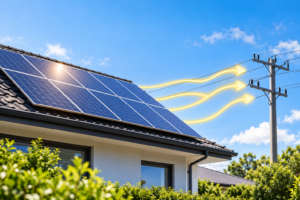

In Western Australia (WA), a solar feed‑in tariff (FiT) is a payment homeowners receive for excess solar electricity they export back into the grid after their household energy needs are met. This payment helps you get additional value from your solar panel system beyond just reducing your power bill.
When your solar panels produce more electricity than you use, that surplus can be sold to your electricity provider under WA’s distributed “buyback” scheme, and you are paid a tariff per kilowatt‑hour (kWh) exported.
How Solar Feed‑In Tariffs Work in WA
Unlike some states that set minimum feed‑in rates, WA uses the Distributed Energy Buyback Scheme (DEBS) — meaning tariffs are set by your electricity retailer (usually Synergy in the Perth & south‑west region and Horizon Power in regional WA).
Under DEBS: Peak export rate (typically 3 pm–9 pm): ~10 c per kWh Off‑peak export rate (other times): ~2–3 c per kWh
These rates apply to electricity you export to the grid — with peak hours paying substantially more than off‑peak.
The exact off‑peak rate can differ slightly depending on your local region and which provider serves you (Synergy vs. Horizon Power).
What This Means for Your Solar Savings
While WA’s feed‑in tariffs are lower than in other Australian states, solar can still deliver great value: You reduce the amount of electricity you need to buy from the grid. You earn credits for exported energy, helping reduce bills. The federal solar rebate continues to lower upfront installation costs.
Because the feed‑in tariff is relatively modest compared with retail electricity rates, many WA solar owners focus on maximising self‑consumption — using as much of their solar energy during the day themselves — for the biggest overall savings.
WA Feed‑In Tariffs: Local Variations
Perth & South‑West WA (Synergy)
· Peak export: ~10 c per kWh
· Off‑peak export: ~2 c per kWh Regional WA (Horizon Power)
· Peak export: ~10 c per kWh
· Off‑peak export: ~3 c per kWh
This means regional households may receive slightly higher off‑peak rates than those on Synergy in urban areas.
Historical View – Why Tariffs Are Lower Now
In the early 2010s, WA offered higher feed‑in tariffs (e.g., premium rates up to ~40 c/kWh) to encourage solar uptake. These legacy rates are no longer available for new solar systems.
Over time, as solar has become more widespread and system costs have dropped, feed‑in tariffs have been reduced, and the current DEBS structure focuses more on paying around standard export rates rather than large incentives.
Tips for Getting the Most from Your Solar in WA
Maximise daytime self‑consumption: Use your solar energy while it’s generated to reduce grid purchases — this often saves more than the feed‑in tariff itself. Consider energy storage (batteries): Storing excess power helps use more solar energy at night when tariffs don’t apply. Check your tariff structure and meter setup: Some tariffs pay more during peak export hours — understanding this helps you plan usage and maximise credits.
Conclusion – Feed‑In Tariffs in WA
In Western Australia, solar feed‑in tariffs are modest compared to past premium schemes or rates in other states. However, the Distributed Energy Buyback Scheme (DEBS) still allows homeowners to earn for exported power and contributes to overall solar savings. Coupled with federal rebates and smart energy use, solar remains a financially strong investment for WA households.